Ans: Use the volume formula as per the shape of your construction site, and then divide the figure by 27. The final answer would be in cubic yards. Make sure all your dimensions are in feet to avoid errors.

How to Determine Concrete Yardage: Complete Step-by-Step Process for Accurate Estimation!
Working on a building project can ruin your pocket if you don’t order materials with care and precision. The more accurate your estimates, the more economical your orders will be. You will only buy how much of something you actually need. That is where learning to determine concrete yardage accurately becomes important. Professionals take this step very seriously because over-ordering on ready-mix concrete means a total waste of money and time.
The mixture gets cooled within 90 minutes of preparation. You can neither return nor use it anywhere due to a lack of time and opportunities. In case you are a DIYer, this support material is for you. Learn to find out your concrete yardage as precisely as possible for maximum savings during construction.
Table of Contents:
- What Does “Determine Concrete Yardage” Mean?
- How Much Concrete Do I Need?
- Understanding Concrete Measurement Units
- The Basic Formula to Calculate Concrete Volume
- How to Calculate Concrete for Different Structures?
- Network & CEMEX as the Best Online Concrete Calculators
- Main Differences Between Concrete Network Calculator & CEMEX Ready Mix Concrete Calculator
- How Much Extra Concrete Should You Order?
- Common Mistakes When Determining Concrete Yardage
- Cost Impact of Incorrect Yardage Calculation
- Standard Concrete Thickness for Common Projects
- Ready-Mix Concrete Ordering Process Explained!
- DIY Vs Professional Estimation: What’s the Difference?
- How to Calculate Full Driveway Concrete Yardage?
- Pro Contractor Tips for Perfect Concrete Estimation
- Final Thought
- FAQs
What Does “Determine Concrete Yardage” Mean?
Professional construction workers and DIYers search for “Determine Concrete Yardage” to access concrete calculators on the internet. Such calculators help them accurately find out how much concrete they need to complete a particular project.
Concrete is ordered in cubic yards. It is a unit of measurement used for bulk orders in construction. After all, the concrete mixture isn’t measured in square feet. One cubic yard is equal to 27 cubic feet, which is for the standard model of 3 feet long, 3 feet wide, and 3 feet deep.
In all construction types, this unit of measurement (cubic yard) is universally accepted and widely used for accuracy.
Also learn: The word yardage refers to the total volume of concrete required for a project. Thus, 10 cubic yards means you need 270 cubic feet of concrete to complete a particular construction activity.
How Much Concrete Do I Need?
That depends on the types of houses you are considering. Whether you are talking about residential construction or commercial, it also has a say in the determination. But, from a general standpoint, you can search for “Determine Concrete Yardage” on a browser. And it will help you find plenty of concrete calculators, as provided below.
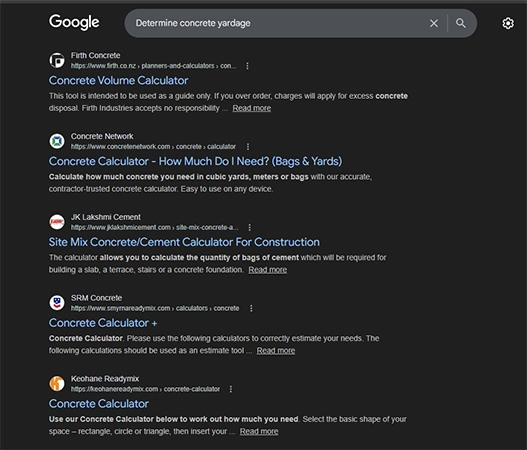
To understand how to use a calculator, consider an example of the concrete network calculator. Learn a few simple steps provided below. And, you are good to go!
- Find out the nature of the shape you need to build out of the concrete. Is it a slab, cube, or cylinder?
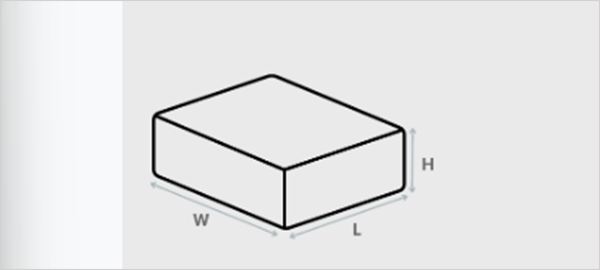
- For a slab, you just need the three basic dimensions, namely height, length, and width. Height is also called thickness. Have an idea from the following image.
- Go to the website (https://www.concretenetwork.com) and choose “Concrete Calculator.”
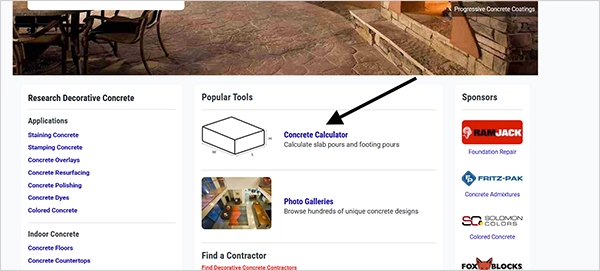
- Locate the calculator for your desired shape on the page.
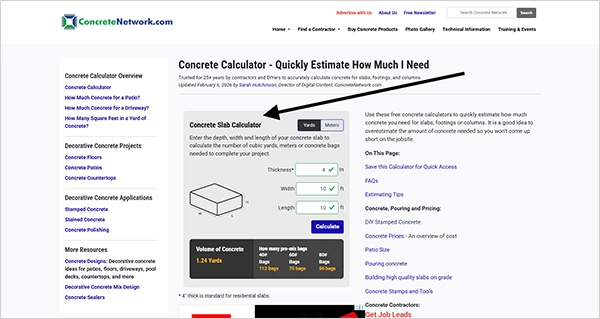
- Fill in all the dimensions here before clicking on the calculate button. That will provide you with the most accurate estimation.
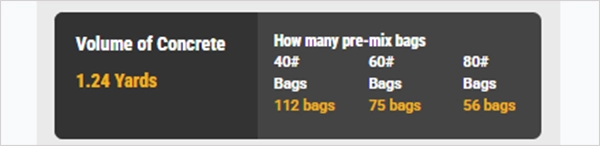
This calculator provides answers in “Volume of Concrete” and “How Many Pre-Mix Bags.” For example, if the height is 4 in, the width is 10 ft, and the length is 10 ft, then you need 1.24 yards of concrete for the slab. The same estimate is also provided in terms of bags, as also shown in the image above.
Do you know? Tapcon concrete screws are the best choice for many. They can be used in a variety of construction activities for maximum stability.
Understanding Concrete Measurement Units
The concrete measurement units are cubic feet and cubic yards. During the measurement, professionals use all types of units. But, ultimately, the volume has to be converted into cubic yards. So, if you are a DIYer, it might confuse you. In that case, it is important to understand what scales are preferred while calculating the concrete yardage.
- Cubic feet vs cubic yards: When we calculate the quality of mortar needed in a construction project, the preferred unit of measurement is the cubic yard. However, there is a well-established relationship between cubic feet and cubic yards. One cubic yard is equal to 27 cubic feet.
- Converting inches to feet: Professionals don’t make this mistake, but a beginner DIYer does. Often, the slab thickness or height is provided in inches. So, don’t forget to convert that into feet before you use any concrete yardage calculator. Otherwise, your estimate is going to be wrong.
- Why contractors use cubic yards: It is the suppliers’ standard unit of calculation used in the ordering process of ready-mix concrete. It helps calculate the material at a macroscopic scale. That is more practical than theoretical, minute measurements.
Be careful: If you are working on your dream project, make sure that you have converted all your units into feet. The rules apply to every type of plan, whether it is a garage apartment plan or a 2 bedroom house plan.
The Basic Formula to Calculate Concrete Volume
To determine concrete yardage, the formula is very basic and involves a two-fold process. It is briefly explained below.
- Length × Width × Thickness = Volume (in cubic feet)
- Volume (in cubic feet) ÷ 27 = Total Concrete Needed in Cubic Yards
To apply this to real-life situations, consider the following explanation.
- First, you need to find the volume in cubic feet. For example, if you are constructing a patio slab, just multiply all its dimensions, such as length, width, and thickness, together. You will get a value in cubic feet. Make sure all units are in feet for the accurate answer.
- Second, in order to convert this volume into cubic yards, simply divide it by 27. That is because one cubic yard contains 27 cubic feet. This way, you will know how much ready-made concrete you need.
Note: From the largest split level house to a tiny shed, all types of residential construction involve the cuboid-shaped slabs. Thus, this formula provided here has a wide application in the construction industry.
Also Read: What Is ICF Construction? Benefits, Cost & How It Works!
How to Calculate Concrete for Different Structures?
Let’s now see how to determine concrete yardage for different types of shapes! After all, you are not going to encounter the same cuboid at all times. What about a cylinder?
- Concrete Slabs: For slabs, the area is going to be a cuboid. So, the same formula applies here as discussed above. You first need to find the volume in cubic feet and then convert it into cubic yards. Just multiply length × width × thickness (or height) together. Then, divide it by 27! That is all.
- Footings and Foundations: For footings and foundations, too, you need to apply the same slab formula. All such spaces are cuboid in nature. Thus, length, width, and height is all that you need.
- Circular Columns: To find the total volume here, use the formula of π × r² × height. Place all your values and multiply them together. Then, you can convert the value into cubic yards by simply dividing it by 27.
- Stairs and Irregular Shapes: Don’t worry when confronted with a complicated structure. Try to divide the space into smaller slabs. Then, apply the standard formula of the length, width, and height in its entirety.
You don’t need to do all the math yourself. Take the help of any available concrete yardage calculator to simplify the work.
Houseura tip: Before you start your construction project, ensure that your contractor has bought the builders risk insurance. That will provide coverage against damage to the property in construction caused by unexpected events such as fire, theft, vandalism, weather, etc.
Network & CEMEX as the Best Online Concrete Calculators
To determine concrete yardage, you can take advantage of a plethora of calculators available online. Here, we are going to talk about the Concrete Network Calculator and the CEMEX Ready Mix Concrete Calculator. These are the major online tools for concrete yardage calculation.
1. Concrete Network Calculator
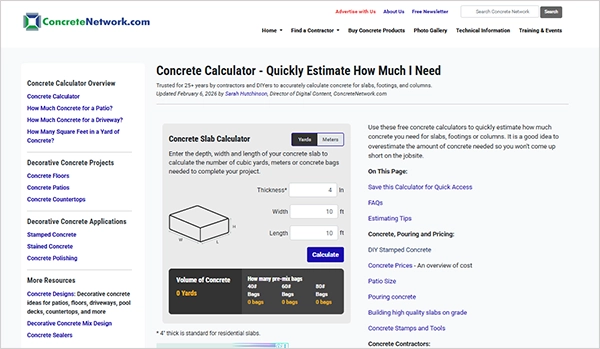
If you are working on a small or mid-sized project, the concrete network calculator is the best option. It is not just accurate but also beginner-friendly. This estimator provides you with tools for slabs, footings, and columns. So, you can find the total volume no matter which shape you are talking about.
Not just in cubic feet, the values are also provided in the number of ready-made concrete bags you need to complete a particular project, as shown below.
2. CEMEX Ready Mix Concrete Calculator
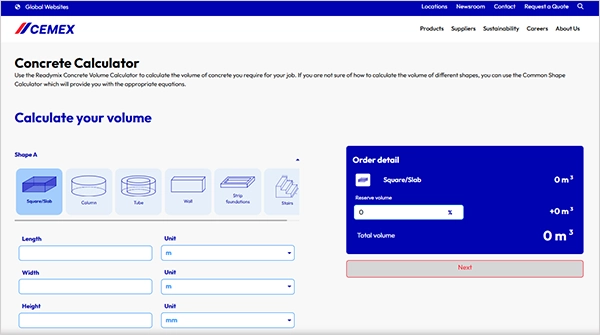
If you are a professional contractor or builder, the CEMEX Ready Mix Concrete Calculator is for you. It even covers the complicated structures, such as concentric shapes or stairs. That means you need no other tool! This one figures out how much ready-made concrete you need with ease. The software is especially designed for professional-level construction activities.
The CEMEX includes almost all types of shapes you would need in a project. That is sufficiently highlighted in the following image.
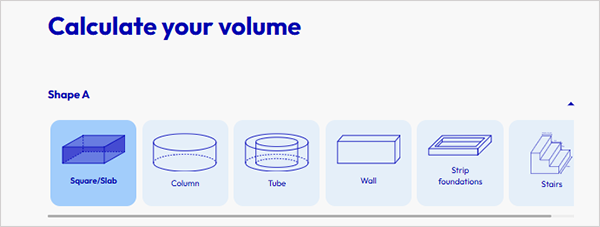
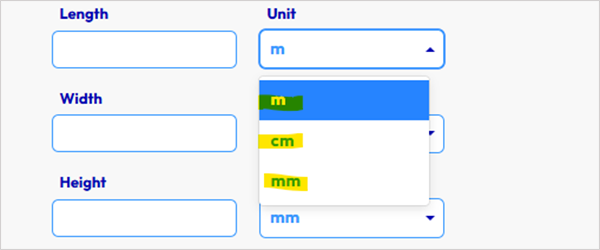
Note: This calculator doesn’t operate in feet. Thus, you might need to convert your values into the given units first and then convert the volume into cubic yards. It might be a little bit of extra work, but that is not a big deal for professional contractors.
Stuck between the manual calculation and online tools? Always remember that online tools save time, but you might not solely rely on them. You must also know how to do the calculations manually. In the event of an internet outage or inaccessibility, you cannot use any software operating on the cloud.
This way, it cannot stop you from figuring yards of concrete at all times.
Main Differences Between Concrete Network Calculator & CEMEX Ready Mix Concrete Calculator
We have briefly discussed two concrete calculators in the preceding section. Let’s now see how these two software programs differ from each other. The following table summarizes the major points of difference objectively.
| Features | Concrete Network Calculator | CEMEX Ready Mix Calculator |
| Primary use | Small projects | Large & commercial projects |
| Units | Inches & feet | Meters, centimeters, & millimeters |
| Waste adjustment | Manual adjustment needed (sometimes less accurate) | Included automatically |
| Specialization | Simple shapes | Complex shapes |
| Best for | DIY beginners | Professional builders |
Point of similarity: Both these tools can be used as a concrete footing calculator.
Also Read: Commercial Dump Truck Insurance: Complete Overview for Truck Owners & Contractors
How Much Extra Concrete Should You Order?
Always add 5 to 10% extra to your ready-made concrete mixture demand or yardage. It will keep things moving in case of a shortage. Adjusting this extra quantity is a crucial part of learning how to estimate concrete yards accurately. This extra part accounts for spillage, uneven ground, formwork gaps, & over-excavation.
Common Mistakes When Determining Concrete Yardage
It is indeed not a big deal for a professional contractor to determine concrete yardage, but a beginner or DIYer might make a few mistakes. It includes:
- Forgetting to convert inches to feet when you figure cement for your project
- Not having all your dimensions in feet or the same unit of measurement
- Measuring uneven depth inaccurately
- Ignoring 5 to 10% extra as your contingency amount
- Only relying on rough guesswork
Avoid all these major pitfalls and calculate the accurate figure.
Cost Impact of Incorrect Yardage Calculation
If you don’t use a concrete slab calculator correctly, the inaccurate yardage will increase the cost in three major ways. These scenarios are concisely explained below.
- Under-ordering: If you order a shorter quantity than you actually need, that means delivery delays and cold joints. In other words, you will require a reorder, meaning a delay in the total volume concerned delivery. Next, when you pour the new batch into already set concrete, it doesn’t provide a seamless and strong grip, known as a “cold joint.”
- Over-ordering: In case you have ordered more than what you need, it results in overpayment. That means you have just spent extra on something that you don’t even need.
- Short loads: When you under-order, you also have to deal with extra supplier fees. It is because now you have to pay the same supplier once again to cover the shortage.
Also Read: MEP in Construction: Meaning, Importance, Common Problems, Future Trends, and More!
Standard Concrete Thickness for Common Projects
In order to accurately determine concrete yardage, you must first calculate the thickness or height accurately. It is often calculated in inches. For the most common projects, the following table provides the typical height.
| Residential driveways | 4 to 5 inches |
| Sidewalks | 4 inches |
| Patios | 4 inches |
| Foundations | 6 to 8 inches |
| Structural slabs | 4 to 6 inches |
Ready-Mix Concrete Ordering Process Explained!
You first figure concrete for slab like how much needed, and then place your order. The major steps in the ready-mix concrete ordering process are provided below.
- Calculating the concrete yardage manually or with the help of a calculator
- Finding the right supplier from available options, based on proximity, affordability, etc
- Placing the order in advance to avoid a shortage
- Preparing your batch (by the supplier)
- Transportation of your mixed concrete batch (by the supplier)
- Delivery of your concrete (by the supplier)
- Pouring the delivered concrete into the required place
- Finishing the structure and letting the unit cure fully
Key Considerations
- Minimum order requirement: 1 to 3 cubic yards
- Truck capacity limits: Standard capacity is 8 to 11 cubic yards
- Scheduling: At least 3 to 7 days in advance
- Pouring time: 90 minutes
DIY Vs Professional Estimation: What’s the Difference?
From the standpoint of the act to determine concrete yardage, there is not much difference because both DIYers and professionals need the same skills and materials for calculation and construction.
However, subtle differences lie in the fact that DIY projects often use bagged concrete while contractors use ready-mix concrete. Furthermore, a DIY may not use professional software tools for estimation. But all the biggest construction companies in the US inevitably use it. Such tools are their lifeline.
How to Calculate Full Driveway Concrete Yardage?
Suppose the length is 50 ft, the width is 20 ft, and the height or thickness is 0.33 ft of a driveway. To determine concrete yardage here, you just need to follow a few simple steps, as provided below.
- Find the total volume in cubic feet. Multiply all the sides together, that is, 50 ft x 20 ft x 0.33 ft. And you get the total volume, which will be 333 cubic feet.
- Next, convert this value into cubic yards. For that, simply divide 333 by 27. You will get 12.33 cubic yards from this division.
- Add 10% extra to the final number. That way, you will get 12.33 cubic yards + 1.233 (10% extra), resulting in the need for 13.563.
So, you need to order a concrete yardage of 13.563 to build your driveway. However, you can also consider the volume of 14 cubic yards as a round figure.
Also Read: How Much Does a Metal Roof Cost? Complete Guide to Panels and Standing Seam Roofs?
Pro Contractor Tips for Perfect Concrete Estimation
After this in-depth analysis, consider some tips for how to figure out the yards of concrete needed as perfectly as possible.
- Measure your volume twice. This will help avoid human errors.
- Check your depth at multiple points. It will help learn irregularities, if any. Also, the more points you consider for measurement, the more accurate your average will be.
- Never ignore the slope. Try to adjust it as much as possible by applying the formula of a tetrahedron or a hemisphere.
- Make sure that you order in a quantity acceptable to your supplier. At least, place an order that lies between 1 and 3 cubic yards.
- Make sure you also check your figure in an online tool, in case you prefer manual calculation.
- If you have already used an online calculator, double-check your estimate by using another online calculator.
Final Thought
To determine concrete yardage, you just need to find out the volume of an area in cubic yards. Finding the volume is easy. Just use the formula according to the shape of the area. If it is a cuboid or a slab, it starts by multiplying length, width, and height together. This value usually comes in cubic feet.
So, to convert it into cubic yards, we have to divide it by 27. After that, you get to know how much concrete you need. Well, if you use an online calculator, you don’t have to compute the yardage yourself. Just put the dimensions and get the estimates in no time.
FAQs
Q. How do I figure yardage for concrete?
Q. What is the 4 2 1 rule for concrete?
Ans: It is the concrete material making formula. It says that you take 4 parts coarse aggregate (gravel/stone), 2 parts fine aggregate (sand), and 1 part cement.
Q. Should you use rebar in your concrete?
Ans: Yes, you must use it for structural, load-bearing concrete.