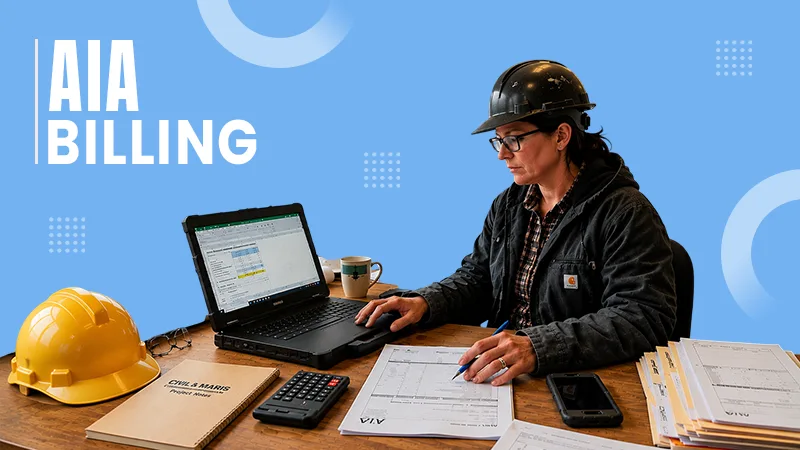
The American Institute of Architects (AIA) created this billing system for transparency and simplicity through standardization of the payment processes in the construction industry. All the documents involved here are to the point and detailed. That makes invoices generated after payment a good tool for project tracking purposes as well.

AIA Billing Explained with Its Key Components, Importance, Benefits, Terms, and More!
AIA billing is the most standardized and technically apt process of making payments for the completed work in a construction project. It is good for contractors as well as project owners, as both need a detailed breakdown of the project scope and associated costs. As an owner, you should learn about this billing for the sake of better resource management.
And, in case you are a contractor, this method of receiving payments will help you get what you deserve without any instances of underpayments. Explore everything you should know in the following sections about AIA construction billing.
Table of Contents:
What is AIA Billing?
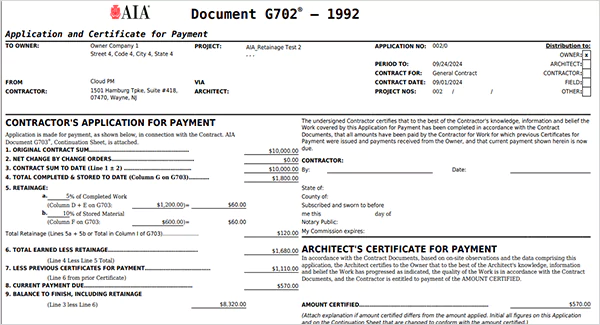
AIA billing, also officially called AIA payment application documents, is a secure and reliable way for contractors to ask for payments from owners. They request payments through this method for the completed amount of work during a construction project. That is, in short, “what is AIA billing?” It is a standardized procedure for payment processing in the development industry for all construction types.
This form of billing is developed by the American Institute of Architects (AIA). That is why it is termed so. This payment method breaks down payable amounts into specific steps and forms. That ensures transparency in the process.
Also Read: 27 Types of Construction Vehicles with Their Names, Pictures, and Features
Key Components of AIA Billing

The key components of AIA billing are G702 and G703 forms, schedule of values, application for payment, the continuation sheet, and certification. These are explained below in brief.
1. G702 and G703 Forms
The entire AIA progress billing at the core depends on two forms, namely the G702 (Payment Application) and G703 (Continuation Sheet). These are the primary documents used by contractors to outline completed work, the value, and the payment requested.
2. Schedule of Values
The next component in AIA billing is the schedule of values. It is a document that provides a detailed breakdown of the contract price as per a variety of specific tasks involved in the completion of the construction project.
3. Application for Payment
It is where the entire payment process starts. Contractors use the AIA G702 form to request payments from contractors. This form requires essential information, such as the billing period, total contract value, and how much work was completed, along with the payment amount requested.
4. The Continuation Sheet
Under the AIA construction billing, the G703 continuation sheet is used along with the G702 form. It provides a complete breakdown of the work completed. Besides, corresponding values and deductions or retainage, if any, are also included in this document.
5. Certification
Before making the payment, it is part of the due process that the billing application has to be certified by the contractor. In certain cases, not just the contractor, but certification from the architect and project manager is also required.
Also Read: 19 Steps to Building a House – Construct Your Dream Living Space With Precision
Why AIA Billing Matters in Construction
AIA billing is important due to standardization, transparency, improved efficiency, and dispute resolution. Consider the elaboration on each point for better understanding in the following sections.
1. Standardization
Following this billing method offers consistency in payments during the construction of a project. Both the contractor and the project owner understand the terms and technicalities well in advance. It makes the process simple and fast, typical benefits of a standard process.
2. Higher Transparency
This element in the AIA billing is ensured by two major components, namely the schedule of values and continuation sheet. Both these documents are highly detailed and to the point. That makes the process highly accessible to all the stakeholders.
3. Improved Efficiency
Due to the mention of every specific task, the AIA invoicing and overall process is very simple and easy to manage. There are no cases of over-payments, overstatement, or restatement of costs. Thus, no waste of resources happens.
4. Faster Dispute Resolution
In commercial as well as residential construction, disputes are pretty common to arise. Thus, at those moments of intensity, AIA documents and forms become a great source of truth. Their detailed nature helps pinpoint even the minutest line item for speedy settlements.
Benefits of Implementing AIA Billing in Construction Projects
The major benefits of using AIA billing include clarity & consistency, transparency, contractual adherence, streamlined process, and other key points as highlighted below. These benefits are available to users regardless of the types of houses being built.
- Clarity and consistency: In this billing method, the involved parties have to use common, standardized forms formatted and crafted by AIA. These are known as AIA payment application documents, including G702 and G703. Thus, things work smoothly from all ends.
- Transparency: We have discussed this while explaining the AIA billing meaning that AIA documents and schedule of values are detailed to every minute line item. That helps ensure transparency in the process.
- Contractual adherence: The owner and the contractor in a project are both bound by law due to the force of the contract they have entered into. So, AIA payment application documents make sure that those contractual obligations are carried out carefully throughout the work and the corresponding payments.
- Streamlined process: The process becomes structured and well-familiarized. That saves time and costs both, eliminating major inefficiencies from the process.
- Change order management: Whenever there are changes to the scope and cost of the project, the detailed nature of the documents involved in the AIA billing makes it easier to make adjustments.
- Lien waiver provisions: This billing process is safe for the project owner. They can stay protected from instances of lien where subcontractors or suppliers try to secure themselves through the legal procedure of lien.
- Documented progress: It ensures a detailed record of all the payments made for the work done so far. That is an absolute necessity when it comes to tracking the progress of the project.
Also Read: MEP in Construction: Meaning, Importance, Common Problems, Future Trends, and More!
Terms Related to the AIA Billing Process
The AIA billing option contains technical terminology as well that you might not be aware of. These are explained below at great length. It includes retainage, schedule of values, and stored materials.
- Retainage: It is the amount of money out of the total project cost that is withheld by the project owner. This practice is essential when it comes to ensuring that the contract provides the agreed services on time and doesn’t leave the work in the middle of the construction. This retainage binds the builder and other construction professionals to provide quality service.
- Schedule of Values: This is another crucial document when it comes to requesting payments through AIA billing. The schedule of values contains a detailed breakdown of the total contract price. Thus, if you want to explore where every single penny is going within the project scope, you just need to refer to this inclusive document.
- Stored Materials: These are included in the AIA invoices, and such materials refer to the resources purchased but not used yet. Stored materials are kept either on- or off-site. Make sure that you communicate the available resources well with each other, whether you are the owner or contractor.
Conclusion
The importance of AIA billing is immense because it helps simplify the process due to high transparency and standardization. Both these factors are crucial for accurate and dispute-free payments in the construction industry. The cases of overpayments because of restatement or overstatement reduce dramatically. And that saves resources, boosting efficiency.
FAQs
What does AIA billing mean?
What is the AIA billing format?
This method of payment in construction uses two standard forms. These are, in short, called the G702 and G703. Contractors have to submit these each month to get the payments issued for the completed work.
What does AIA stand for?
This stands for the American Institute of Architects. It is the world’s largest and most influential network of architecture and design professionals. That is how the institution defines itself on its official website.
Sources
AIA: aia.org