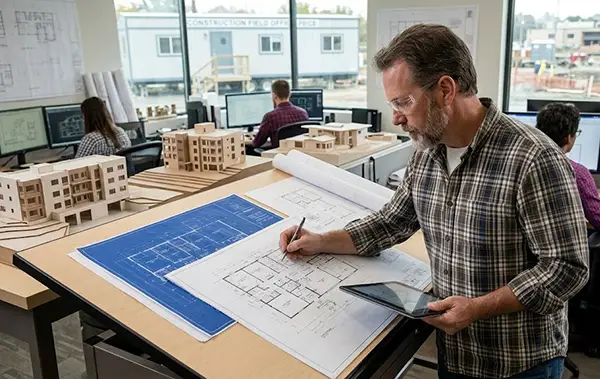
Erecting a construction project is a complex task. Property owners always need a professional to manage their construction work and deliver a finished project. That’s where the role of a general contractor comes in. What does a general contractor do? A general contractor is a construction professional who delivers, manages, and supervises the whole construction project according to the requirements of the property owner.
In this detailed article, we will study the roles and responsibilities of a general construction contractor, its types, and how to become a general contractor. By the end of this article, you will get an idea of how to hire good construction contractors for your home.
A general contractor (GC) is a construction professional who works on a contract basis and handles the construction work, manages the people working under them, and ensures the completion of the project on time within the set budget limit by their client. A professional contractor coordinates with architects for designing structures, engineers for managing safety compliance, and laborers for manual work, and executes the work by taking charge of the full construction process.
The contractor possesses good organizational and communication skills with technical knowledge of building codes and safety regulations. Understanding what does a general contractor do also involves recognizing the importance of time management, coordination, and collaboration in completing projects successfully and on schedule.
Types of Contractors in Construction Projects
In general, there are several types of general contractors based on their expertise, knowledge, and license. However, based on the field of construction, the types of general construction contractors are residential general contractors, commercial general contractors, design-build contractors, and corporate contractors.
Let’s look at the types of general contractors:
1. Residential General Contractors
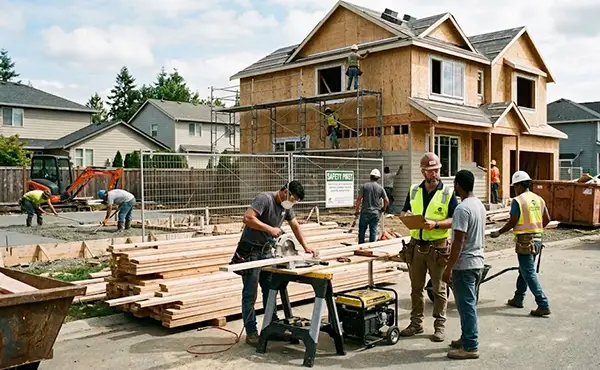
Residential construction contractors are the professionals who work on the construction, renovation, and remodeling of residential buildings, which include small family houses, apartments, duplexes, or triplexes. They hire subcontractors and laborers, source materials and equipment, ensure safety standards, and oversee the full construction process from start to finish. They can be called local contractors, house contractors, remodeling contractors, and home improvement contractors.
2. Commercial Contractors
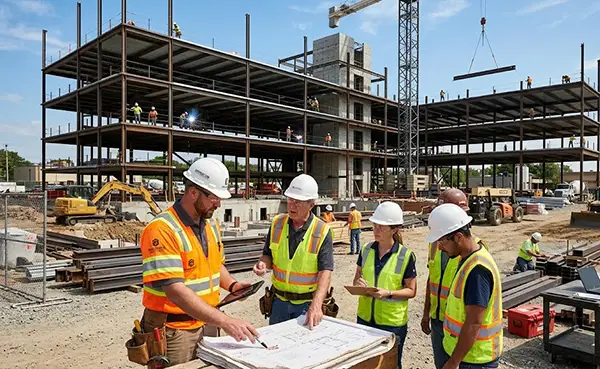
A commercial general contractor specializes in managing the construction of commercial spaces like office buildings, shops, restaurants, schools, malls, government buildings, parks, etc. They are highly qualified professionals who meet legal responsibilities by following building codes, safety standards, and zoning requirements to ensure public safety while handling projects as part of their broader role in what does a general contractor do.
3. Design-Build Contractors
Design-build contractors have multiple responsibilities: they first design the plan and structure the project according to the client’s needs, then execute the construction project by hiring subcontractors and laborers. There can be either a single contractor coordinating to tie multiple people together to accomplish the work, or it can be a full-fledged company where roles are already assigned to the professionals.
4. Corporate General Contractors
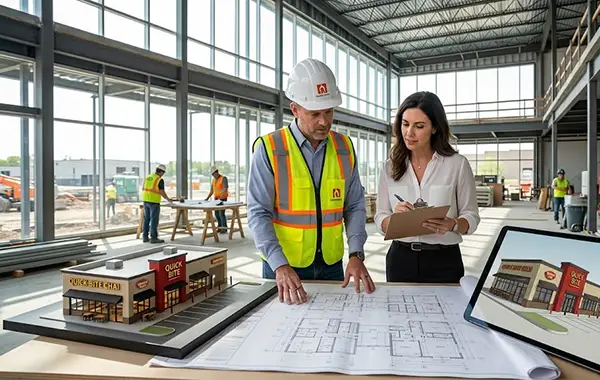
Corporate general contractors are contractors or companies that manage the construction for large businesses like retail spaces, chain restaurants, gas stations, etc. They collaborate with architects and construction companies to make exact replicas of the buildings where needed.
What are the Roles and Responsibilities of a General Contractor?
A general construction contractor oversees everything from understanding the plan himself to finishing the project in the timeline. Also, the contractor has multiple roles and responsibilities, like construction bidding, understanding the client’s needs, sourcing materials and equipment, hiring subcontractors, laborers, painters, carpenters, and electricians, solving on-site problems and conflicts, and finishing the project on time.
Below are some of the roles that will guide you on what a general contractor does.
1. Bidding for the Project
Before starting the construction, many commercial contractors or companies have to either bid or give their quote to the clients or property owners. The contractor with the best services, tender, quotation, and background experience gets the final deal in hand. This process helps explain what does a general contractor do when securing and managing construction projects.
2. Understanding the Client’s Needs
Once the contractor gets the deal, they need to understand what the project is, what type of construction needs to be done, the time limit, budget, location, and working conditions by doing open-ended conversations, active listening, and taking notes on each important consideration and technical requirement
3. Hiring Subcontractors and Other Laborers
Contractors hire subcontractors and skilled workers to handle tasks such as masonry, bricklaying, roofing, painting, electrical installations, plumbing, and HVAC system fitting. They may also employ carpenters, technicians, and general laborers to keep the work organized. Coordinating these professionals and ensuring each task is completed on schedule is an essential part of what does a general contractor do on a construction project.
4. Getting Permits and Approvals
Most corporate and commercial projects that are built on a large scale require some zoning permits and approvals from the permitting authorities or corporations. Many general contractors who are qualified and skilled are required to obtain the permits, which are official approvals of initiating the construction project and adhering to the building codes and regulations.
Do you know? As per OSHA, contractors who violate the safety codes bear a fine up to $16550 per serious violation. Also, a GC may not a single person; it may be a full-fledged organization providing contracting services to the clients.
5. Overseeing the Construction Site and Tracking the Progress
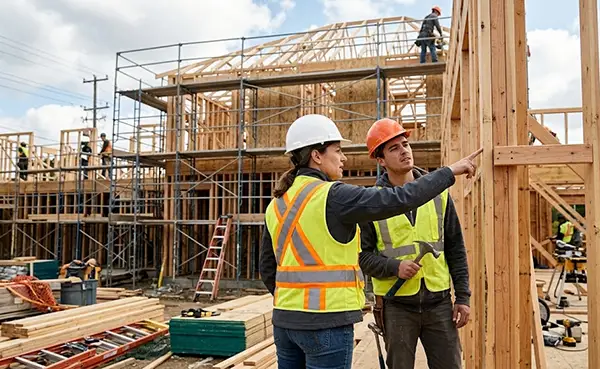
General contractors have major responsibility on the construction site. They oversee all aspects of the project. Ensure the availability of construction materials, machines, and labor; they check that everyone works efficiently on the given schedule, fix work discrepancies or emergencies, take care of the weather conditions, schedule the work accordingly, check for quality compliance, and make sure no resources or materials get wasted.
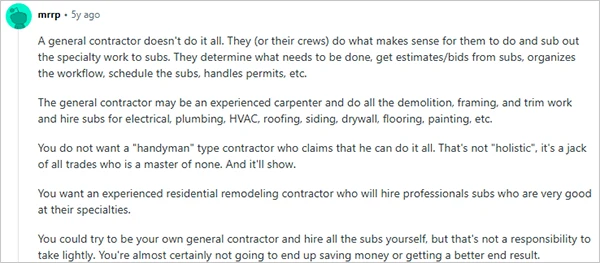
Query: Should you hire a general contractor to do it all or a specialized contractor?
You can refer to Redditors’ advice to understand their opinion.
Houseura Tip: Hire general contractors for construction projects that include whole-home building, and specialized contractors for single-trade jobs like roofing, plumbing, and painting
General Contractors vs. Construction Manager
General contractors and construction managers both have different responsibilities in construction projects. While general contractors oversee and manage the construction project on-site, coordinate with professionals, and acquire permits, the construction managers are responsible for the design of the buildings, plan the budget and schedule, and act as the advisor for the project.
Take a look at the difference between a general contractor and a construction manager.
General Contractor
Construction Manager
Oversees the activities on the construction site.
Planning, design, and scheduling activities.
Can work on projects of various sizes, from residential to commercial.
Can work on a variety of projects from small residential to big commercial projects.
Secure the legal zoning permits required to be obtained from authorities.
Act as the advisor for the project.
They have a larger share in the cost, as they make their commission from the labor or the material used.
Have an open book or transparent fee system.
How to Become a General Contractor?
Becoming a general contractor is not too difficult a task. While a formal education degree is not needed to become a contractor, you need to have a diploma or GED in construction management. Taking civil engineering or construction management is a plus. Along with that, relevant experience in construction management and a certified contractor license can take you on the path to becoming a general contractor. Below are some of the tips to become a general construction contractor.
1. Determine Your Goals as a Contractor
The construction industry offers various career paths, so choosing a specific area of expertise is an important first step. You can explore fields such as painting, carpentry, HVAC, or electrical work based on your interests and abilities. You should also decide whether to work as a home improvement contractor, house contractor, local contractor, or remodeling contractor. Learning what a general contractor does will help you understand the responsibilities involved and identify the training, experience, and licensing you need for your chosen field.
2. Get Formal Education
The minimum qualification for becoming a contractor is a high school diploma or GED (General Educational Development), but in general, taking a bachelor’s degree in architecture, construction management, business administration, or civil engineering, and an associate degree in construction technology or building construction will make you a highly qualified professional.
3. Gain Relevant Experience
Not only does knowledge matter, but experience also matters a lot in general contracting. With experience, you will have various construction skills, like budget and work schedule planning. Permits, building codes, and regulations, as well as skills in design, coordination, communication, and time management, will in turn help in the construction project. To gain experience, you can:
Work at an entry-level or small level, like as an assistant or helping a contractor in their day-to-day activities.
Join any trade or union program (a program that provides the foundational knowledge of safety rules and regulations, codes, and supervision training).
Get hired in some small construction companies to see their working process, daily operations, and the bidding process.
4. Give the Licensure Exam
Here are different licensure exams, like the trade/technical exam for testing your practical skills or building knowledge and the business or law exam to check your knowledge of contracting laws and building regulation laws. A NASCLA-accredited examination is also accepted in some states to streamline the process of licensure, as it allows you to bypass the trade exam.
5. Get Your Contractor License.
After gaining education and experience, it’s time to get a contractor license, which differs based on locality. You need to submit proof of insurance and a contractor license bond (a surety bond that guarantees that the GC will adhere to safety codes and will work ethically), along with some other documents, and pass a written exam to get the license. Understanding what does a general contractor do also helps you prepare for the legal and professional responsibilities involved in managing construction projects.
6. Get Your Insurance
Insurance is important for any contractor to keep himself and his business protected while on the job. Some of the insurance that is needed to become a general and certified contractor are general liability insurance for the general property damage risk, workers’ compensation insurance, professional liability insurance, surety bonds, and contractor’s tools and employment insurance.
How to Get a Contractor License?
A contractor license is necessary to get general contractor jobs and construction-related projects. A license approves you as a credible and certified professional eligible to take on contracting projects and start a new business. For commercial and large-scale projects, clients tend to choose and award the tender to contractors who have a contractor license.
You can get a contractor license in these ways:
1. Partnership with RME
If you have limited experience, partnering with an RME (Responsible Managing Employee) may be an option, depending on your state’s licensing rules. An RME is a qualified professional who provides the required industry knowledge, holds the necessary qualifications, and supervises construction activities. Understanding what does a general contractor do can help you recognize how an RME supports licensing compliance and oversees job-site operations. Before proceeding, verify your state’s requirements, as an RME arrangement does not automatically guarantee a contractor license.
2. Grandfathered or Exempt License
If your family or relatives have a contracting business, then they can can pass their license to you to become a new contractor. But remember, you still have to pass the state examination to get the license. Relatives of the license holder can also get the license; you don’t need to be an immediate family member of the license holder.
3. Create a Contracting Company With a License Holder
If you own or create a company with a licensed contractor, you will be able to gain relevant experience in the contracting business, which will allow you to apply for your own license. Till then, you can use the company’s contractor license number to help you get projects and contracts.
Identify the Qualified Individuals
For each specialty, like subcontractors, plumbers, etc., identify the qualified individuals. The individual must pass the technical examination related to the specialty and must be a full-time bona fide employee working 30 hours per week.
Fill Out the License Application Form
You need to fill out the Contractor License Application Form to apply for the contractor license and submit it to your state’s official e-district portal along with all the needed documents and required fees. Wait for some time; application processing takes 30 days. After processing, the license will be mailed to your registered email address. Understanding what does a general contractor do can also help you prepare for the responsibilities associated with this profession.
Other methods include taking education, enrolling in trade programs and apprenticeships, and then taking the licensure exams, which will get the contractor’s license.
How to Hire a Good General Contractor for Your House Renovation?
If you are planning your home improvement project, hiring a contractor can be a challenging task to do, as it requires multiple checklists, like getting the contractor within budget, who should be a licensed professional with great communication skills, have relevant experience, and be associated with a licensed company.
Get a Minimum of Three Quotes While Bidding: You must consider at least three contractors or companies and compare their cost estimates and working methodologies, and then select the best one according to your needs
Hire Local Contractors: Local contractors are readily available at the time of need and in emergencies, and they know the building codes and regulations of your area better.
Check for the COI: The contractor you choose must have the certificate of insurance (a legal one-page document that is provided by the insurance company that ensures the insurance coverage) with the correct policy number.
Past Experience: You need to check the contractor’s relevant experience in years, referrals for work, work reputation, professional behavior, and successfully delivered projects.
Understand Your Cancellation Rights: While you are in the cooling-off period, don’t forget to check the Federal Trade Commission cancellation rights so that you can cancel the contract without any cost-cutting or penalty charges.
Point to note: Always have an agreement or contract in writing to get clarification of the work, and it acts as legal proof of the deal, which ensures timely payments to avoid future disputes.
Conclusion
Wrapping up! In this detailed article, we studied what a general contractor does. A general contractor is a licensed professional in construction who oversees and supervises construction projects, coordinates with engineers and construction managers, and hires laborers/workers to meet the client’s needs and finish the project on time. To become a general contractor, one must have the relevant experience, a degree/diploma in construction management, and a contractor license to take on construction projects.
While hiring a home improvement contractor, you must check the contractor’s years of experience, license, working style, and your budget and requirements to accomplish your home renovation. Houseura helps readers understand construction services and make informed decisions when planning their building or home improvement projects.
Frequently Asked Questions
What is the role of a general contractor?
A general contractor understands the client’s requirements, hires workers and laborers, sources the materials and equipment, and oversees the day-to-day activities of the construction projects.
What is the average salary of a general contractor?
The average salary of a general contractor is $70000 to $130000 per year. For entry-level contractors, it varies from $60000 to $92000, and for senior or experienced contractors, it varies from $130000 to $150000.
What is the difference between the general contractor and a construction manager?
While a general contractor oversees the day-to-day activities, planning, and hiring of subcontractors and workers, the construction manager is responsible for the design, materials, and budget of the project structure; they also work as an advisor to the client.
What is the difference between a general contractor and a subcontractor?
A general contractor is in charge of the whole project, but a subcontractor is hired by the contractor for specific services like plumbing, carpentry, etc.
What kind of warranty do contractors offer on your work?
Quality contractors offer a workmanship warranty that covers their labor for a set period (often one year) after project completion.
Source
2025 Annual Adjustments to OSHA Civil Penalties: OSHA