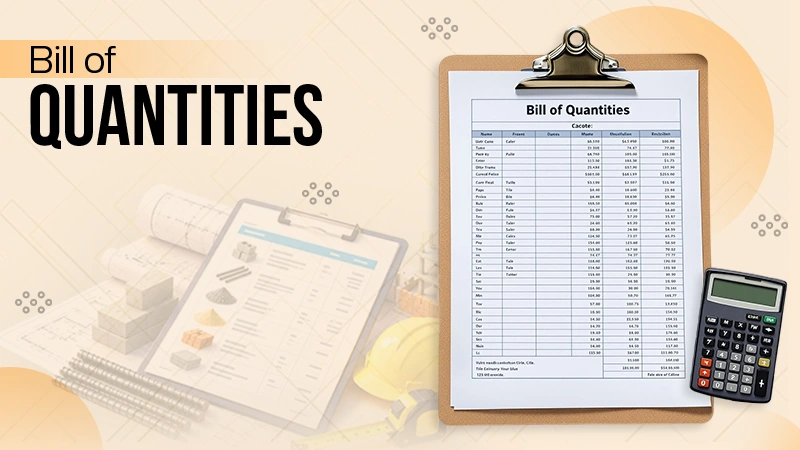
A bill of quantities, or BOQ, is a structured document that contains the list of the materials, labor, and costs required to build a construction project.

What is a Bill of Quantities, and How Is BOQ Helpful in Construction Projects?
In major construction projects, one of the effective ways to manage the overall costs and quantities is to create a bill of quantities. A bill of quantities is a structured list of labor, materials, and costs required for the whole construction project. BOQ helps in making the financial roadmap of the project, which provides the estimated quantities and budget and helps in improving the planning, scheduling, transparency, and communication between the owners, contractors, and workers.
In this detailed article, you will get to know what BOQ is, its importance in construction, and how to prepare a bill of quantities before executing the final project.
Quick Answer: A bill of quantities is a structured document made by quantity surveyors that includes the list of the materials, costs, and labor required to build a construction project.
Table of Contents:
- What is a Bill of Quantities?
- What Does the Bill of Quantities include?
- Importance of Bill of Quantities in Construction
- Types of BOQ in Construction
- Bill of Quantities vs. Bill of Materials vs. Material Takeoff
- How to Prepare a BOQ?
- Software Tools for Creating BOQ
- Common Mistakes to Avoid While Preparing a Bill of Quantities
- Conclusion
- Frequently Asked Questions
What is a Bill of Quantities?
A bill of quantities is a documented bill consisting of a list of all the possible elements, like materials, costs, labor, and services, with their accurate measure and quantities used in the whole process of construction. BOQ is generally created by a quantity surveyor/architect/contractor of the project to ensure that all the contractors, bidders, and project owners rely on the information in the bill for effective contract management.
The key purposes of BOQ are:
- Construction cost management
- Material procurement
- Purchase planning
- Tracking inventory stock levels
- Quality and coordination management between the project team
What Does the Bill of Quantities include?
A Bill of Quantities is not just a typical list of items; it is a well-formatted document that contains the estimated measure of each component, item, and unit with its quantity. The total cost is determined by multiplying the no. of items by the individual item/service cost. BOQ consists of the line item structure and the major sections that include the cover page, preliminaries, tasks to be done, risks section, and summary.
1. Main Elements Section of BOQ
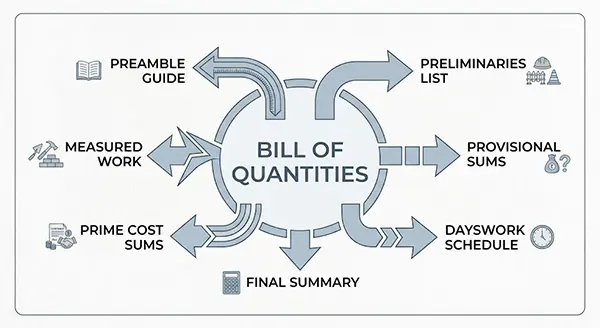
BOQ is divided into various sections that provide the complete breakdown of the cost and quantities required to complete the project, including the preamble, day works, provisional sums, and summary.
- Preamble: Explains how the BOQ will be prepared, the guidelines to calculate quantities, and how to fill in the rates and currency details.
- Preliminaries: Indirect requirements are usually not mentioned in the costing list, like security and overhead costs.
- Measured work: Gives a breakdown of the detailed quantities, cost, units, and rates for the detailed work like roofing, plumbing, masonry, bricklaying, finishes, etc.
- Provisional sums: Allowances for work that are anticipated but not directly included in the material list.
- Prime Cost sums: Money or allowances secured for the work to be done by the specific contractor or architect.
- Dayswork: The schedule for labor, material, or cost for emergency/urgent work that was not included in the work section of the BOQ
- Summary: It is the total of individual sections of BOQs, including the percentage buffer, tax cost included, and the tender cost by the contractor.
2. Item Structure
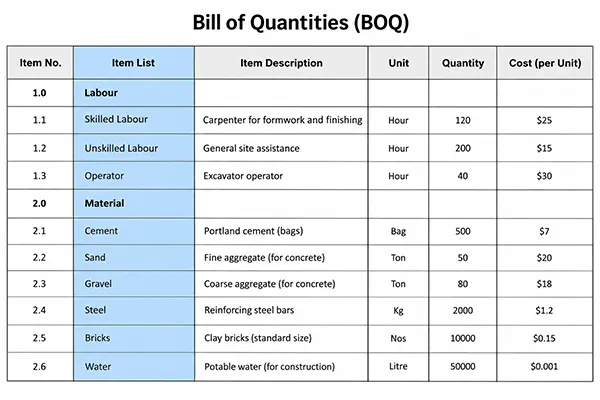
Item structure in a BOQ is a tabularly formatted list including the item no. , description, measurement unit, quantity, cost of each item, and the total cost
- Item no.: Each item number is mentioned in front of its respective item, which makes it easier to find the item individually.
- Item list: It defines the type of items (labor or material)
- Item description: Specific item name with its use case
- Unit: The base unit of measurement of the item, like square feet, inches, meters, gallons, etc.
- Quantity: The exact no. of items or the no. of labor hours or the amount of materials.
- Cost: The average cost per unit for each time
- Total cost: The quantity multiplied by the rate (cost per unit) gives the total cost of each item.
Importance of Bill of Quantities in Construction
There are various aspects to define the scope of the construction project. The Bill of Quantities gives aspects like labor management, cost control, material planning, and purchase planning a defined outcome. It’s important in construction, as it helps in managing the project cost, fair tendering, effective scheduling, risk anticipation, and tracking the overall progress and payments.
1. Cost Control Management
When we have exact data about the materials, items, and their quantities, we can plan our budget, compare the best process in the market for material procurement, and cut extra expenses and avoid material wastage.
2. Fair Tendering Process
All the contractors doing construction bidding for the project get access to the same information, which standardizes the scope of the project and helps them to understand the quantities better. It also helps the clients to compare the bids correctly.
3. Planning and Scheduling
A derailed BOQ helps to effectively plan and schedule the work by avoiding delays in ordering the materials on time without being worried about their shortage or overstock.
4. Track Progress and Payments
An effective BOQ is used as a reference measure to the work completed and for tracking inventory levels. Project owners can verify the contractor’s claims about the finished product and expected material purchase cost with the BOQ list.
5. Improved Communication and Transparency
BOQ provides an analysis of the work progress, which helps in determining possible operational mismanagement, and accurate data improves communication. Owners can find effective solutions for minor mistakes while doing the measurements or estimating the budget for the whole construction site.
Types of BOQ in Construction
On the basis of design completion and organized work structure, there are mainly five kinds of BOQs: Firm BOQ, Approximate BOQ, Elemental BOQ, Trade BOQ, and Location BOQ.
1. Firm BOQ
A firm BOQ is a completely designed document used when the design part of the project is totally finished. It included the lump sum amount of the full project, as if no changes were marked between the project. So the price considered at the initial phase will be the same as at the time of the finishing phase.
2. Approximate BOQ
An approximate BOQ is the document that is created at the initial stages of design. It does not include the exact and accurate amount of the material breakdown, which leads to uncertainty in defining the measurements and rates. It helps to get the bidding contract faster, but the scope of numerous future changes makes the construction process complex.
3. Elemental BOQ
Elemental BOQ creates elements by grouping the building structure into superstructure or substructure, which divides the work into sections and helps to compare the cost for each section effectively.
4. Trade BOQ
Trade BOQ categorizes the construction project into various trades/departments like civil, plumbing, electrical, roofing, etc. to manage costs according to the specific category and provide a detailed description of each item.
5. Location BOQ
The location BOQ is the document that provides the detailed breakdown of the cost, items, materials, and labor according to the location or zone of the project. I help the contractors to track which area is acquiring more materials/cost.
Also Read: 19 Steps to Building a House – Construct Your Dream Living Space With Precision
Bill of Quantities vs. Bill of Materials vs. Material Takeoff
Bill of Quantities, Bill of Materials, and Material Takeoff are related terms to the quality of materials used in the construction project. While the BOQ is the structured, contract-style document for the materials, labor, and services to be used in the project, the BOM is the list of the exact raw materials, parts, and components to be used in the manufacturing of a product. MTO is the forecasted quantity list of the materials taken directly from the engineer drawings and BIM models to know the expected materials to be used during construction.
Here is the detailed difference between BOQ, BOM, and MTO.
| Aspects | Bill of Quantities | Bill of Materials | Material Takeoff |
| Focus |
|
|
|
| Helps in |
|
|
|
| When is it used? |
|
|
|
| Who does it? |
|
|
|
| Limitation |
|
|
|
How to Prepare a BOQ?
Creating a bill of quantities is a crucial part of the construction project, which helps the stakeholders and contractors to have a clear roadmap of the budget and bridges communication gaps between them. Preparing a BOQ can differ by type of project, but the core structure and components remain the same.
Step 1 – Understand the Project Well
Before jumping into making the document, you need to understand the project type, its specific design, construction methods, scope, and end goal. Based on these considerations, you will be able to create a structured document.
Step 2 – Create a Tabular Sheet
Create a tabular-formatted sheet and make columns for item no., material description, unit of measurement, quantity, per-unit cost, labor, and total cost.
Step 3. Break Down the Work in Distinct Sections
Break the work according to the specific work type, in chronological order, like site preparation, masonry, flooring, plumbing, electrical, drywall, painting, waterproofing, roofing, etc.
Step 4. Assigning Measurement Units for Each Item
Considering the requirements of the project, write the accurate amount of each item needed using standard units. Keep 10 to 20% extra wastage allowances to manage the shortage of stock in future.
Step 5. Define the Material Descriptions
Material descriptions help to decide how the material will be used in the construction process. Write the precise details like the material type, its dimensions, how it will be used or installed, any regulatory standard to follow, precautionary measures, etc.
Step 6. Consider Labor Needs
Estimate the labor requirements for each category, like how much labor is needed for a particular task, for how many hours, and what time of day they will work. Keep the scope open for changes in the future.
Step 7. Make a Cost Estimate
You can create your own cost estimate of all the materials and labor for your reference so that you can compare the bids of multiple contractors and select the best one that fits your budget.
Step 8. Final Review of the Bill
After listing all the materials and costs, review and recheck the list for any calculation errors, missing items, or unit and total cost estimate mistakes, and check if all the sections align with your needs and budget.
Houseura tip: For a quality BOQ, you can get help from a professional (quantity surveyor or architect) who is experienced in construction projects to avoid unnecessary errors.
Also Read: 2 Bedroom House Plans & Key Considerations Regarding Suitability, Costs, Limitations, & More!
Software Tools for Creating BOQ
There are certain BOQ tools available online that use technology like digital rulers to take measurements, price books to get the standard material cost in the market, and calculators to sum up the total cost of the items. These BOQ software tools help to reduce measurement and calculation errors, save your time, and make the list properly structured to be understood well by the contractors for bidding.
Some of the tools to create BOQ are CostX, Into AEC, Planswift, Bluebeam, and Quantity Report.
1. CostX

CostX, or RIB CostX, is construction cost estimating software that helps to project the materials, cost, and labor for a construction project using modern 2D and 3D drawings and BIM models instead of doing the whole measurement manually.
| Key features |
|
| Best for |
|
| Pricing |
|
2. IntoAEC

Into AEC is an AI-powered BOQ software tool specifically designed for architects, engineers, and surveyors to make the items and cost list faster for building projects. It is an all-in-one solution to keep everything organized and easily accessible in one software by simplifying complex files into simplified workbooks.
| Key features |
|
| Best for |
|
| Pricing |
|
3. PlanSwift

PlanSwift is a digital takeoff and material estimating software that uses digital drawings and blueprints to calculate the materials, their quantities, cost, labor, and volume of a construction project. It helps to fasten the bidding process, taking the near-to-perfect measurements and saving time in manual errors.
| Key Features |
|
| Best for |
|
| Pricing |
|
4. Bluebeam
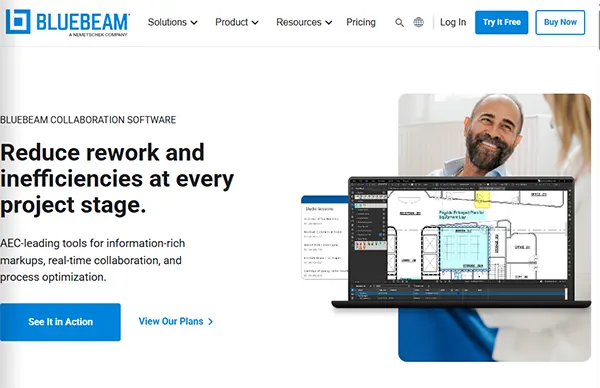
Bluebeam is a specialized cloud-based PDF creation, markup, and collaboration software used by architects, engineers, and construction contractors to measure and manage technical blueprints. It lets you add text, symbols, and shapes directly into the digital drawings.
| Key Features |
|
| Best for |
|
| Pricing |
|
5. Quantity Report

The quantity report is the digital software used in the construction project to accurately measure quantities, materials, costs, and labor requirements using the digital 2D drawings or BIM models. It keeps all the data centralized to act as a single source of truth.
| Key features |
|
| Best for |
|
| Pricing |
|
Also Read: What is a Submittal in Construction? Learn How Submittals Work and Why You Need to Focus on Them
Common Mistakes to Avoid While Preparing a Bill of Quantities
Common mistakes to avoid while creating a bill of quantities are poor detailing of the work, inappropriate descriptions, measurement faults, and neglecting wastage. It’s important to have an accurate BOQ to avoid future disputes and unexpected changes in the project.
- Vague Descriptions: Improper detailing of the work and material descriptions, such as work level/type, missing dimensions, area, and finish of the material
- Measurement faults: using outdated measurement techniques like pen, paper, and ruler instead of digital drawings and PDFs.
- Calculation and unit errors: Creating incorrect formulas and omitting small details like gaps in doors and curved surfaces; not using standard measurement units (sq foot/sq metre/cubic metres)
- Ignoring wastage: The total wastage (10 to 20% for every material type) adds to the cost; ignoring it might cut your budget but leads to extra costing in the future.
Conclusion
The Bill of Quantities is the formatted document to make the list of the material, cost, and labor for the construction project. It is helpful to manage the project cost and labor requirements, which saves the project owners time from estimating the costs at every step of the project.
A BOQ contains sections like item no., work/material description, unit, quantity, cost per unit, and total cost. It helps the owners to provide the same information to multiple contractors for the bidding process and in comparing their bidding quotes. For a structured BOQ, you must consider your project needs, accurate project design/measurements, and estimated material costs verified from trusted sources.
Frequently Asked Questions
What is a Bill of Quantities?
Who creates the Bill of Quantities?
A bill of quantities is created by professional construction specialists like a quantity surveyor, cost consultant, or civil engineer associated with the construction project.
What is the role of technology in the BOQ creation?
Modern BOQs are created using digital tools that help in extracting measurements and material costs directly from the digital drawings or CAD files. Integrating BOQ with BIM models links the estimated cost data with 3D drawings and updates material quantities when the design changes.
What are some of the digital tools to create BOQs?
Some popular digital tools or software to create BOQs are CostX, Into AEC, Planswift, Bluebeam, and Quantity Report. These AI-powered tools help to take accurate measurements, reduce calculator errors, and speed up the bidding process.
How do contractors deal with the BOQ during the bidding process?
Contractors receive the BOQ with their tenders and fill in the rates/costs column in the document as part of the bidding process, which acts like a quote for the project owners. The owners then compare the quotes made by the multiple contractors and choose the one that aligns best with their needs.
Related Posts