Common types include ball clay, kaolin, bentonite, fire clay, and earthenware clay.

13 Types of Clay in Ceramics: Composition and Properties
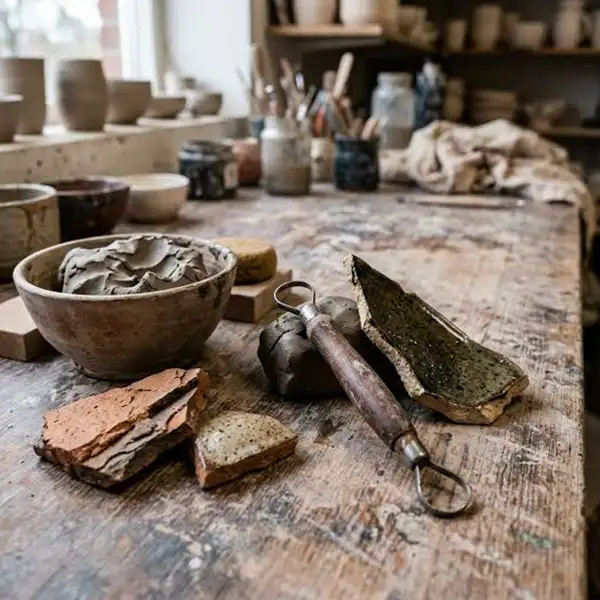
Most people think that the type of clay which they use while creating a ceramic item is not necessary because a ceramic item should only be considered by its colour, design and shape. However that is not true at all.
The type of clay used in a ceramic good is one of the most important factors because this is the material which affects the work ability of a ceramic body which means that the type of clay will decide what kind of shape you can give to your ceramic good because of the ease of shaping or drying of it. The type of clay you use also determines the necessary characteristics which will help to create your ceramic items. For example if the clay you are using has enough strength then it can be used to create objects which can carry bulky weight.
This is why it is important to know the material that you are using so that you know how it is going to behave as a final product. Hence, under this guide we will learn about the 13 important ceramic raw materials with their characteristics so that whenever you are creating anything ranging from tiles, sanitaryware, pottery to other Ceramic products, you know what to choose.
Table of Contents:
Types of Clay Material in Ceramics: Composition and Properties
In the manufacture of ceramics, multiple different kinds of clay minerals and auxiliary raw materials are used. Some fill with plasticity and cohesion, some help in regulating shrinkage and melting properties and others assist the physical properties of the finished product. Let’s take a look at the different materials on offer in Expolica Ceramics product range.
1. Ball Clay
Ball Clay is clay of fine grain size, with a kaolinite content of ranging nature and composition, that has been collected in a sedimentary form. It has an intense degree of plasticity, good binding capacity and work properties. It is often paired with other clays for shaping and forming in ceramic factories.
2. Kaolin Clay
More popularly known as china clay, kaolin is majorly composed of the mineral kaolinite. It has low plasticity, demonstrates a high whiteness and possesses a good resistance to high temperature. It is a vital component in porcelains and ceramic body materials and other light-colored ceramics.
3. Levigated China Clay
China Clay, levigated (purified) clay with the unwanted coarse particles and impurities removed. It has a better particle distribution which leads to a smooth consistency and quality of the ceramic formulations. It can be of use when manufacturers need to alter controlled raw material properties.
4. Bentonite Clay
A montmorillonite bearing clay, bentonite has an increased absorbing capacity. It has desirable binding attributes, significant plasticity and water absorbency. Small amounts can be used to regulate ceramic mixture workability and suspension.
5. White Clay
White clay signals to clay materials shortlisted for their light colour and suitability for producing white or light-coloured ceramic bodies. It is a combination of multiple ingredients, which differ depending on the source and grade. It is tested by manufacturers for purity and plasticity and to check its firing characteristics.
6. Kaolin Clay Noodles
Kaolin clay noodles is the manufactured form of kaolin which is formed as a convenient physical product. They are a composition of kaolin and suitability depends on grade and processing requirements. They can help to make feeds more manageable and to be able to control feeding in industrial production.
7. Blended Ball Clay
Blended ball clay is a combination of selected grades of clay for processed characteristic properties. Based upon the kinds and proportions of different mixtures, it can be used for an ideal plasticity, hard binding, and consistency in ceramic manufacturing. Different properties should be checked for the intended application.
8. Soda Feldspar
SODA FELDSPAR is not technically a clay, but a useful ceramic flux. It is a great source of sodium with feldspar minerals, which can decrease the melting temperature of the ceramic compositions. It assists with the vitrination process and helps in forming a densified ceramic body.
9. Potash Feldspar
Potash feldspar consists of potassium-bearing feldspar minerals and is utilised as a flux for ceramic formulations. During firing it helps to promote the formation of liquid phase/vitrification. A popular ceramic glaze and body ingredient.
10. Quartz
Quartz is a crystalline form of silica (SiO₂). A non-plastic ceramic raw material which helps to control the drying and firing shrinkage. It has a significant role in altering the dimensional stability and thermal behavior of the ceramic product being made because of particle size and number.
11. Talc
Talc is a magnesium silicate mineral that is used for ceramic formulation, and its thermal properties. It can be used as a flux based on the mixture used and to influence the thermal expansion. It is added to various ceramic bodies and for special uses.
12. Silica Sand
The main ingredient of silica sand is silicon dioxide. Use as an ingredient in ceramic formulations to keep shrinkage under control and dimensional stability in the product. The purity and particle size distribution has a role in determining its appropriateness for various manufacturing processes.
13. Ceramic Binder
Ceramic Binder is a part of the formulation which is used to increase the binding capacity of the ceramic mixture, the cohesion and handling strength. It is actually made based on the grade. Strengthen unfired ceramic elements and keep them in shape during forming with binders.
How Do You Choose the Right Ceramic Raw Materials?
Shortlisting materials requires more than comparing their names or prices. You need to understand how an individual ingredient behaves during mixing, forming, drying, and firing. Keep these factors in mind:
- Plasticity: indicates how effortlessly the ceramic mixture can be shaped.
- Chemical composition: adjusts the firing behaviour, colour, and final properties.
- Particle size: determines workability, packing, and surface quality.
- Shrinkage: assists in determining dimensional stability during drying and firing.
- Firing temperature: Responsible for checking whether the material suits your production process.
Checking material samples and reviewing technical specifications can be useful in establishing a consistent formulation for your manufacturing pre-requisites.
Conclusion
The knowledge of the Types of Clay can help in making decisions about the quality of the product, the consistency in processing, and manufacturing performance. Each individual ingredient has a certain function in the manufacturing of a ceramic, ranging from ball clay and kaolin to feldspar, quartz, bentonite. Choose Expolica Ceramics as your trustworthy provider of clay products in India.
It includes various types of clays, key ceramic minerals and has material selection and quality assurance systems in place. Get in touch with Expolica Ceramics, top clay manufacturers in India to check out the raw material needs and find the suitable raw material for your manufacturing processes.
Frequently Asked Questions
1. What are the main types of clay used in ceramics?
2. What is the difference between ball clay and kaolin?
Ball clay offers greater plasticity, while kaolin provides whiteness and refractory properties.
3. Why are feldspar and quartz used in ceramics?
Feldspar promotes vitrification, while quartz helps control shrinkage and dimensional stability.
4. How do you select clay for ceramic manufacturing?
Consider composition, plasticity, particle size, firing behaviour, and intended product requirements.
Related Posts