Cinder blocks are an older, lightweight type of concrete block.

Concrete Blocks: Definition, Types, Standard Size, Key Uses, Benefits, Factors Affecting Costs, & More!
The concrete blocks are used in various places, such as residential buildings, sheds, additional dwelling units, stairs, the flooring of the entrance, big commercial projects, etc. These are not just strong and durable, but affordable and easy to lay as well.
This construction material typically comes in five major forms, namely solid, hollow, aerated autoclaved, paving, and decorative concrete. Their shapes are mostly rectangular and square. Learn more about them in the following sections.
Table of Contents:
- What are Concrete Blocks?
- Types of Concrete Blocks
- Standard Concrete Block Sizes
- Key Uses of Concrete Blocks
- Benefits of Using Concrete Blocks
- Concrete Blocks vs Bricks
- Factors Affecting Concrete Block Prices
- How to Choose the Right Concrete Blocks?
- Best Practices for Installing Concrete Blocks
- Common Mistakes to Avoid When Using Concrete Blocks
- Conclusion
- FAQs
What are Concrete Blocks?
The answer to “What are concrete blocks?” is very simple. A concrete block is a solid structure made out of cement, sand, gravel, crushed stone, and water. All these materials are mixed together and then poured into a mold. After curing, a form, called a concrete block, is ready to be used in all construction types.
Do you know? The United States produces approximately 1 billion concrete block units on a yearly basis. China produces roughly 5 billion units in the same period.
Westbrook Concrete Block Company and CEMEX are the two most popular suppliers of these blocks across major locations in the United States.
Types of Concrete Blocks
The major types of concrete blocks are solid, hollow, aerated, paving, and decorative ones. These are explained below with all the subtle nuances. You will find these blocks in one form or another in the most expensive house in America, as well as the cheapest state to buy a house!
Solid Concrete Blocks
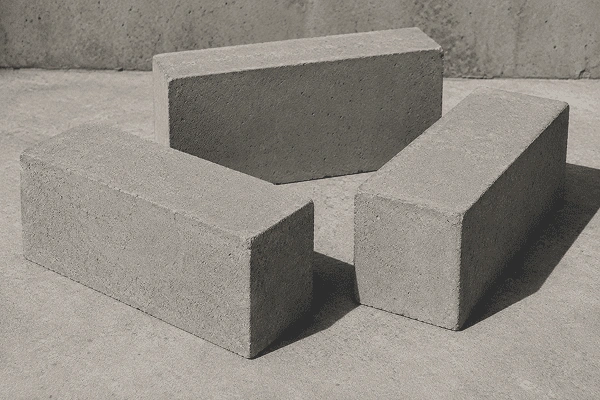
In this type of concrete block, there are no holes. It is just one plain cuboid-like solid structure. These units are typically larger than grey bricks. Such blocks are great for creating enduring walls against the elements. However, these building blocks can also be used for outlining outdoor spaces such as a garden, a patio, etc.
Do you know? Solid concrete blocks are heavier than hollow blocks and also more expensive! That is because they use more material within their ambit.
Hollow Concrete Blocks
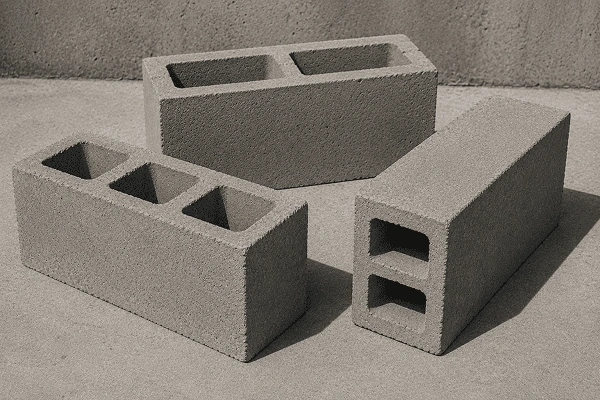
Hollow concrete blocks are hollow in one way or another. There are basically three grades in which these units are available, namely, Grade A, Grade B, and Grade C.
| Grade | Density |
| Grade A | 1,500 kg/m3 |
| Grade B | Less than 1,500 kg/m3 |
| Grade C | Greater than 1,000 kg/m3 |
Functionality-wise, grades A and B are both used for walls supposed to bear loads. However, for structures not supposed to bear the load, grade C is the perfect type of hollow concrete block!
Do you know? The major types of hollow concrete blocks are
- Stretcher block
- Pillar block
- Lintel block
- Jamb block
- Column block
- Corner block
- Splitface block, etc.
Aerated Autoclaved Concrete Blocks (AAC Blocks)
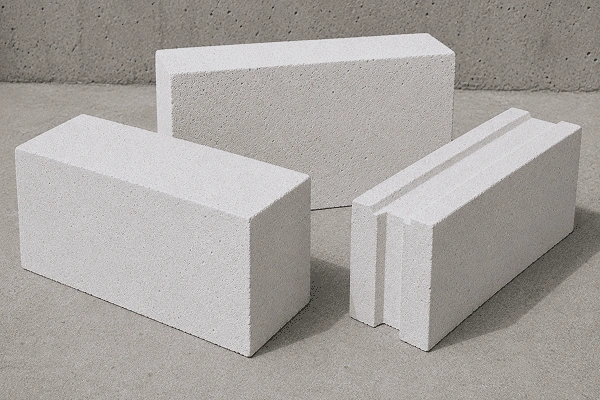
For high sound and temperature insulation, AAC or Aerated Autoclaved Concrete blocks are often the first choice in all types of houses. This block is very lightweight and known for its fire-resistant properties. If we talk about the composition, these blocks are more than 75% air. That is why this block is known as “Aerated.”
Aerated blocks are perfect for easy use of nails and screws after construction. That is due to the air content in its composition.
Caution: You cannot use these blocks for load-bearing structures. These are supposed to give way whenever there is more weight than their bearing capacity.
As a potential downside, this block deteriorates pretty quickly when exposed to bad weather conditions. So, make sure you seal it with a quality protection material, such as Eagle EU5 Concrete Sealer, Rainguard Premium Concrete Sealer, etc.
Paving Blocks
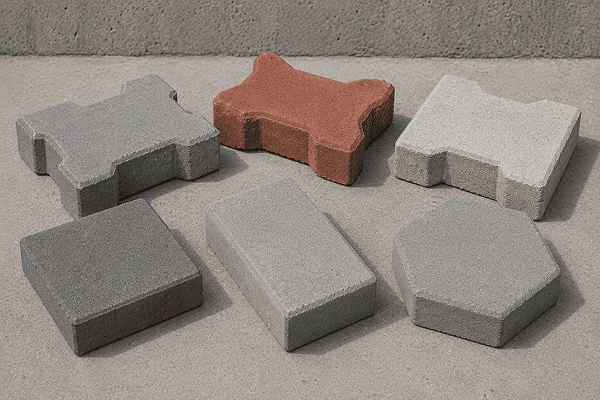
As the name suggests, a paving block is used for paving. Typically, they are used for pedestrian areas on either side of the road or even a walkway. This block comes in both rectangular and square shapes.
Paving units are available in a variety of sizes and all sorts of colors. The major types of these units are concrete, clay, plastic, stone, and rubber pavement blocks.
Decorative Concrete Blocks
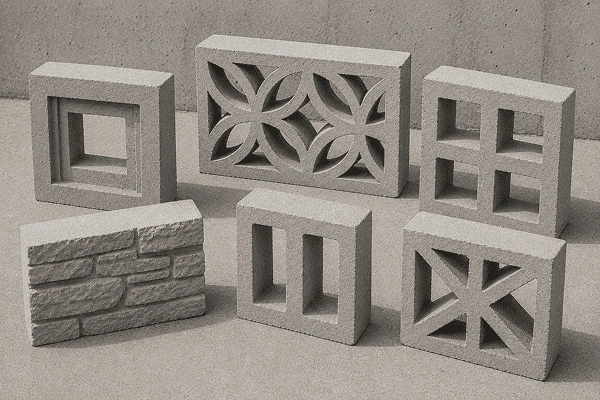
Decorative concrete blocks are also known as breeze blocks. And, these are typically used for making exterior walls. However, such fancy cubic or cuboid units are fabulous for small ventilation points in residential construction. Additionally, to name a few, breeze blocks are used in walls, edging, planters, and paving.
Might not know! Decorative blocks are also used in Grass-crete for an elevated sense of aesthetics and curb appeal.
Also Read: Construction Safety Checklist: A Brief Walking Through OSHA-Supported Safety Guidelines!
Standard Concrete Block Sizes
Concrete block sizes commonly come in four major variations, such as 4-inch, 6-inch, 8-inch, and 12-inch units. To learn about the full dimensions, refer to the following tables.
| Inches | Length x Width x Height |
| 4-inch block | 4x8x16 |
| 6-inch block | 6x8x16 |
| 8-inch block | 8x8x16 |
| 12-inch block | 12x8x16 |
How does the size work? Each block will not be exactly 16 inches in height. It will be slightly shorter. That is because the mortar joint accounts for the missing inches!
Key Uses of Concrete Blocks
Mostly, concrete blocks are utilized in making low-height walls, decorative walls, pavements, solid structures, etc. Some of the areas where it is widely used are residential and commercial construction projects. These concrete block uses are detailed below.
- Residential construction: All types of concrete blocks find application in residential properties, such as a split level house, a rambler house, a tudor style house, etc. They use everything from decorative units, hollow blocks, and paving forms to other types. Walls, foundations, and boundary walls are the major places where it is found!
- Commercial buildings: In big commercial complexes and structures, decorative blocks are often used for proper ventilation. Additionally, solid concrete units are the first choice for strong walls.
Do you know? Many malls or other tourist places also use breeze blocks to create beautiful structures around fountains.
- Infrastructure projects: Many government-owned buildings and infrastructure also use concrete blocks for a variety of purposes. For example, the side walls on both sides of the roads can be constructed with solid concrete units for maximum strength and durability! However, for an airy feel in a waiting room outside a big transit facility, decorative blocks can be used. That is true for other public facilities as well.
- Landscaping applications: Garden walls, patio, pergolas, gazebos, pavilions, arbor, and other structures also deploy all types of these blocks.
Benefits of Using Concrete Blocks
The major benefits of using these hard, versatile construction materials are highlighted below. Basically, it includes durability, flexibility, sound insulation, low-maintenance, energy-efficiency, fire-resistance, etc.
- Durability: The concrete blocks have always stood the test of time. They are strong in the build and remain intact for years to come. And, to the user’s benefit, they are also subject to the least wear and tear.
- Flexibility: This block concept is very versatile. You can use these in a variety of ways, such as on house walls, public facilities, garden walls, outdoor flooring, pavements, walkways, etc.
- Sound insulation: If you are looking for quality materials to control outside noises, start with these blocks. Walls made with such units are the most immune to noise pollution.
- Low-maintenance: Due to high durability and minimal wear and tear, these building units don’t require too much upkeep. They don’t even accumulate mold and mildew over time.
- Energy efficiency: Low-cost, high-profile public places often feature these blocks inside walls. That is because solid concrete blocks are great at locking the habitable temperature in, while preventing the outside extreme weather from interfering too much.
- Fire resistance: Compared to wood, strong blocks are way more fire resistant and thus the prime option for construction in fire-prone places.
- Other benefits: Additionally, these construction units are wind-resistant, eco-friendly, and cost-effective as well. You don’t need to spend a fortune to buy them. Yet, they come with multiple advantages.
Concrete Blocks vs Bricks
Consider the two comparison tables below, drawing differences between concrete blocks and clay bricks. It touches on various aspects, such as bulk density, compressive strength, thermal conductivity, and wall-laying speed.
| Criterion | Lightweight Block | Clay Brick (Hollow) |
| Bulk density | 800–1200 kg/m³ | 1200–1600 kg/m³ |
| Compressive strength | Medium | Medium |
| Thermal conductivity | 0.12–0.25 W/mK | 0.25–0.45 W/mK |
| Wall laying speed | High | Medium |
| Plaster consumption | Low-medium | Medium |
| Fire performance | A1, very good | A1, very good |
| Workability (Cutting/Chasing) | Easy | Medium |
| Criterion | Normal Weight Block | Clay Brick (Hollow) |
| Bulk density | 1500–1900 kg/m³ | 1200–1600 kg/m³ |
| Compressive strength | Medium–high | Medium |
| Thermal conductivity | 0.40–1.00 W/mK | 0.25–0.45 W/mK |
| Wall laying speed | High | Medium |
| Plaster consumption | Low-medium | Medium |
| Fire performance | A1, very good | A1, very good |
| Workability (Cutting/Chasing) | Medium | Medium |
Note: Never use lightweight blocks for load-bearing structures. For that end, normal-weight blocks might be a better option.
Also read: Contingent in Real Estate: Meaning, Process, Examples, & More!
Factors Affecting Concrete Block Prices
Major factors that affect concrete blocks are raw material costs, block size & type, manufacturing quality, transportation, and local market demand.
- Raw material costs: Water, cement, gravel, crushed stone, etc., all are basic elements to build blocks. Thus, a slight fluctuation in their prices immediately affects the prices of the concrete units.
- Block size and type: Hollow blocks are typically cheaper than solid blocks. So, the type of material you need also influences the price dynamics. Likewise, the bigger the size, the higher the cost will be.
- Manufacturing quality: Precision and the smallest size discrepancies are the hallmarks of quality manufacturing. But such high-end production isn’t cost-effective. Blocks are priced higher to account for quality.
- Transportation: Blocks also need to be transported from a manufacturer’s location to construction sites. That adds transportation expenses to the equation.
- Local market demand: High demand with low supply is the cause of rising inflation. The same logic also applies to high concrete unit prices in the local market.
How to Choose the Right Concrete Blocks?
While selecting concrete blocks, pay attention to certain aspects, such as size, load-bearing capacity, weather conditions, zoning laws, performance, and cost. Consider a brief explanation below.
- Size: There are several types of blocks based on size, such as 4-inch, 6-inch, 8-inch, and 12-inch. So, choose the one that you need for your construction project.
- Load-bearing capacity: This is another important factor for the choice. Don’t get lightweight materials for weight-bearing walls.
- Weather conditions: Aerated autoclaved concrete forms are not good for harsh weather conditions. You will require an additional protective layer if you use it. Thus, choose solid blocks.
- Zoning laws: Consider a small plot where you also need to maintain setbacks. That means your buildable area will be reduced substantially. In that case, if you use solid large blocks for walls, it will reduce the actual living space even more. So, here, choose slim blocks over broad ones.
- Performance: You can also choose a block based on its type and functionality. For example, paving units are best for outdoor flooring. And decorative blocks work best for garden walls or small ventilation points in houses.
- Cost: Compare prices and see that you don’t pay unnecessarily. That is also important while choosing these construction materials.
Best Practices for Installing Concrete Blocks
The best way to install concrete blocks is provided below. It basically involves preparing the foundation, mixing mortar, laying the first course, building the wall, and adding final touches.
- Preparing the foundation: Clear the site and mark the layout using a marker. Make sure that the ground soil is stable and can support the foundation.
- Mixing mortar: It is the adhesive material that is needed to hold two blocks together. For that, combine one part cement and three parts sand. Water must be added as needed. The secret to a quality mortar batch relies on good mixing as well. So, mix until you get the right consistency.
- Laying the first course: Accuracy is the key here. The first line decides the stability of the entire block wall. So, be careful and make sure you put enough mortar for max grip.
- Building the wall: Once the first course is stably installed, make sure that you carefully build your way up. Don’t miss the top outlines of the previously laid blocks. You don’t want a misaligned structure.
- Adding final touches: Let the mortar cure properly. Then, fix inconsistencies such as gaps or mortar overflow instances, if any.
Also Read: What Is ICF Construction? Benefits, Cost & How It Works!
Common Mistakes to Avoid When Using Concrete Blocks
The most common mistakes while using concrete blocks are as follows. It basically involves using incorrect block types and not using enough mortar for grip. Next, ignoring drainage needs and skipping inspections are also the ones.
- Incorrect block types: Talk to your contractor first. You must know which type of concrete blocks you need right from the beginning.
- Not using enough mortar: The right quantity of mortar means better strength and stability of the final structure. Never cut back on this adhesive material.
- Ignoring drainage needs: Make sure your walls have enough outlets to facilitate drainage. Otherwise, it will be a big hassle to drill a hole through the cured wall.
- Skipping inspections: Keep checking on the alignment at the time of construction. Also, make sure your measurements are right when creating the layouts.
Conclusion
Hence, the concrete blocks are the most versatile building units used in various projects. They are available in a great number of different styles. For example, there are solid, hollow, aerated, paving, and decorative blocks. Each one serves a unique purpose and is used in varied settings. Before you purchase these materials, make sure you know your requirements well.
FAQs
What is the difference between a cinder block and a concrete block?
How much do 1000 concrete blocks cost?
It depends on the type and size of the material you need. However, you can expect a range from $1,250 to $2,500 on average.
Can I use concrete blocks for a shed base?
Yes. You can use these blocks for the base of your shed.
Sources:
Beavertown block: The Top 9 Benefits of Concrete Blocks
Related Posts