The construction site is full of activities. Many people are working simultaneously on various aspects of a single project. In such human endeavours, the potential for risk factors is immense. That is what makes the construction safety checklist important. It is like a proactive approach to preventing major life-threatening events in all construction types. Learn more about this safety tool in the following article.
The construction safety checklist is a productivity tool in the hands of a contractor or any other professional in charge of safety at a development site. This list, without fail, helps effectively identify and fix potential hazards that can harm vulnerable workers. For example, installing proper safety nets and scaffolding is a major part of the inspection process. And it almost completely reduces damage to workers by unexpected falls from heights.
Occupational Safety and Health Administration (OSHA) provides key safety guidelines in this regard. Everyone involved in construction has to follow these rules. Ultimately, this precaution helps prevent accidents and ensure that things are moving as per the authority standards (compliance). Workers can engage in various activities without worries, leading to high efficiency. This construction site inspection checklist is mandatory in all types of projects, whether commercial or residential construction.
Gist: The only goal of this checklist is to make sure that every worker completes a project with no safety worries or physical injuries.
Why is a Construction Safety Checklist Important?
The construction safety checklist is very important because it makes the site and equipment inspection process easy. Major benefits of use are reduced accidents, legal compliance, improved productivity, better culture, and enhanced accountability.
Reduces accidents: When all the workers are equipped with protective gear such as helmets, gloves, boots, etc., and other factors on-site are in good condition, it leads to zero physical injuries.
Legal compliance: Construction legal authorities, such as OSHA, State-Plan Agencies, NIOSH, ANSI, etc., provide key rules and regulations for safety in building activities. All construction project managers have to follow them. Otherwise, the safety of workers is considered at stake, and non-compliance leads to penalties. That applies to projects involving all types of houses or commercial structures.
Improved productivity: With the mind no longer worrying about physical safety or health, workers exclusively focus on tasks. So, fully concentrated minds take work quality and quantity to the next level.
Better culture: Incorporating the safety inspection into daily, weekly, or monthly routines is the key objective of the construction site safety checklist. It ultimately helps build a safety culture and makes it habitual to take a proactive approach towards workers’ physical and mental safety.
Enhanced accountability: Having a checklist means you have straightforward tasks to carry out. Such clarity (or documentation) makes things easy to implement. Also, a person in charge can be particularly made accountable for things specifically mentioned with ambiguity.
Economies: Fewer on-site worker injuries mean reduced liability. Furthermore, a boost in productivity leads to a higher quantity with fewer resources spent. Both scenarios reduce construction costs considerably.
Key Components of a Construction Safety Checklist
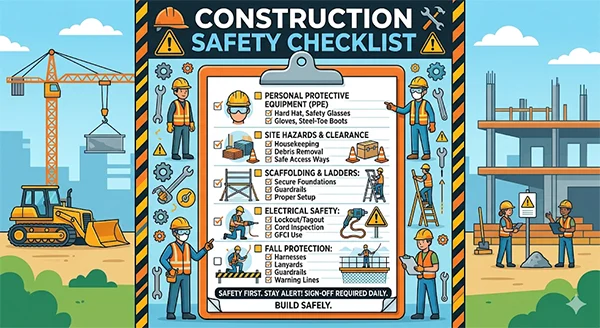
The key components of the construction safety checklist are PPE, site hazard identification, equipment safety, fall protection measures, electrical safety, and emergency preparedness. Each section is concisely discussed below.
1. Personal Protective Equipment (PPE)
Construction workers must have all the essential pieces of personal protective equipment ( or PPE in short).
It shouldn’t be just a piece of formality. Helmets, gloves, boots, goggles, etc., have to fit individuals properly for full body-part coverage and maximum protection.
Furthermore, contractors or professionals should provide training on how to use the gear for the best results.
Next, each worker should be well aware of the conditions under which they should not use the safety item.
Compliance: All the biggest construction companies in the US deploy workers on the site after well equipping them with protective gear. That helps them stay compliant with legal regulations.
2. Site Hazard Identification
This part of the construction site safety checklist deals with the safety of the site. Majorly, the manager must ensure that there are no slippery surfaces. Or, if any, there has to be a warning sign put in place for caution.
That ensures no slips, trips, or falls. It becomes even more important at heights.
Safety nets and scaffolding must be in good condition. Old and damaged nets won’t be able to catch a falling person harmlessly.
The only aim here is to make the workspace as safe as possible.
3. Equipment Safety
Here, the proper functioning of tools and construction vehicles is ensured before use.
Machinery inspection is another crucial part of the construction safety checklist. Trained professionals must check that all heavy-duty vehicles are in good condition and working well.
Without a thorough test, no machine is put to work.
All the maintenance records are checked at this stage. It helps accurately learn about the status or workability of the machinery.
Moreover, the complete training on how to use the equipment is important too for safety. That is also provided to reduce accidents.
4. Fall Protection Measures
Guardrails, safety harnesses, and scaffolding checks are all inevitable for fall protection.
Strong guardrails provide additional safety around the dangerous edges.
It must be used with safety nets if the construction is being done at heights.
Before installing the scaffolding, make sure all its parts are strong enough to bear the load.
Each pole and unit has to be clear and rust-free for max safety.
5. Electrical Safety
The biggest component of the site inspection is the electrical safety. It has a particular part in the construction site inspection checklist.
It commonly includes that no exposed wire causes physical injuries or fire emergencies.
All the flammable materials or liquids are to be put away from the major electrical points.
Wiring should be done properly.
Lockout/Tagout (LOTO) is also discussed in this part. It is the safety practice to prevent essential equipment from turning on unexpectedly during repair or service.
6. Emergency Preparedness
Lastly, as usual, emergency preparedness is part of all types of safety guidelines. That is not only about the construction safety checklist.
So, the safety manager has to ensure that all fire extinguishers are in place and well functioning. It is an unavoidable part of the fire extinguisher inspection checklist.
There have to be enough first aid kits for the events of unexpected physical injuries.
And, no need to mention, emergency exits should be fully functional.
Looking for the construction site safety checklist PDF? Have a look at the following points. You can take it as a starting point along with the advisory issued by the state or national authorities.
Provide PPE: Make sure that all workers have safety gear before they go to work. Their most vulnerable body parts have to be well protected. To achieve it, use strong and intact safety items, such as hard caps, thick gloves, boots, etc.
Inspect tools: From the biggest crane to the smallest excavation machinery, all equipment is prone to failing. Thus, before using them, ensure a thorough check. That way, you can rule out major concerns in time.
Clean and organize the worksite: Construction workers use walkways, entry or exit points, and stairs throughout the day. Thus, these points of the site shouldn’t be obstructed or slippery anyway! That helps prevent slips, trips, and falls from the elevated edges. After all, organized spaces save time and boost productivity.
Ensure visible safety signs: Proper placement of hazard signage, such as high voltage, danger, etc., is indispensable. You cannot compromise with it. Always use signs with clear visuals. If the clarity is compromised, use another signpost. Besides, don’t forget to mark the emergency exits with precision.
Place emergency articles within reach: Fire extinguishers and first aid kits are very crucial in all projects under development. Thus, they must be easily accessible to everyone. Such facilities have to be installed or placed within reach throughout the construction site.
Houseura tip: All construction companies or individual contractors must ensure builders’ risk insurance for managing liability during the construction in case of unexpected, destructive events.
Weekly and Monthly Aspects of the Construction Safety Checklist
The construction safety checklist doesn’t end at the daily routine. There are weekly and monthly aspects as well. Regular inspections cover things like a clean floor, proper fall safety, all equipment working well, etc. This keeps the site safe and operational each day.
But when it comes to the weekly and monthly inspection, the focus shifts to ensuring once-a-week maintenance, providing up-to-date safety training sessions, and identifying newly surfaced hazards. The reports on the ongoing monitoring & improvement are also discussed with the team every week or every month as part of effective communication.
When it comes to implementing the construction safety checklist, many people end up making particular mistakes. Major ones are related to PPE, communication, training, and inspections, as highlighted below.
Ignoring PPE: Suppose a construction worker is working without a hard hat even though one was provided. And there is no one around to enforce its use. So, under a falling-object-prone area, what is the most likely possibility? You know, right! That is why personal protective equipment is so essential. It minimizes injuries and fatalities to a great extent.
Poor communication: Failing to inform workers of risks is an example of poor communication. Other incidents include not educating the workers clearly on safety precautions. Next, if there isn’t enough time for doubt clearing, misunderstanding is also a huge pitfall.
Lack of training: Suppose you have all the equipment. But you don’t know how to use it with care. That is where the power of proper training comes from. Without the right education, the true potential cannot be unleashed. Lack of training often becomes the cause of huge on-site accidents.
Skipping inspections: There are many cases in construction where the project manager doesn’t conduct proper checks. And it leads to life-threatening events, particularly due to open electrical points. Thus, don’t forget to check the site properly for potential risk factors first.
Tips to Improve Construction Site Safety
Implementing the construction safety checklist can be daunting if you are a beginner. That is why we have provided the following points for an easy start. Consider these to-the-point instructions for maximum safety of workers.
Conduct regular meetings to ensure that everyone is well-informed of the well-known risks at the site and safety protocols. That is because education precedes practice.
Keep the checklist in a digital format and share it with everyone. Digital lists are more effective and efficient than manual ones.
Support your staff members when they report any hazards. If possible, also recognize their vigilance, which will encourage a safety spirit and culture.
Don’t train once and then leave the topic. Workers require constant training and updates as per new developments in the field. It keeps their safety knowledge refreshed for mindful applications.
Who is Responsible for Construction Safety?
There is no single person who is responsible for ensuring the construction safety checklist. It is a collective enterprise of several professionals. Major names on the list of the concerned are as follows.
Site managers
Supervisors
Workers
Safety officers
Houseura tip: If you are a project owner and thus learning about this safety checklist, the home inspection concept is also crucial. It helps you immensely when buying a house as a beginner. Learn about the cost of a home inspection and hire a professional if it is under your budget.
The importance of a construction safety checklist is immense. It is meant to save lives and prevent life-threatening injuries on the construction project site. The major aspects of this list are personal protective equipment (PPE), site hazard identification, equipment safety, fall protection measures, electrical safety, and emergency preparedness.
However, education requires careful implementation. That is why you should always be vigilant in applying the safety rules carefully.
FAQs
Q. What are the 5 basic safety rules?
Ans: The 5 basic safety rules are as follows.
Stop, think, and stay alert.
Look and identify hazards.
Assess risks.
Control hazards.
Report & monitor.
Q. What is a QC checklist?
Ans: It is a quality control checklist. This features a structured, step-by-step document used in manufacturing, construction, and services. The main objective of this is to ensure that the final project meets defined standards.
Q. What is the OSHA checklist?
Ans: OSHA stands for the Occupational Safety and Health Administration. This organization provides comprehensive details on construction safety education and checklist points for practical use.