A small problem, such as flashing damage, is likely repairable. Leaks and seam problems indicate the need to get a roof replacement.

What Building Owners Should Know Before Replacing a Commercial Roof in Hamilton
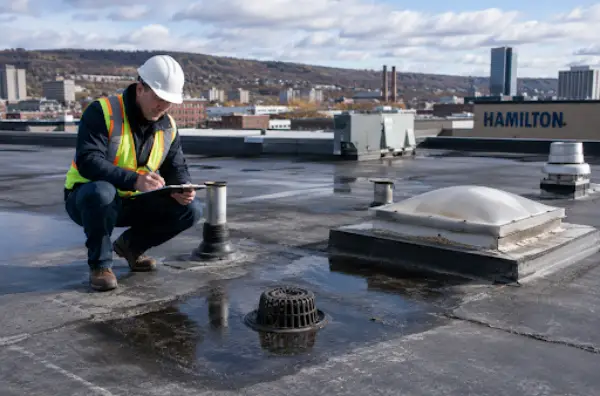
Replacing the roof on a commercial building is an expensive investment. However, there is a tendency to consider only the part that can be seen, like cracks, deterioration, or an old membrane. This is not enough.
The property managers in Hamilton should examine the entire performance of the roof system, the history of repairs, how the drainage system performs, and the impact of the quality of the insulation.
The right evaluation of the roof condition will help not only prove that there is an issue. It will show whether repair or replacement of the system should be done.
Table of Contents:
Start With the Condition of the Entire Roof
A commercial roof survey should include more than just leaks and the state of the surface of the roof. Seams, flashings, penetrations, roof edges, drainage areas, previous repairs, and locations around rooftop equipment can all provide information about how the system is performing.
The roof’s history matters as well. An older membrane that has required only occasional localized repairs presents a different situation from a similar-aged roof with recurring leaks across several areas. Past maintenance should reveal whether any of the issues have been isolated.
Moisture below the membrane deserves particular attention. Wet or deteriorated insulation can affect thermal performance and may increase the eventual replacement scope. Knowing the condition of the roof insulation before starting the project will allow the owners to allocate funds for roof replacement properly.
Decide Whether Repair or Replacement Makes Financial Sense
The age of the roof is no indicator of when the time comes for replacement alone. A roof with localized defects and an otherwise sound assembly may remain a reasonable candidate for repair. This can be particularly true when leaks have identifiable causes such as a damaged flashing or isolated penetration.
The financial calculation changes when repairs become frequent, or deterioration is widespread. Leaks, failures in seams, moisture entrapment, damage to insulation, or drainage issues in the roof all make it harder to keep repairing.
Owners considering a commercial roof replacement Hamilton project should therefore compare the cost of replacement with the likely cost and operational impact of keeping the existing roof in service. Emergency repairs, interior damage, disruption to tenants or operations, and increasingly frequent maintenance all contribute to lifecycle roofing costs.
It’s not a matter of making the roof last as long as possible at this point. It’s about knowing when it makes sense to stop investing.
Compare Roofing Systems in the Context of the Building
Most widely used systems of roofing are TPO roofing, EPDM roofing, and modified bitumen roofing; however, material selection should follow an assessment of the building rather than lead it.
TPO is a single-ply membrane system commonly used on low-slope commercial roofs. Installation details, seams, penetrations, substrate conditions, and drainage design can all affect long-term performance.
EPDM is another single-ply option with many years of experience in commercial applications. Owners evaluating EPDM roofing should consider attachment methods, detailing requirements, maintenance expectations, and whether the existing roof configuration provides an appropriate substrate.
Modified bitumen roofing uses asphalt-based materials reinforced for commercial roofing applications. Depending on the system and installation method, it can suit buildings where durability, traffic patterns, existing construction, or particular detailing requirements influence material selection.
None of these flat roofing systems should be selected simply because it looks like it is the best in a product comparison chart. Roof geometry, rooftop equipment, existing materials, drainage configuration, building use, and future maintenance requirements can change which approach makes sense.
Account for Hamilton’s Climate and the Complete Assembly
Hamilton roofs experience seasonal temperature swings, freeze-thaw cycles, snow, ice, and periods of heavy rainfall. These conditions make drainage and detailing particularly important.
Standing water can increase stress on sensitive areas and expose weaknesses around seams, flashings, and penetrations. During colder periods, repeated freezing and thawing can further challenge deteriorated components. Commercial roof drainage should be inspected before installing new roof drainage systems.
The same whole-system approach applies to insulation, flashings, parapets, roof edges, penetrations, and rooftop mechanical equipment. Replacing a membrane without addressing underlying deficiencies can leave important sources of future problems unresolved.
This is also why contractor evaluation needs to start from the assessment phase rather than from the installation quote. A qualified resource for commercial roofing Hamilton should be able to evaluate how the membrane, insulation, drainage, penetrations, and other roof components interact before recommending another repair or full replacement.
For owners comparing proposals, useful questions include how the existing assembly was evaluated, what deficiencies were identified, which components are included in the scope, and why the proposed roofing system fits the property. The terms and conditions of the warranty, experience in similar commercial or industrial buildings, and maintenance are also relevant issues.
Plan Around Lifecycle Costs and Future Maintenance
Lowest installation cost doesn’t guarantee lowest overall cost. Owners should consider expected service life, routine commercial roof maintenance, potential repair exposure, insulation performance, warranty requirements, and the complexity of eventual replacement.
Project scope can have an important effect on these calculations. Correcting drainage deficiencies or replacing compromised insulation may increase initial costs but address conditions that could otherwise affect the performance of the new system. Finally, installing new parts when existing ones are still functional can lead to additional spending. Proper assessment allows for such discrimination.
Maintenance planning should begin when the replacement system is selected, not years after installation. Scheduled inspections can identify developing problems around flashings, penetrations, seams, drainage areas, and rooftop equipment before they become significant defects.
It is important to keep drainage parts clean, as well as document any modifications that use mechanical equipment or involve roofing penetration. Maintaining records of inspections, repairs, warranty information, and roof alterations also gives future facility managers a clearer picture of the system’s history.
For Hamilton building owners, a commercial roof replacement is ultimately an asset-management decision. Evaluating the complete assembly, comparing repair and replacement costs, choosing a system based on the property requirements, and planning for preventive maintenance of the roof will make the decision better.
FAQs
When do I need roof repair or roof replacement on my commercial property?
Which types of roofs are the most common in Hamilton?
TPO, EPDM, and modified bitumen are the most popular systems. Your choice depends on roof geometry and roof drainage and doesn’t come from a comparison table.
Why is drainage crucial when replacing a roof?
The freeze-thaw cycle and precipitation in Hamilton add strain to standing water. Drainage, scuppers, and roof slopes must be evaluated before installation of any system.
What questions do I need to ask a potential contractor for my commercial roof replacement project?
Ask what they considered when analyzing your existing roofing system and what issues they identified. Additionally, you can ask why they recommended a certain type of roof for you.
Related Posts