A quick move-in home is a fully finished property with all certifications done and that is ready to be occupied by the new homebuyer.

How to Find New Construction Homes: A Complete Roadmap to Get Your Dream Move-In-Ready Home
Are you trying to find a move-in-ready home for yourself but not getting any reliable sources to buy one? New construction homes are newly built properties that are ready to be occupied for residential purposes. The fresh construction homes feature modern finishes, facilitate more energy efficiency, are built with advanced technologies, and are more convenient than older or existing homes.
Some of the ways to find new homes are searching real estate websites, contacting local home builders, taking help of social media, assessing financial conditions, etc. In this guide, you will learn how to find new construction homes for yourself using simple methods and how to compare home prices.
Table of Contents:
- Why Do People Prefer to Buy New Construction Homes Over Older Built Homes?
- 1. Search Online Real Estate Websites
- 2. Explore New Housing Developments in Your Area
- 3. Contact Local Home Builders
- 4. Visit Model Homes and Construction Sites
- 5. Check Your Budget and Financing Options
- 6. Use Social Media and Local Community Groups
- 7. Look for Newly Built Homes That Are Move-In Ready
- 8. Compare Prices Across Different New Home Communities
- Final Checklist for Finding a New Construction Home
- Conclusion
- FAQs
Why Do People Prefer to Buy New Construction Homes Over Older Built Homes?
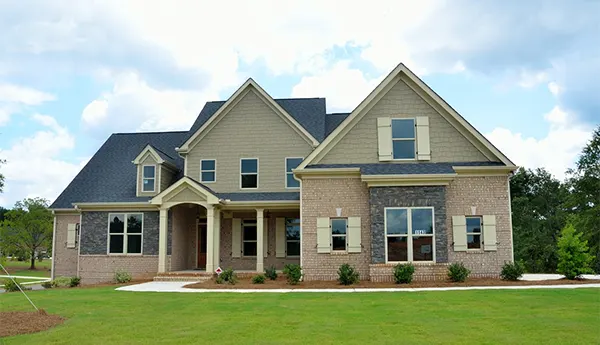
New construction homes are brand-new houses that are either completely ready to move in or are customized as per the buyer’s needs. Buyers prefer to invest in new construction homes over older homes, as they are built with new materials and equipment, which makes them strong for the coming years. Other benefits of buying new construction homes are:
- Build With Advanced Technology: New homes are made with modern tools and materials and equipped with advanced technologies like HVAC systems, automated security systems, etc., which are sometimes missing in older homes.
- Customizable Plans: Buyers can plan the full house structure according to their needs, such as making open-layout floor plans, adjusting ceiling height, lighting controls, etc.
- Low-Cost Maintenance: Unlike older properties, newly built properties require less maintenance and repair work, which saves money being spent on renovations.
Below are ways to find new construction homes or move-in-ready homes using simple methods.
1. Search Online Real Estate Websites
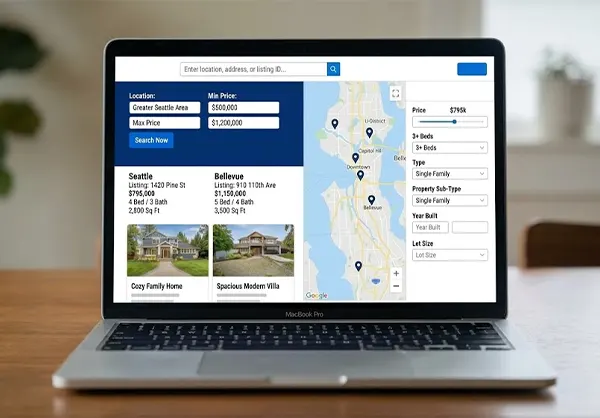
A real estate website is an online site or platform for real estate businesses that deal with buying, selling, renovating, and renting homes and properties. There are certain popular real estate websites that can be used by homebuyers to search for their desired house. For searching houses on these websites, you can:
- Log in to a Trusted Platform: Create an account on a trusted real estate portal and choose the option to buy.
- Use Filters: By using filter options, set your location, price range, and all preferred customizations you want in your home.
- Check the Location: Using the map feature, have a look at the surrounding neighborhood, markets, parks, etc.
- Allow New Alert Notifications: For new home listings or updates, allow the website to send you alerts so that you can be aware of new housing opportunities.
- Book a Consultation: If the site allows contact with the property owner, then book a consultation or meeting to have a face-to-face conversation about the pricing or customizations.
- View Testimonials: Check for the reviews or testimonials of the previous buyers and how the site helped them.
Also Read: What Does Under Contract Mean in Real Estate? – The Ultimate Guide for Buyers and Sellers
2. Explore New Housing Developments in Your Area
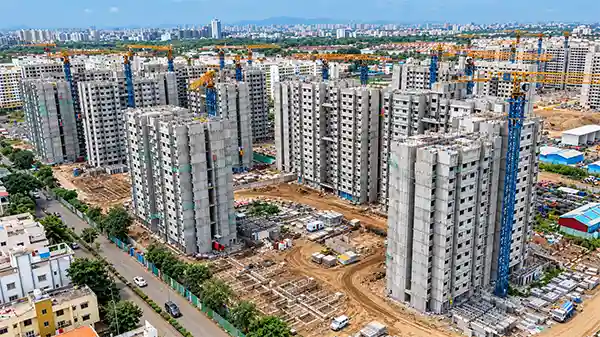
Many new housing projects and development works are executed on an everyday basis in every locality. You need to make an effort to find the new developments, subdivisions, or construction projects being implemented in your area. To find fresh housing developments in your area, you can follow the following ways.
1. Search on Local Municipal Websites
Local municipal websites have portals where mapping views of upcoming or completed construction projects are visible using simplified maps with their project status. For buying a new home, you should check these websites on a regular basis.
Did You Know?: GIS (Geographic Information System) is an online web tool used by civic websites that gives real-time location-based data about construction project updates in the form of charts, tables, maps, etc.
2. Review Company Websites
Many construction companies have a communities section on their sites to allow users to search for new construction projects with timelines and check the company’s press releases, where the home builders have announced the location, design, and other important information about the house.
3. Be Part of the Community Association and Meetings
Various community associations in a society provide new housing development updates through their newsletters or community meetings, where local home builders or project planners discuss the upcoming developments with proper planning. Being part of these conversations keeps you ahead in the race to buy the best house for yourself.
4. Have a Small City Tour
Take a ride through your city to see the new developments or any new projects being started around your neighborhood. Talk to people or residents in your neighborhood to know the current building rates, owners’ contact details, and other useful information that may help you to buy a new home.
3. Contact Local Home Builders
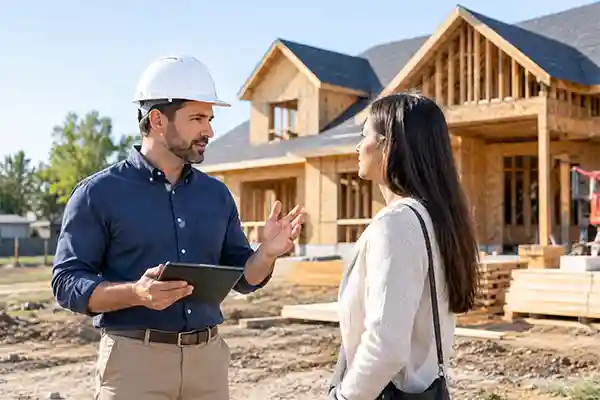
Local home builders are the construction professionals who manage permitting, physical construction, and the design of construction projects. They are preferred to contact for building a new house, as they have good knowledge of the local housing rates and charge lower fees than other premier real estate builders. Below are the ways home builders help you to find a new home.
1. Builder Websites
Home builders develop custom-built websites that showcase their portfolios, past projects, all new housing developments, ready-to-move-in homes, their features, floor plans, quotation request features, and their contact details. It helps them contact potential homebuyers.
2. Guide for the Entire Process of Building a House
They help you through the entire process of building a house and guide you to the best locations, floor plans, and customizable designs, or suggest the type of house that will suit you. Local home builders help you to get the permits required to start the process of construction.
3. Model House Tours
If you are planning to build your house from scratch, then local home builders help you to take a tour of the model houses (houses that are lookalikes of the house you want for yourself) to understand the overall structure, layout, design, planning, look, and feel of your future house that will look similar to the model house.
To find a good home builder, you must check the best home builders near your area online and check their past projects and experience, online reviews and reputation, and their compatibility and professional behavior towards you. If everything looks good, finalize the home builder to find a newly built custom home for yourself.
4. Visit Model Homes and Construction Sites

When we buy a new home, we get confused about what the home will look like; will we like it or not? A model house is a fully designed and constructed house that is specifically designed by real estate agents, who act as a showpiece for potential new buyers. Visiting these model homes helps to:
- Understand the room layouts, lighting, storage, and finishes.
- Know the quality, quantity, and cost of each item or material to be used in building your home.
- Check neighborhood compatibility and construction completion timelines
- You get to know what you like and what doesn’t fit in your dream home’s interior design.
What to Check During A Model Home Visit?
If you are buying a house with the help of a real estate agent, then you will be asked to visit a model home to get an overall idea of the home you want for yourself. To check if your future home will be a good fit for you or not, you can use this checklist:
- Check Location: See the nearby road connectivity, proximity to schools, hospitals, parks, etc., and the surrounding neighborhood atmosphere.
- Look for Quality Assurance: Check the cement and overall material quality, like tapping the tiles, the functionality of windows by opening and closing them, etc.
- Experience the Layout and Design: Ask the real estate agent to explain the room dimensions, floor type/plan, and interior design layout while giving you the full home tour.
5. Check Your Budget and Financing Options

Before buying a home, you need to analyze your financial conditions, whether you are able to make a full one-time payment or want it on an EMI basis. On the basis of the type of home you want to purchase, you need to assess whether you would have to take a personal loan and how you would manage emergencies. Below are some of the ways to check your budget and financing options:
1. Assess Your Financial Conditions
Firstly, look at your bank balance, savings, and other personal loans, if any. Analyze your monthly expenditures, your future goals, and the difference between the amount you have to pay as a down payment and the total amount to buy the house. This will help you to get an idea of the sum of money you will have to take as a loan.
2. Compare the Mortgage Options
If you have a good, stable income, then go for the conventional loans offered by private institutions or banks, and if you are a first-time buyer, then choose the government-backed loans like FHA or USDA loans that are federally insured and reduce the loan complexity, which people suffer from when taking government loans.
Check the interest rates and the Annual Percentage Rate (APR), which is the total yearly cost of borrowing the money, including the principal loan amount and the other processing fees.
Note: FHA stands for Federal Housing Administration; it is a government mortgage plan to help first-time home buyers with low incomes on a minimum of 3. 5% down payment. The USDA (US Department of Agriculture) is a government-backed loan that helps buyers with moderate incomes with a 0% down payment.
3. Verify Transaction/Homeownership Expenses
Along with the full payment, ask the homeowners about the closing costs (the costs or fees paid while finalizing the deal for the house) and the property tax (the government tax to be paid on the house to assess the public welfare). HOA fees (Homeowners Association fees paid to the association to maintain the shared spaces, amenities, and communities).
Point to Note: According to the Consumer Financial Protection Bureau’s February 2026 data about mortgages, 404682 mortgages originated in 2026, which sums up to $162.1 billion in mortgage value, which is a 35.4% increase in year-over-year originations in the US.
6. Use Social Media and Local Community Groups
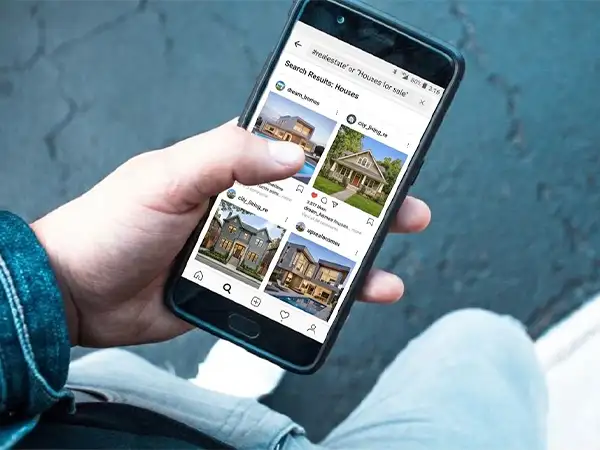
Digital media provide you with a vast scope for finding homes and interacting with people with the same needs as you. Many home sellers list their properties on various Facebook selling groups; they post videos on platforms like Instagram and YouTube with captions like “For Sale.” You can contact those people using the contact details on their social media handles.
Community groups made on various websites like Reddit and Quora help you interact with people with the same needs; they share their experiences and give some useful tips that can be helpful for you as a homebuyer. Neighborhood forums are the official groups of the residents of a locality who decide the neighborhood’s plans. Having access to these resources, you can get to know the developments that are going to be done in your future locality.
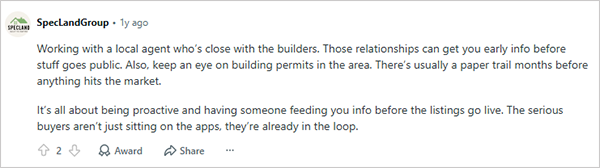
Here is one of the Redditor’s advice on finding a new home, which can help you to get a new construction home.
7. Look for Newly Built Homes That Are Move-In Ready
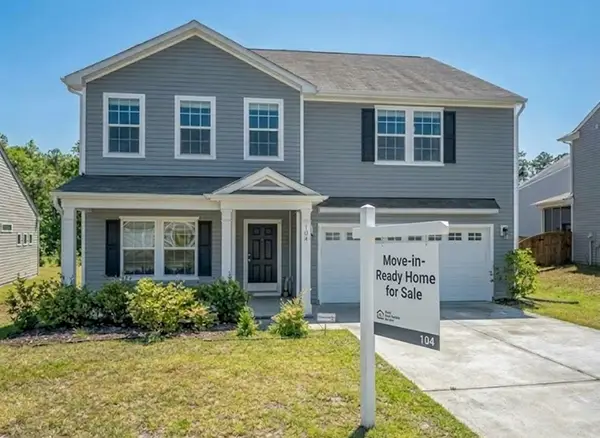
Move-in ready homes are considered a good option for people who don’t want to wait for a long period for the full construction of the house. They are fully completed homes that are ready to be occupied by the home buyers and have all the certifications or legal formalities already done by the home builder and the property owners.
Take a look at the difference between the move-in-ready homes and under-construction homes.
| Differentiating Aspect | Under Construction Homes | Move-in-Ready Homes |
| Meaning |
|
|
| Price |
|
|
| Scope of Customization |
|
|
| Risk Factor |
|
|
Did You Know? : 5% GST applies to under-construction homes because construction is an ongoing process, and builders use materials like cement, stone, bricks, and labor services. For these services, the government charges a fixed GST. While move-in-ready homes are fixed and immovable property, the government does not charge this GST on fully finished properties.
Buying quick move-in homes is profitable for new home buyers, as they don’t have to wait a long time to take possession, which saves their time.
Also Read: What to do at home: 25 Productive home improvement ideas
8. Compare Prices Across Different New Home Communities
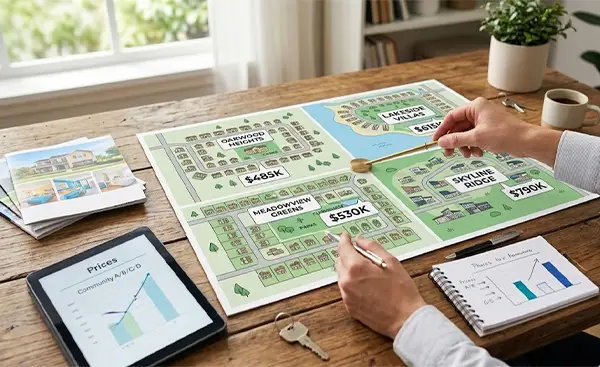
Home communities are housing developments or shared neighborhood spaces that include multiple houses, parks, apartments, and other shared amenities that are managed by a builder or the developer who makes decisions for the whole development of the community. Below are ways to compare prices in different home communities.
- Compare the Whole Usable Space Along With the Base Price: Ask the builder not just for the base price per square footage of the house, but also consider the cost according to the carpet area (floor area of the house).
- Check the Additional Fees or Costs: Compare the HOA fees, stamp duties, closing costs, maintenance fees, property taxes, and other legal compliance fees.
- Look for the Upgrades: Two homes may vary in cost because of their upgrade level, as prices may vary by floor number, parking lot accessibility, open or closed layouts, etc.
- Compare the Overall Cost: Don’t just see the advertising price sent to you by the builder; visit the location and see the overall cost, including the heavy equipment, furnishing, and HVAC costs.
Final Checklist for Finding a New Construction Home
Before signing or closing the final deal on the home, you should have a final checklist for inspecting the new home, as builders are always busy with multiple clients, which can lead to mistakes in some legal paperwork. You must check the house on a physical level, location-wise, documentation level, and for legal procedures.
Below is the checklist to find a new construction home before you finalize the deal.
1. Full House Physical Inspection
As per the purchase contract, there should be nothing left unfulfilled. You should look over every room and even every single corner, window, or door of the house for any unnoticed faults or anticipated risks. Below is the inspection checklist for every part of the house:
- Bedrooms: Look for the functionality of the doors, windows, and closets; check the storage space availability, ventilation space, and walls and ceilings for any cracks or faults.
- Kitchen: Check the countertop’s strength, cabinet hardware functionality, electrical appliance safety, storage space, sink and drainage system alignment, etc.
- Bathrooms: Look for the waterproofing tiles; check showers, taps, and flush functionality; check the pipes or walls for any leakage and the floor for being slippery.
- Living Area: Check the living area for the wall texture and overall flawless finish; look for the lighting fixtures and ceiling safety design. See if the furniture placement leaves enough space for walking. Roof: Check if the roof has waterproofing done; look for the boundary railing strength on the sides and the stairs; see if there is a proper system for draining stagnant water.
- Other Factors: Look for the entry gate security and functionality; check the exterior spaces and neighborhood with market and road connectivity.
2. Document Checklist
Apart from doing the physical inspection, legal formalities need to be done in the form of documentation or legal paperwork. You need the documents for three stages: pre-buying, while taking a loan, while purchasing the house, and while finalizing or closing the deal. Below is the necessary documentation checklist for buying a new house.
- Proof of Income and Employment: To take a mortgage, you need to show proof of income and employment, or certificates.
- Offer Letter: The letter you write to the buyer stating why you want to buy the house, to connect with the buyer on a personal level.
- Purchase Agreement: This agreement is the official contract signed between the seller and the buyer, which includes all the property details, terms and conditions, and the cost of the house and other important details.
Other important documents include the home inspection report, home appraisal, and the closing disclosure between the lender and the buyer.
Also Read: How Much Does a Metal Roof Cost? Complete Guide to Panels and Standing Seam Roofs?
Conclusion
Summing up! In this article, we studied how to find a new construction home in different ways, what the difference is between under-construction homes and ready-to-move-in homes, and the final checklist to follow before buying a new home for you.
You can find a new construction home by taking help from real estate websites or agents, talking to a home builder, and searching on various community or Facebook groups. Remember, buying a new house is a big responsibility, so always trust verified professionals and websites while you are in the process of buying a home for yourself.
FAQs
What is a quick move-in home?
Whom to contact: the real estate agent or the home builder for finding a new construction home?
You should consider talking to a real estate agent, as the agent is a professional in selling or buying properties who can show you the best location homes at good prices. On the other hand, a home builder deals in home construction, so he can guide you on getting the right building materials and the physical structure of the house.
Which communities can I join to find new construction homes?
You can join communities like real estate forums, home communities, Reddit discussion forums, Facebook groups, neighborhood forums, etc. to know about new construction developments in the location where you want to buy the home.
From where should I take the loan—the government or private institutions?
You should take government loans if you have a lower credit score (below 550), or take a private loan if your credit score is 700+ or your income is generally moderate to high.
What documents do you need before buying a new construction home?
To find a new house, you need to have an official government ID, a bank statement, citizenship verification proof, a pre-approval letter for the mortgage, and a credit report.
Sources
Mortgages: Consumer Financial Protection Bureau