Screwdrivers, hammers, utility knife, pliers, wrenches, flashlight, tape measure, level, saw, a versatile power tool like a drill.

Why Equipment Breadth Beats Price on Large Infrastructure Projects
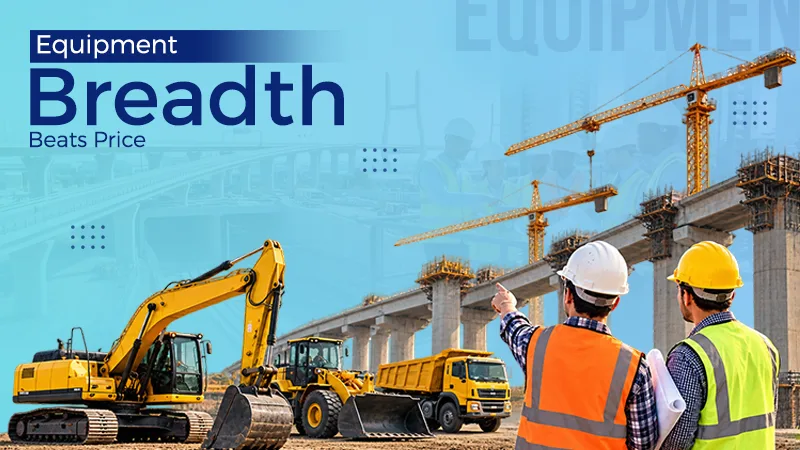
Whenever you decide to undertake a large infrastructure project, it’s going to require a different set of tools for different purposes. And all those can be expensive, but sourcing them from a vendor can do more harm in the long term.
That’s why it’s better to have reliable and sturdy equipment for infrastructure projects. Read this blog to learn why Equipment Breadth Beats Price on Large Infrastructure Projects.
Table of Contents:
How Inefficient Equipment Sourcing Creates Costly Gaps
Lowest-price-per-unit sourcing makes sense. When you manage a large infrastructure build, each quote looks competitive in isolation. Renting a telecom bucket truck from one vendor, a cable placer from another, and service vehicles from a third seems cost-effective.
But during execution is when the problems emerge. Your procurement team juggles multiple contracts with different terms, payment schedules, and insurance requirements. If equipment arrives late or underperforms, Accounting cycles stretch as invoices arrive from several sources at different intervals. You’re coordinating with multiple vendors to pinpoint accountability.
These inefficiencies drain hours from project managers and delay crews waiting for the right machinery. Redundant rentals stack up when delivery windows don’t align with project phases. Contractual penalties for missed deadlines compound when equipment gaps push your schedule off track.
Why Fragmented Equipment Sourcing Raises Your Long-Term Costs
When delivery schedules conflict between vendors, crews sit idle. The downstream financial impact of fragmented sourcing often dwarfs whatever you saved on individual rental rates. When accountability blurs across suppliers, resolving equipment failures consumes days instead of hours. These coordination breakdowns translate into real budget overruns.
From the New York City Department of Design and Construction (DDC), recent data show the scale of this problem — 80% of DDC-managed capital projects ran behind their original schedules by an average of 3.5 years. A sample of 18 large-scale infrastructure projects saw costs increase from $4.14 billion to $4.51 billion — a $370 million increase — while the audit pointed to oversight, planning, monitoring, and cost-tracking issues as contributors to delays and overruns.
This is where the breadth of equipment becomes essential. A provider offering a full range of specialized machinery under one contract eliminates the gaps that multi-vendor sourcing creates.
The Value of Working With One Equipment Partner
Instead of managing six vendor relationships, you work with one point of contact who understands your entire project timeline and can adjust deliveries as phases shift.
Consolidating your equipment needs under a single provider with comprehensive offerings closes the coordination and accountability gaps that plague fragmented sourcing.
There’s no finger-pointing between vendors when a delay occurs.
When equipment issues arise, resolution happens faster because one team owns the entire fleet supporting your build.
Coordinated delivery means your bucket trucks, excavators, and service vehicles arrive in sync with your actual work schedule rather than conflicting timelines dictated by separate rental agreements. Your crews stay productive rather than waiting for the next piece of machinery to arrive.
Shared accountability across all equipment types lets you optimize resource allocation. You can shift underutilized machinery between project phases without renegotiating terms or paying redundant rental fees to multiple vendors. This operational efficiency translates into real cost savings that outweigh any per-unit price premium you might pay for consolidated sourcing.
Seeing Equipment Breadth in Action
One provider that demonstrates a comprehensive breadth of equipment in practice is Custom Truck One Source. As a specialized truck and heavy equipment solutions company, it offers a single-source model spanning new equipment, used equipment, rental and leasing options, aftermarket parts, and full-service support.
With more than 10,000 rental units across 40+ locations in North America, Custom Truck One Source serves the utility, telecommunications, rail, forestry, construction, and infrastructure sectors.
The Rental Purchase Option allows you to rent equipment now and acquire it later without tying up capital up front. A 24/7 call center ensures you can resolve issues around the clock rather than waiting for standard business hours. A network of over 755 production and service experts and more than 575 production and service bays supports equipment maintenance and service needs.
One contract replaces multiple vendor agreements. One delivery schedule replaces conflicting timelines. One accountability chain replaces finger-pointing between suppliers. This breadth directly addresses the pain points outlined earlier.
Where coordination complexity scales with project scope. For large infrastructure builds, consolidating equipment sourcing under a provider with this range of capabilities can be the difference between staying on schedule and watching delays compound.
Choose an Equipment Partner Built for the Long Haul
As you evaluate potential equipment partners for your next large infrastructure build, consider whether their offerings span the full range of machinery your project demands and whether their operational footprint can support you through every phase. Equipment breadth matters more than per-unit price when your project timeline and budget depend on seamless coordination.
Frequently Asked Questions
What are the 10 common tools?
Should I choose a manufacturer or a local equipment dealer?
Choose based on the project’s complexity. A manufacturer may be better suited to custom engineering, while a dealer may be useful for standardized equipment and local availability.
What heavy equipment is commonly used in construction?
Excavators, skid steers, loaders, forklifts, telehandlers, cranes, bulldozers, and graders. Larger infrastructure projects may also require compactors, asphalt pavers, and trucks.