Although there is no perfect size. But a golden rule says to cover around 65% of the space above the furniture.

How to Hang Oil on Canvas Art Room by Room: A Practical Styling Guide
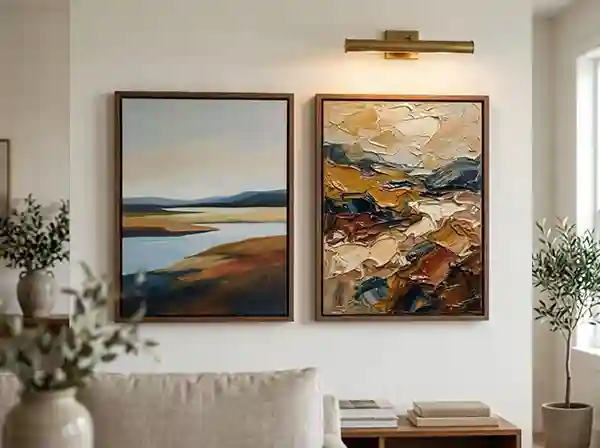
The visible brushwork and layered texture of an original oil painting create depth that printed reproductions simply can’t replicate
There is a point when a clear thought comes in – either the painting completely transforms the space or it simply sticks there. And this is not mainly about how the painting is, or how expensive it is.
Oil on canvas has an impact that prints usually don’t have. A difference in textures and other aspects is clearly seen. But when this same painting is hung at either a higher height or too low, it just messes with the view.
This practical guide shares the practical ways to hang oil on canvas art, room by room.
Key takeaways
- Oil on canvas makes the paintings more attractive because they have better texture, depth and light connection.
- The placement or the positioning of the painting matters more than the painting itself, as it decides many of its aspects.
- Offices should avoid using deep work, as it actually distracts the focus and grabs attention.
Table of Contents:
Why Oil on Canvas Art Stands Apart From Other Wall Decor
There’s a reason Canvas holds 45.11% of the global wall art market in 2026, according to the Fortune Business Insights Wall Art Market Report (March 2026). It’s the best material category by a wide margin. And within canvas-based wall art, original oil paintings take up a different tier apart from printed reproductions.
When you’re shopping for oil on canvas art, the physical properties of the medium matter as much as the topic. Oil paint builds up in layers. Skilled painters work wet-into-wet or let layers dry between sessions, creating a surface that traps light variously depending on where you’re standing. A printed copy has none of that. It’s flat by definition.
A 2025 study published in Frontiers in Psychology analysed how different styles of oil paintings affect people’s emotional experience in a room, using EEG data and the PAD (Pleasure-Arousal-Dominance) emotional model.
The researchers found that decorative oil paintings directly and effectively impact how occupants feel in an interior space – not just aesthetically, but physiologically. That’s not a minor point for anyone designing a room they’ll spend time in daily.
The Texture Factor: What Prints Can’t Replicate
Impasto techniques – where paint is mixed thick enough to create visible ridges and peaks – are impossible to capture in a reproduction. The same is true for the subtle layers that oil painters use to boost visibility.
You can capture a painting and print it at full size, and the result still appears flat. In a real interior, that flatness becomes obvious the moment light rakes across the wall.
A Medium That Outlasts Trends
Oil paintings from the 15th century still keep their color. The Deloitte Art & Finance Report (2025) found that 61% of art collectors now view art as both an asset and a lifestyle upgrade.
For homeowners in the middle of a renovation, that dual value matters. A quality original oil painting won’t need replacing when trends shift again in five years.
Room by Room: Where to Hang Oil on Canvas Art
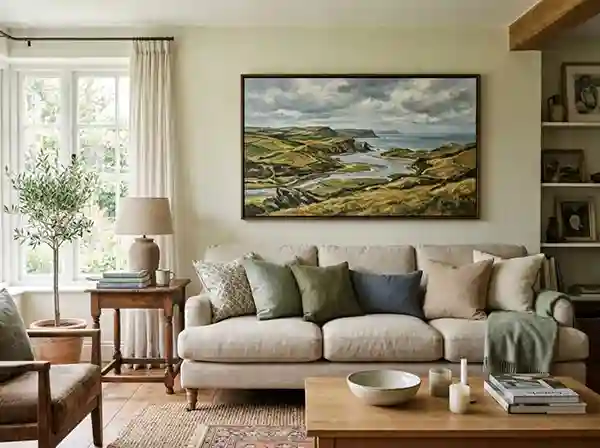
A horizontal oil landscape sitting at eye level above the sofa shapes the living room’s visual composition and sets the color palette for the entire space
A painting feels different depending on what it shows, how big it looks, and where your eyes meet it while moving around.
Begin by thinking about what happens in the room, rather than which walls are free. Location ties closely to activity; size shifts perception; sightlines shape experience.
Living Room: The Statement Wall
The living room is where large-format oil paintings work best. For a standard sofa – 7 to 8 feet wide – a painting should be at least 36 inches wide. A 48- to 60-inch-wide piece is better.
The usual frame height places the painting’s center at 57 to 60 inches above the floor, which sets it at eye level for a standing adult and keeps it within a natural viewing distance from a seated position.
Landscape, abstract, and symbolic subjects all work here. The rule is simpler than most people expect: the surrounding decor needs to stay quiet.
In case the room has loud patterns in the rug, the curtains, or the upholstery, a bold painting gets lost in the visual clash. Pull one standout color from the painting and repeat it in a cushion or throw – that’s enough to tie the piece to the room without hyping it.
Bedroom: Calm Over Drama
Bedrooms ask for a smaller scale and more comfortable designs. High-contrast visual work or dark, busy frames affect the brain in ways that can cause problems with sleep. Florals, soft landscapes, and understated abstract pieces are better choices.
A painting set above the headboard works, but so does a smaller piece hung at eye level beside a window or above a bedside table.
Don’t feel an urge to fill the wall. In a bedroom, a single, but effective painting at the right scale does more than a set of smaller pieces.
Dining Room and Entryway: First and Lasting Impressions
Dining rooms benefit from one mid-size painting on the front wall – the one you face when seated at the head of the table. A piece that needs a second look works well here, since guests spend extra time in that room.
Figurative work and architectural subjects tend to grab attention better than abstract pieces in dining settings.
Entryways have different rules. The space is usually narrow, and the viewing distance is short. Vertical formats work better than wide horizontal pieces.
A painting in an entryway sets the tone for the entire home, so subject matter matters – something that defines character rather than just filling space.
Home Office and Hallways
In a home office, the goal is something that unites the room without asking for a focus during work. Landscapes and drawings in cooler, neutral tones work well. Avoid busy visual scenes or highly complex color variations directly in the line of sight when you’re working.
Hallways work best with a sequence of smaller paintings in a consistent frame style, hung at eye level. Before hanging anything, it’s worth addressing the wall surface itself – take a look at common wall painting mistakes to avoid before you start, since the color behind a painting affects how it reads more than most people realize.
Getting the Scale and Framing Right

Directional picture lighting at a 30-degree angle brings out the oil medium’s characteristic surface sheen and makes brushwork visible from across the room
A common mistake people make is buying art that’s too small for the wall. A painting should use between 57% and 75% of the wall width above a piece of furniture. Below that range, the piece looks like an add-on. Above it starts to feel dense – though that’s a less common problem.
Frame choice comes down to interior style. Ornate gilt frames suit traditional and transitional rooms. Simple wood or thin metal frames work for modern spaces.
Floating frames – where the canvas sits with a visible gap inside the frame – read as modern and clean. The frame shouldn’t compete with the painting, but it also shouldn’t go away entirely.
For lighting, directional picture lights or adaptable track lighting aimed at a 30-degree angle from the wall surface bring out the sheen that makes oil paint so unique.
Avoid direct sunlight. UV exposure yellows the varnish over time and fades certain pigments – curtains or UV-filtering glass help in rooms with south or west-facing windows.
Caring for Your Oil Painting at Home
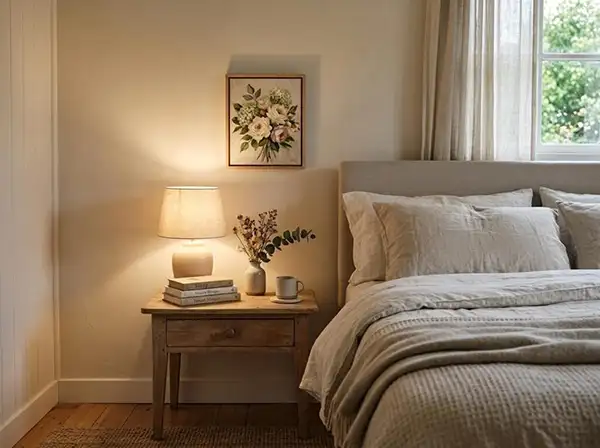
Smaller oil paintings are well suited to bedrooms – a floral or nature study at this scale adds warmth without disrupting the room’s restful atmosphere
Oil paintings are more durable than most people assume, but they do need basic attention. Dust the surface lightly with a dry, soft-bristled brush when needed – never a damp cloth and never any cleaning product. Most surface dirt on an oil painting comes off during professional cleaning, unlike day-to-day repair.
Keep paintings away from humidity shifts. Kitchens can work if the ventilation is good. Bathrooms require more thought – a climate-controlled bathroom with proper ventilation can work.
And if you’re redesigning that space, bathroom remodeling ideas that elevate your space include ventilation features worth reviewing. A bathroom with condensation problems will damage the canvas over time, so either fix the ventilation or choose a different room.
Professional re-varnishing every 5 to 10 years restores the surface clarity and shielding layer. For original paintings valued at $500 or more, check whether your homeowner’s insurance covers scheduled personal property – some policies do not include artwork unless it’s listed separately. A quick call to your agent is worth the five minutes.
Making Your Walls Work Harder
At the end of the day, adding more decor is not a way to build great interiors – they are set up with better decisions. A single well-placed oil painting can be much more effective than many pieces when hung smartly.
This can be done by scaling right, having a strong purpose behind things and allowing painting to merge. This will not require every wall to have a painting; instead, just one wall with it will count as four.
To get started, begin with one piece and see the difference.
FAQs
What is a smart way to choose the right size of painting for my wall?
Is it necessary to add lighting to them?
No, it’s not necessary. But yes, it definitely adds more weight to the painting.
Can we hang art in small spaces, too?
Yes, but some strategies, such as small works in narrow lines, make it more impactful and attractive.
Related Posts