Even if a dresser is short, a mirror will add a lot of height. So decide based on your wall height, preference, and available space.

How to Choose the Right Dresser for Your Bedroom
The bedroom is the most important space in the house. It’s not a home without a bed. And so everything in it is also a big deal and should be thought out nicely for our comfort. A dresser is one of the largest pieces of furniture in many bedrooms; it will affect the look and the feel of the room. If it’s too big, it looks out of place; if it’s too small, it looks awkward. Size, space, design, and functionality. There are so many things to consider. There has to be a middle ground in this.
How do we choose a dresser that fits the whole bedroom and enhances it. We do that space planning. Use this blog to learn how to pick the right dresser.
Table of Contents:
Measure the Bedroom as a Whole
Do not measure only the empty wall. Record the area of the bed, closet doors, windows, heating vents, outlets, and the main walking paths through the room. Then imagine how far drawers will go when fully open.
A dresser may fit nicely against a wall but still block the route to the closet once a drawer is pulled out. This is very common in narrow rooms where the bed and storage sit opposite each other.
Painter’s tape can help imagine the footprint before buying. Mark the width and depth on the floor, then walk through the room and open nearby doors. This simple exercise often finds issues that are difficult to understand from a floor plan alone.
The choice between a low dresser and a tall chest starts with the available wall.
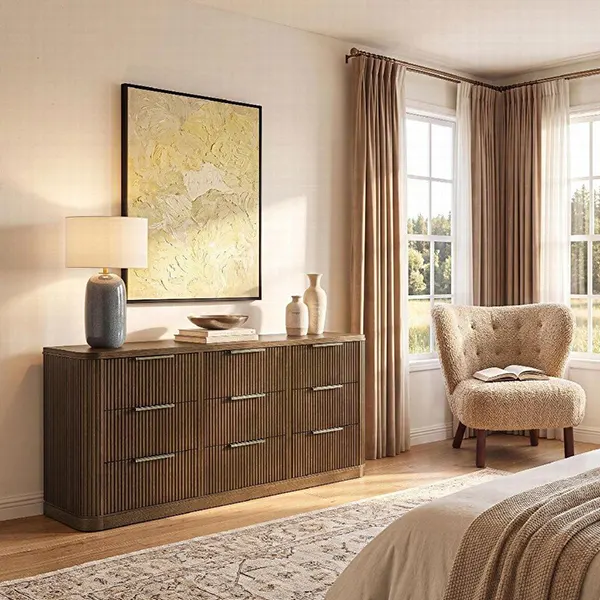
A low, wide dresser gives a broad surface and can visually stretch the room horizontally. It usually works well under a mirror, artwork, or television. Because the drawers are spread across the width, clothing categories can be separated easily.
A tall chest uses less floor area and may be better for a small bedroom, but it adds more vertical mass. It can also place upper drawers out of comfortable reach for some users.
The right choice depends on wall width and storage volume. In many renovation projects, it is helpful to select the bed first and then choose storage that balances its scale rather than competing with it.
Plan Drawer Space Around Real Clothing
Drawer count alone does not tell the full story. Shallow drawers are good for accessories, underwear, and smaller items. Deep drawers can hold sweaters, jeans, or bulkier clothing but may become messy if they are packed.
Think about how clothing is now stored and what usually ends up without a proper place. If the closet already handles hanging clothes well, the dresser may need to focus on folded items. If closet space is limited, deeper storage can be more useful.
Some people like many smaller drawers for organization, while others pick fewer large drawers. The best layout is the one that fits the existing habits rather than forcing a new system.
Storage decisions belong in the renovation plan earlier than many people expect.
When a bedroom is being renovated, furniture dimensions should be thought out before electrical and wall decisions are finalized. Outlet placement, wall lighting, television mounting, and even trim details can affect where storage furniture can sit.
A clear furniture plan can stop an outlet from ending up directly behind a drawer unit or a wall sconce from being centered in the wrong place. If built-in wardrobes are part of the renovation, decide how much clothing storage they will provide before choosing freestanding pieces.
Thinking about dressers early in the design process can reduce repetition. There is little value in installing extensive built-ins and then adding a large dresser that the room no longer needs.
Pay Attention to Drawer Clearance
Drawer clearance is easy to miss because product dimensions usually define the furniture when closed. In reality, the room needs enough space for a person to stand in front of an open drawer and move comfortably.
This matters most when the dresser faces the bed. Measure the distance between the two pieces, subtract the drawer extension, and think about whether the remaining space feels usable.
If clearance is tight, a shallower dresser or a taller structure may be more practical. Sliding closet doors and carefully placed furniture can also help lower conflicts in compact bedrooms.
Materials should be considered for everyday use as much as looks.
The dresser surface may hold jewelry trays, lamps, framed photos, perfume, books, or a television, so the finish should suit daily contact. Natural wood has warmth and variation. Painted finishes can create a crisp, contemporary look. Textured fronts can add depth without needing bold color.
Durability matters around drawers and handles because those areas are touched all the time. Hardware should feel secure, drawers should move smoothly, and the structure should feel stable when opened.
For a bedroom renovation, it is also useful to compare the furniture material with flooring and built-in cabinetry. The pieces do not need to match precisely, but they should feel planned together.
The top surface works best when it has a clear purpose.
A wide dresser can become a clutter magnet if the surface has no clear goal. Decide what needs to stay there and give those items specific areas.
A tray can organize small objects. A lamp can add useful ambient light. A mirror can make dressing easier and reflect light around the room. Artwork may be better if the dresser already has enough useful items on top.
Leaving some empty surface makes the room feel calmer and keeps the furniture easier to clean. In design terms, negative space can be just as important as decoration.
Balance the Dresser With the Bed
The bed is usually the visual center of a bedroom, so big storage furniture should support rather than compete with it. If the bed has a tall upholstered headboard, a lower dresser may create balance. If the bed is minimal, a taller storage piece may be easier to adjust.
Color and material can connect the furniture without creating a matching set. Reusing a wood tone, metal finish, or simple shape is often enough to make the room feel coordinated.
Avoid filling every wall with large furniture. A bedroom feels more restful when there is some open space between major pieces.
Safety and stability deserve a practical check before the room is completed.
Tall or heavily loaded furniture should be installed according to the manufacturer’s safety instructions. In homes with children, tip-over prevention is quite important. Wall anchoring may be recommended or required for certain designs.
Renters or homeowners worried about wall attachment should check the installation requirements before purchase. A stable piece placed on a level floor is vital, but stability measures should never be skipped simply to avoid a small installation step.
Drawers should also open and close smoothly without extra force. Furniture that rocks, binds, or feels unstable should be addressed before regular use.
Think About Long-Term Flexibility
The bedroom needs change. A guest room may become a child’s room, a primary bedroom may be renovated, or a future home may have a very different design. Furniture with balanced proportions and useful drawer sizes is easier to repurpose.
A low dresser can sometimes work as storage in a hallway, office, or living area. A tall chest may fit into a smaller future bedroom. Neutral materials can adapt to new wall colors and bedding more easily than highly specific finishes.
The goal is not to avoid personality, but to choose a piece whose function stays useful even as the room evolves.
Make the Decision From the Floor Plan, Not the Product Photo
Product photography can make furniture look smaller, taller, or more spacious than it will feel at home. The final decision should come back to measured dimensions and the floor plan.
Confirm wall width, floor depth, drawer clearance, and the relationship to the bed. Then consider storage, construction, and finish. When those practical questions are done, style becomes much easier to judge.
The right dresser can make a bedroom renovation feel complete because it joins storage with the overall layout. By treating it as part of the room plan rather than an isolated purchase, homeowners can create a bedroom that is easier to organize, more comfortable to move through, and visually calmer for years to come.
Frequently Asked Questions
1-What is a good height for a dresser with a mirror?
2-Is it better to buy a dresser and mirror set?
Matching sets guarantee style consistency and often a better fit, but separate purchases allow more customization. Whichever you choose, do it with a plan.
3-Are soft close runners worth paying extra for?
In a bedroom, usually yes. They stop drawers from slamming, reduce wear on the carcass, and make early mornings considerably quieter.
Related Posts