What Is a Townhouse? A Guide for Future Homeowners
If you are looking for your next home, you may have encountered the term townhouse. Many new buyers wonder what a townhouse is and how it is different from a detached house, condo, or apartment. Knowing the answers will help you decide your property choice, leading to a more rewarding homeownership experience.
At Champions Real Estate, we often assist homebuyers in making their purchasing decision by showing them all types of residences available on the market, including townhouses, detached houses, and condo-like houses. This guide will provide you with a complete understanding of what is a townhouse and a few that might suit your needs or preferences.
- What Is a Townhouse?
- What Does a Typical Townhouse Look Like?
- How Does a Townhouse Work?
- What Is the Difference Between a Townhouse and a House?
- Townhouse vs. Condo: What Is the Difference?
- Types of Townhouses
- Advantages of Living in a Townhouse
- Disadvantages of Living in a Townhouse
- How Much Does a Townhouse Cost?
- What Are HOA Fees in a Townhouse?
- Are Townhouses Good for Families?
- Are Townhouses a Good Investment?
- What Should You Check Before Buying a Townhouse?
- Is a Townhouse Right for You?
- Final Word
What Is a Townhouse?
A townhouse is defined as a multi-story residential establishment sharing at least one wall with other buildings in the neighborhood but having its own entrance.
The word townhouse designates a residence for a household, in many cases owned by that household though often built in an attached fashion. Originally, the term referred to the residences of wealthy families living close together in the city. Some common features of townhomes:
Layout of Townhouse
A townhouse has a standard vertical layout, featuring a ground floor with the main entrance, living room, dining room, and kitchen, an upper floor that houses bedrooms and bathrooms
Main floor only, but in some cases, a basement is present
Shared Walls
Townhouses are characterized by the presence of walls adjoining them with other houses in the same row. These side walls provide connection between a house and neighboring units.
Individual Entrance:
Townhouses, though joined with other houses by walls, have a private entrance for their use. Access to a house is done through an external point on the street or the sidewalk and the approach does not go via shared entryways.
Multi-Storey Buildings
As a rule, townhouses have two or more levels, which is another important distinction from many condominiums and apartments. What is a townhouse becomes clearer through this multi-level design. It has separate living areas and sleeping areas, separate bathrooms, and so on, making it more appealing for families, home office employees, and potential buyers, as it ensures living space without having to buy a big house.
Limited private outdoor spaces
Although townhouses do not have an extensive backyard like some other homes, they usually provide a small area for the private outdoor activities of their owners, so there can be:
a backyard fenced on all sides, a platform for sitting outside, a balcony on the upper floor, a terrace on the roof of the building, a garage or a parking lot, open and covered
Townhouse Arrangements in Planned Communities
Townhouses are mostly arranged in rows or blocks, as seen in many planned communities. A row of townhouses is based on the principle that one townhouse is attached to the next one, forming a chain of attached houses. End units, being in the row of townhouses, share one wall only with the neighboring house, while middle units share two walls.
What Does a Typical Townhouse Look Like?
A townhouse combines the feeling of living in a single-unit house with the spaciousness and efficiency of attached houses. Understanding what is a townhouse can help explain these unique characteristics. The architectural style of townhouses may depend on the region and the builder, but this kind of dwelling has its own distinguishing characteristics.
Exterior Features
Townhouses normally consist of a series of houses which have been built in almost the same style. They have identical heights, roofs, and materials.
Some Common Exterior Features of townhouse developments are:
- Row-type construction, meaning the homes are placed side-by-side
- Side walls are shared with adjoining residential units
- Each house has its own entrance and a small front porch
- There is uniform roofing and architecture in the whole community
- There can be a small backyard, patio, or a balcony
- Some houses will have a garage
- There is a driveway or designated parking area
- The landscaping varies from simple to elegant
Common interior features
Common interior features of a typical townhouse include the following:
- The living room is placed on the first floor
- The kitchen-dining area usually has an open-concept design
- Bedrooms are located on higher floors
- Many bathrooms, which may include a guest half bath and one or more full-size bathrooms
- There is a staircase connecting all floors
- Enhanced Storage Capacity, such as closets, pantry, linen cabinets, etc.
- Some designs will have a laundry room
- There can also be a basement
- Most new developments have attached garages with access to the indoors
In terms of design, there can be differences in townhouses that depend on the site, developer, plot size, and design of the buildings. When considering what is a townhouse, some additional characteristics may be found in some areas, like a rooftop terrace, a wider garage, etc.
How Does a Townhouse Work?
Once you know what a townhouse is, knowing its features will be helpful to you. A townhouse is a type of residential property that belongs to a unitary construction and is a part of the residential community. While being designed to meet the needs of individual residents, townhouses also have common features that connect the units to each other.
Key features of townhouse apartments
Private living space: The residents have exclusive access to the interior of their own living space, such as a kitchen, a bedroom, a bathroom, etc.
Common walls: The buildings of a townhouse type are connected to the neighboring houses via one or two walls, as they are legally separate buildings.
Common areas: Many residential developments also offer public areas, which can be parks, playgrounds, and parking lots.
Homeowners associations (HOAs): Together with other residents, homeowners are also members of HOAs formed to manage the common property of the area, collect fees for the use of the common property, and ensure its upkeep.
Responsibilities of maintenance: The common area maintenance is usually taken care of by the association. However, homeowners deal with repairs within their units. In a townhouse community, Homeowners Associations set strict rules for your community such as the colors of paint used on outside walls, allowed noise levels, kind of pets you can keep, trash placement, parking and fencing.
Parking: The types of parking arrangement vary based on the design of the community and may include garages, parking lots, or open guest lots for residents.
Landscaping: Most common areas such as gardens and lawns are maintained by the HOA, which lets homeowners take one other point to worry about since all the work is done by the corporation that expects them to pay for all the services.
In simple words, a townhouse unites the concept of property ownership with HOA functions, which implies the division of responsibilities between the homeowner and the Homeowners Association of the community. This is an important part of understanding what is a townhouse, as it explains how ownership and community responsibilities work together.
What Is the Difference Between a Townhouse and a House?
Townhouses can be defined as a form of residential property that is different than the detached house. The major differences between a townhouse and a detached house stem from the nature of construction, level of privacy, maintenance responsibilities, and ownership experience. All of the stated differences can aid people in obtaining whatever option they would like the most in accordance with their needs and budget.
The following table illustrates the differences between a townhouse and a detached house through comparison.
| Feature | Townhouse | Detached house |
| Construction Type | Construction of a townhouse involves connecting the structure to the neighboring units. | Standalone houses provide for a higher privacy level. |
| Privacy level | Townhouses provide for a moderate level of privacy, with limited noise that may reach the areas of the property | Standalone houses provide for a higher privacy level. |
| Size of lot | Townhouses are constructed on smaller land plots | Standalone houses provide for a higher privacy level. |
| Maintenance Responsibility | Exterior maintenance is performed by HOA | Both exterior and interior maintenance is done by the owner. |
| Outdoor Space | In a townhouse, there is often a small yard, patio, balcony, or terrace, | detached house typically has bigger front and back yards with more outdoor area |
| Parking: | There’s often a garage or a driveway | owns a private garage and driveway, |
| Cost: | It is affordable in the same locality | Expensive, because the land is bigger, providing more privacy |
| HOA | HOA has a big role in the lives of the townhouse dwellers | There’s no HOA |
| Customization Options: | May have limited chances to change the exterior of the townhouse | Owner can customise as per their choice |
A townhouse is ideal if you’re looking for a property with lower maintenance, a smaller lot, and often a lower price. Knowing what is a townhouse can make it easier to compare this option with other types of homes. In contrast, a detached single-family dwelling is a better choice if privacy and spacious outdoor access are the highest priorities.
Townhouse vs. Condo: What Is the Difference?
Townhouse apartments and condos may look alike on the outside, but the real difference lies in ownership and maintenance. Have a look at the key differences.
| Feature | Townhouse | Condo |
| Ownership type | The buyer owns the interior, exterior, and the land underneath the building | The buyer gets the interior; exterior and common areas with the other condo owners. |
| Common Walls | Have shared walls with one or two neighboring houses | Must share walls, floors, ceilings, and other common areas with other owners. |
| Separate entrances | Has its own entrance. | Common entrance, lobby, hallway, and staircase |
| Open space | Has a garage, small yard, balcony, and terrace | No or just one small private walking space in the condominium. |
| Maintenance Responsibility | Owners have to maintain the outside of the house | Management company takes care of exterior and other common areas. |
| Fees Charged by HOA | Generally, mild and focused on amenities and exterior upkeep | HOA fees are higher due to more services and building maintenance coverings |
| Interior vs. exterior responsibility | Interior is the owner’s responsibility, while depending on the community, exterior responsibility may also be shared with the HOA. | Interior belongs to the owner, while the association usually maintains exterior walls, rooftops, and common areas. |
| Privacy Level | Usually offers more privacy and fewer communal spaces | Generally provides sharing of spaces and being closer to other residents. |
| Typical layout | A multi-story house with living spaces on the first floor and sleeping spaces on the upper floor | An apartment-style layout, but multi-story apartments also exist. |
Townhouses are more comparable to attached homes in that they usually have some outdoor space, multiple floors, and a private entrance. On the other hand, condos resemble apartments in terms of ownership regarding maintenance, such as outdoor upkeep of the shared areas.
Types of Townhouses
There are various types of townhouses, each offering different layouts, levels of privacy, and architectural looks. Below are some of the most common types of townhomes.
Traditional Townhouse
It is a classically structured attached house, presented in rows, that features two or three stories, with separate entrances but shared party walls between the houses.
End Townhome:
House corners provide an opportunity for more light in the house since they typically share only one wall.
Attached House:
Attached houses share a similar design that forms a continuous series of buildings. It is often suitable for larger urban areas and bears similarity to townhouses.
New Townhomes:
Contemporary houses feature modern design, with open floor plans, large windows, and innovative construction materials.
Advantages of Living in a Townhouse
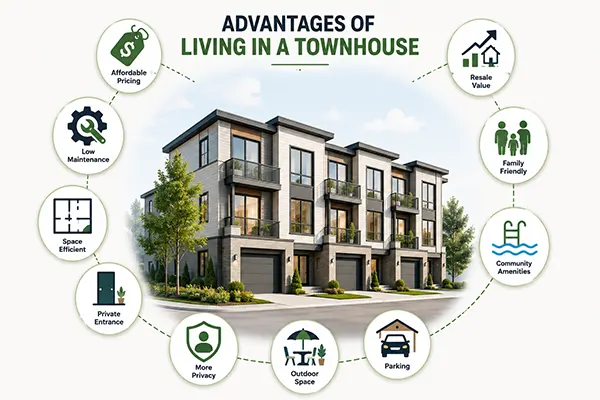
Some benefits of townhomes are given below
- Affordable pricing: Townhomes have a lower prices as compared to stand-alone houses built in surrounding areas.
- Comparatively lower maintenance work: Most maintenance chores will be taken care of by HOAs.
- Well-utilized: Multi-floor arrangement allows for utilizing the space better on a small lot.
- Separate Private entrance: Townhome residents will have a personal entrance to their home without having to share hallway with others.
- Enhanced privacy compared to a flat: Townhomes usually share just one wall with another house.
- Small outdoor area: Patios, balconies, or small yards provide outdoor living with easy maintenance.
- Parking Availability: Most townhouses come with a garage, driveway, or designated parking space.
- Joint facilities: Some residential areas have parks, swimming pools, paths, or fitness centers.
- Perfect for first-time buyers: They balance affordability with ownership.
- Enhanced resale value: Townhouses are in high demand among families, employees, and retirees.
Disadvantages of Living in a Townhouse
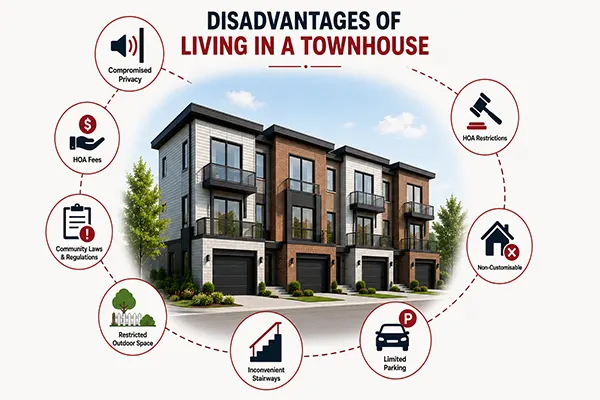
Here are some drawbacks too, mentioned below
- Compromised privacy: Noise can travel through neighboring homes’ walls.
- Fees charged by HOA: Regular fees can increase housing expenses.
- Community laws & regulations: HOA may limit properties’ exterior changes, parking rules, pet ownership, or even decoration.
- Restricted outdoor space: Yards tend to be smaller than in regular single-family homes.
- Possibly inconvenient stairways: The multiple floors can cause difficulty for small kids, older people, or those with disabilities.
- Parking Availability: The community may limit parking possibilities for the neighbors.
- Non-customisable: Significant changes in the façade typically need HOA permission.
How Much Does a Townhouse Cost?
The price of a townhouse can differ greatly from one locality to the other, which means that there are no universally accepted prices across nations. When you know what is a townhouse, it becomes easier to understand why prices vary by location. A townhouse in a big city may cost a lot more than a similar-sized property in a smaller neighborhood or any rural area.
Factors influencing the price of a townhouse
- Location: Houses located in big cities, areas with great demand, good schools, or areas with a booming economy are often more expensive.
- Square footage: Bigger townhouses with more floor space tend to be more expensive.
- Number of bedrooms: Two-bedroom townhouses can often be less expensive than three- or four-bedroom homes.
- Age of the property: Newer townhouses usually command a higher price, while older houses can be cheaper but may need repairs and upgrades.
- Quality of construction: Use of high-quality materials, better insulation, renovations, and high-quality construction lead to higher renovations and prices as well.
- The amenities of the townhouses: If a townhouse has swimming pools, parks, fitness centers, or security features, it is usually considered to be expensive.
- HOA fees: The monthly charge for the homeowners association can differ a lot based on the services provided, including but not limited to maintenance of the exterior, landscaping, insurance, etc.
- Garage or parking: Owning a private garage/canopy parking space or having access to additional space for parking will increase the value of the property.
- Local real estate market: The processes of determining townhouse prices are influenced by supply and demand, interest rates, economic conditions, as well as housing inventory in the region.
When purchasing a townhouse, buyers must analyze the townhouse’s price and the total cost of ownership.
What Are HOA Fees in a Townhouse?
The HOA, which stands for Homeowners Association, is the body responsible for managing and maintaining the common parts of a townhouse community. A lot of townhouse developments have the presence of the HOA because the buildings are placed close to one another and there are common areas and exterior properties that need to be taken care of by the community.
Why Townhouse Communities Have HOAs
Townhouse communities have HOAs to ensure similar looks of houses, supervise shared property and other common items, assist with repair and maintenance, and ensure compliance with the rules.
Items Covered by HOA Fees
HOA fees usually cover expenses associated with
- Landscaping,
- Common space maintenance (common areas),
- Exterior building maintenance,
- Community facilities, and
- Shared spaces. In some townhouse communities.
HOA fees also include coverage for some shared spaces and/or exterior buildings. However, not all fees include the same amount of coverage, so buyers should verify the details in HOA agreements when considering what is a townhouse.
Are Townhouses Good for Families?
- Children and young families: Townhouses can make it possible to buy a home in a cost-effective manner and with less maintenance required.
- Couples: Townhouses consist of more than one bedroom and thus enable owners to stay comfortably.
- Professional individuals: Townhouses can be located in an urban area or be convenient in other ways.
- Extra bedrooms: Additional bedrooms provide a space for children, guests, home offices, or hobbies if necessary.
- Reduced exterior maintenance: Reduced exterior upkeep facilitates the reduction of home-maintenance work for homeowners because the HOA takes care of landscaping and other external maintenance.
Are Townhouses a Good Investment?
Yes, a townhouse can be a good investment. However, the possibility of making a profit relies on multiple factors, including location, rental demand, purchase price, HOA fees, other maintenance-related expenses, taxes, resale demand, and the overall situation on the housing market. For buyers asking what is a townhouse, understanding these investment factors is equally important. Hence, the fact that a property is located in a good place with a high rental demand and acceptable purchase and running costs may guarantee a reasonable profit, while high HOA charges, taxes, or maintenance expenditures would mean a loss.
Hence, it is necessary to assess expected rental income, as well as possible resale income, and not consider every townhouse an investment opportunity.
What Should You Check Before Buying a Townhouse?
Before deciding to purchase a townhouse, you must check the following important aspects:
- Property taxes of the area
- Number of shared walls
- Condition of the roof
- Proper plumbing
- HVAC system
- HOA fees charged to the owner
- HOA Regulations
- Electrical maintenance system
- Condition of windows and doors
- Parking Area
- Storage Capacity
- Future evaluation
- Property Reviews
- Resale value of the house
- House Insurance needs
- Amenities provided
Is a Townhouse Right for You?
If you wish to get a home providing you with more area and privacy than an apartment, but at the same time committing not too much time managing a detached house, then a townhouse may meet your expectations and help in becoming a homeowner. For those wondering what is a townhouse, this type of property can offer a practical balance of space, privacy, and convenience. However, even though a townhouse is likely to suit the needs of first-time buyers, casual couples, small families, and professionals, you need to remember about HOA fees, shared walls, the number of outdoor spaces available, and neighborhood regulations before making the final decision.
Final Word
There is a perfect combination of privacy, area, affordability, and low-maintenance living in the townhouse. With the help of private entrances and several floors, outdoor spaces, and community facilities, a townhouse can meet the needs of different people. However, it is necessary to know about HOA fees, maintenance obligations, the location of the townhouse, and future expenditures before anything else.
Related Posts