Fontana’s expanding logistics industry creates jobs, but high housing costs make homeownership difficult for workers earning typical warehouse wages.

How Fontana's Logistics Boom Is Pricing Out the Workers Who Run It
Handle utilities, property maintenance, and household logistics during relocation with Fontana, as it has become the logistics heart of Southern California. Goods arriving at the ports of Los Angeles and Long Beach pass through Fontana before moving across the country.
They form a part of a logistics pipeline worth billions of dollars each year. It also creates staggering truck traffic regardless of its self-cleaning street lamps, while this brings in a lot of money.
The proposed 1.1 million-square-foot Goodman Logistics Center Fontana III project alone was expected to generate 658 daily truck trips, as per a California Attorney General comment letter.
The Attorney General’s office also noted that warehouses in South Fontana collectively generate thousands of daily heavy-duty diesel truck trips.
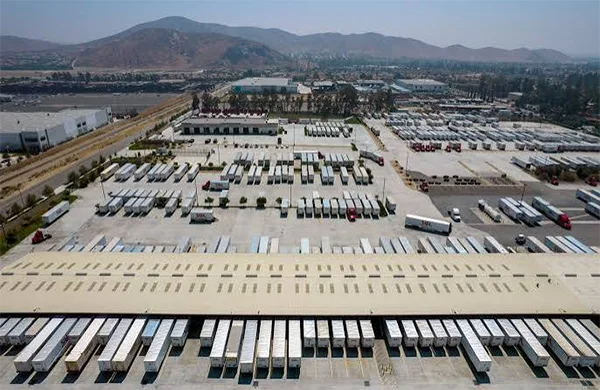
Table of Contents:
A City Built on Logistics, Earning Logistics Wages
Fontana has approved warehouses at a quick pace. Since 2010, the city has signed off on more than 70 of them across some 860 acres, according to CalMatters. This rapid expansion is part of a deliberate plan to change the city into an industrial hub.
Researchers at Pitzer College’s Robert Redford Conservancy estimate Fontana has nearly 122 million square feet of warehouse space. That places it as the second most warehouse-saturated city in the Inland Empire, behind only Ontario.
Logistics fills approximately 12,000 jobs in the city and pads the budget with tax revenue, which is why Mayor Acquanetta Warren has backed it for years. These jobs were supposed to support the community, but the situation is different.
Employment isn’t the issue. The pay is. ZipRecruiter’s 2026 data pegs the average California warehouse worker at $35,533 a year, about $17 an hour. The national median wage for hand laborers and material shippers, per the Bureau of Labor Statistics, is $37,680.
Those digits set the ceiling for what most Fontana households earn, and unfortunately, the housing market does not bend to meet them. In most neighborhoods, home prices have completely decoupled from what a local worker can really afford.
What a Warehouse Wage Can’t Buy in Fontana
The median sale cost of a Fontana home was $648,000 in September 2026, according to Houzeo, and sales closed at 100.2% of the asking price. Even at those prices, buyers still compete. Figures have slipped only 0.31% from a year earlier, but they stay high enough to shut out many households. A worker on the loading dock gets no help from that.
Run the numbers. A mover who earns $37,000 to $48,000 a year and puts 10% down on the median home would owe about $3,580 a month in principal and interest at the current 6.23% rate. That equals approximately 116% of gross pay at the low end and 90% at the high end, before taxes and insurance. Lenders want housing costs under 30%. That leaves the service providers who keep Fontana running with almost no path to ownership in the city.
Renting is also not an easy way out. According to the California Association of Realtors, only about 18% of households statewide can afford the median home price. That leaves most households priced out, and many of them rent. That requires landing in an Inland Empire rental market with little room to spare.
Fontana homes for sale spent a median of 61 days on the market in September. Providing buyers time to consider their options. Time alone has not bought a discount, though, because nearly 46% of homes sold above their list price. Figures have held steady, yet a warehouse paycheck still falls far short of the cost of entry. The housing market tells only part of Fontana’s story. Some of the logistics boom’s highest prices never appear in home prices.
The Hidden Cost of Fontana’s Logistics Boom
According to CalMatters, unhealthy AQI days in San Bernardino County rose from 15% of the year in 2019 to 20% in 2020. San Bernardino and Riverside are now among the five most ozone-polluted areas in the region.
A major cause is truck traffic. Thousands of trucks move through the region to serve warehouses, ports, and distribution centers. In South Fontana and nearby Bloomington, some homes and schools sit only a few hundred feet from big docks and truck routes.
That burden doesn’t fall at once. The UCLA Latino Policy and Politics Institute found that Latino neighborhoods face far more diesel pollution, raising the risk of asthma, lung cancer, and cardiac disease.
Latinos make up 42% of the Inland Empire workforce but approximately 62% of its warehouse workers, according to the UC report, State of the Unions: California Labor in 2024. That population inhales the worst of the exhaust. It’s also the population most likely to work the jobs creating that pollution.
Yet many of those same workers are shut out of the general housing market. According to Houzeo, the median sale price in Fontana was $648,000 in September 2026, down only 0.31% from a year earlier. A dip that small does little for service providers already stretched past what they can afford.
The Affordability Gap Inside Fontana’s Boom
The statewide median home price touched $899,720 in September 2026, per the California Association of Realtors. Next to that number, Fontana’s $648,000 median looks like a deal, but only for particular kinds of buyers.
Remote workers, dual-income professional households, and investors seeking Inland Empire appreciation are the ones landing these homes. They’re not competing with warehouse wages, so a tight market like Fontana’s really works in their favor.
Fontana curated its tax base and its identity around logistics, and the workers made that possible. What the city hasn’t built is a housing market that lets them stay close to those jobs. Until that shifts, the people powering Fontana’s boom will keep living outside it, watching the industry they built from farther away every year.
FAQs
Why are warehouse workers being priced out of Fontana?
How much does a home cost in Fontana?
The median sale price of a Fontana home was $648,000 in September 2026. That puts homeownership beyond the reach of many warehouse workers.
How does Fontana’s warehouse growth affect local communities?
Warehouse expansion brings employment and tax revenue, but increased truck traffic also contributes to diesel pollution and poor air quality that is hazardous for nearby people.
Related Posts