Ans: Land development is the process of building useful infrastructure out of raw, unprocessed land.

The Land Development Process, Its Stages, Costs & Other Key Factors!
Land development is an inevitable need for a higher GDP and a constant rise in a country’s production level. People need better roads and highways to reach offices and contribute to economic activities. And, not just that, the availability of better homes also requires quality infrastructure. All of it makes this progressive development a prerequisite to a higher quality of life. To learn more about this progressive construction activity, follow along the sections provided below.
Table of Contents:
- What is Land Development?
- Why is Land Development Important?
- Types of Land Development
- Step-by-Step Land Development Process
- Land Development Checklist
- Key Factors that Affect Land Development
- Land Development Cost Factors
- Common Challenges in Land Development
- Land Development for Commercial vs Residential Projects
- Conclusion
- FAQs
What is Land Development?
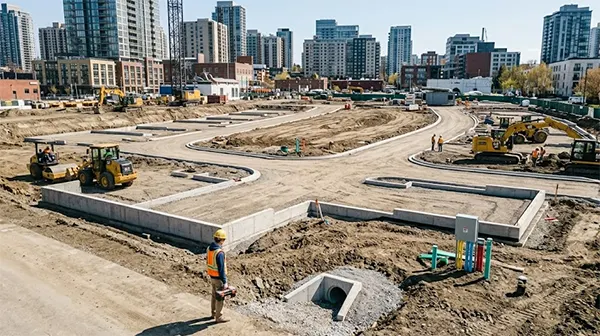
Land development is a highly human thing. It marks one of the key pillars of modern civilization. In the simplest terms, this is a process of using a raw piece of land and turning it into something more useful. It is known as a procedure of altering the landscape so that it suits a particular community better.
The changes to raw land are made as per various residential, commercial, or industrial needs. The better GDP and a raised standard of living are among the biggest advantages of such land development. Shopping centers, office buildings, industrial parks, roads, bridges, private properties from residential construction, and public infrastructure are all part of this gradual process.
Why is Land Development Important?
The major reasons why the land development process is important are elaborated below. In short, they include increased property value, diversification, community impact, constant appreciation, income generation, safety, accessibility, and infrastructure readiness.
- Increased property value: Highly developed areas automatically increase the prices of the property within. A house in a well-planned region with all the facilities, nearby, such as roads, schools, hospitals, etc., inevitably costs much more than a dwelling or shop in an underdeveloped remote area. And that holds true for all types of houses and other properties.
- Diversification: Land development helps big investors diversify their portfolios. They can invest their standing funds in land building and its modernization. And, avail of the steady streams of passive income from rentals and sales.
- Community impact: This construction process on a raw piece of land holds great economic value. New jobs get created. Expenditure and income, as a result, increase, leading to a high production level. Ultimately, the quality of life enhances.
- Constant appreciation: It is not that the properties in the developed areas are only going to see a one-time boost in value. Rather, there is more to the process. A one-time development in a region leads to a constant rise in the property value over time. That is where the multiplying effects of economic development set in.
- Income generation: For all the commercial project owners, the process of land modernization brings an impressive prospect of passive income. Such properties can include malls, shopping centers, educational institutions, hospitals, etc.
- Safety: Another important aspect of this process is safety. Well-developed areas with better roads and connectivity promote security with fewer accident chances.
- Accessibility: Capable transit systems connect communities with all the essential facilities of life in the modern world.
- Infrastructure readiness: A country, whether nationally or locally, depends a great deal on the strength and robustness of its infrastructure. That is why land construction planning is done in the first place.
Types of Land Development
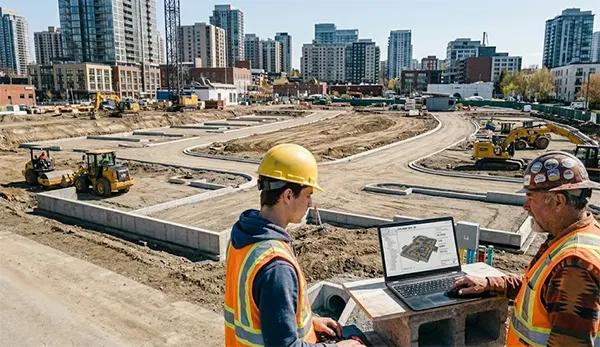
The major types of site development are residential, commercial, and industrial constructions. These are the three major pillars of land development. Consider a brief elaboration on each point in the following sections.
1. Residential Land Development
This category of land building includes the construction of homes, apartments, and other varieties of housing on land. Some of the major examples here are developing housing plots, apartments, and townships.
- Housing plots: These are vacant lots upon which living units are built for modern-day accommodation. Majorly, this type of residential construction includes Tudor style house, rambler houses, split level houses, and even tiny dwelling structures.
- Apartments: These are bigger residential structures than those built on most housing plots. This building accommodates many families at once. Such units can be private or public, also famously known as condos among buyers. However, this living arrangement often faces various types of conflicts. The Todd Creek Farms Homeowners Association Lawsuit is one of the most relevant examples of the same.
- Townships: The modernization of a township is largely carried out as part of a bigger county integrated development plan. The development of such smaller units ensures both infrastructural readiness and economic well-being of locals, and then the entire county!
Houseura advice: If you are an investor, make sure you know the difference between a condo vs townhouse very well. That will help you calculate your ROI better.
2. Commercial Land Development
It involves the construction of offices, shopping centers, big malls, hospitals, and other commercial properties. Consider the key components of this upliftment below.
- Office buildings: These are the sitting places where most of the business operations take place. It is often the hub of digital control for a business’s key activities.
- Retail spaces: Such are the spaces where people often go to buy a variety of things. The expenditure promotes income generation, strengthening the economy and its key stakeholders.
- Warehouses: This is a crucial part of a region’s logistics system. A warehouse is where most goods are stored before being distributed to various wholesale or even direct retail shops.
3. Industrial Land Development
The land development process here involves the creation of habitable factories, accessible logistics parks, and robust manufacturing units. Most such buildings are planned with the techniques of ICF construction for better energy efficiency.
- Factories: The labor class is at the base of all economic activities. Without them, manual work cannot be imagined. That is why better factory buildings are always part of all types of economic development.
- Logistics parks: These are bigger units of many warehouses in a collection. Multinational product companies often rely on the robustness of this large storehouse network. This is a prerequisite to seamless international economic activities.
- Manufacturing units: Industrial development also includes the construction of production units. Heavy machinery and highly skilled human beings both need a conducive environment to achieve productivity.
Do you know?
Land development is also a crucial step towards empowering the disaster management crew. That is because the construction makes infrastructure readiness possible, which is an essential aspect of connectivity in civilized societies.
Also Read: Construction Estimating in 2025: Get 100% Accuracy with Tried and Tested Methods!
Step-by-Step Land Development Process
The land development planning involves various stages. Major aspects of the process can be summarized into the following 6 steps.
- Land Survey and Site Analysis
- Zoning and Legal Approvals
- Site Planning and Design
- Clearing and Grading
- Infrastructure Installation
- Final Plot Preparation
The following sections touch upon each of these steps in brief.
1. Land Survey and Site Analysis
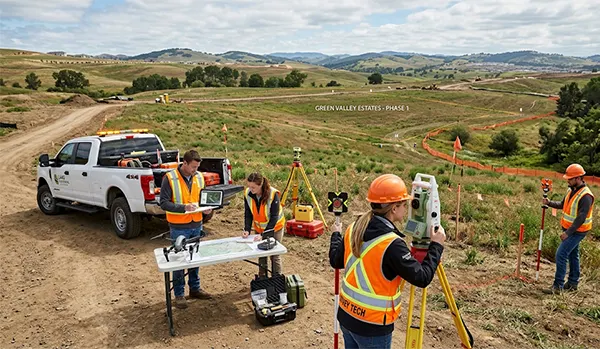
The first step demands a deep inspection of the land that is going to be developed. From a variety of perspectives, the land’s properties are analyzed. It usually involves soil testing and measuring boundaries initially.
Furthermore, topography is conducted carefully so that the size of the buildable envelope can be figured out. Next, it also ensures that no future construction harms any natural resources in the vicinity or underground.
2. Zoning and Legal Approvals
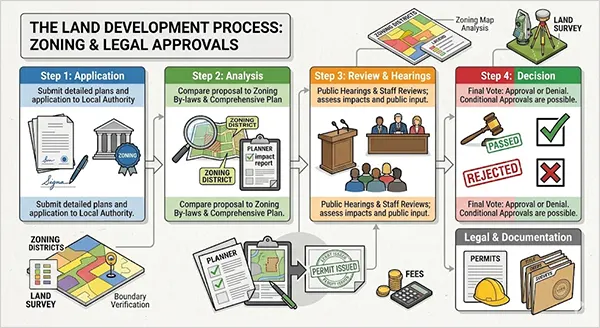
Once everything is perfect, the project manager must obtain a variety of approvals before construction begins. It is typically mandatory for compliance with the zoning laws of the country or region.
Local impositions differ from place to place. The contractor has to interact with local authorities to ensure that everything is legally approved.
3. Site Planning and Design
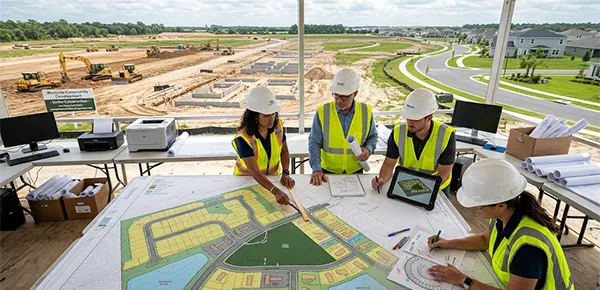
Legal permits might be a big hassle in some cases. But once that’s done, the next step involves site planning and design. Major layouts are mostly outlined on robust CAD software for ease of editing.
Apart from residential, commercial, and industrial units, roads, utility lines, & drainage elements are also designed meticulously. The complete structure is constructed virtually for real-time guidance during construction.
4. Clearing and Grading
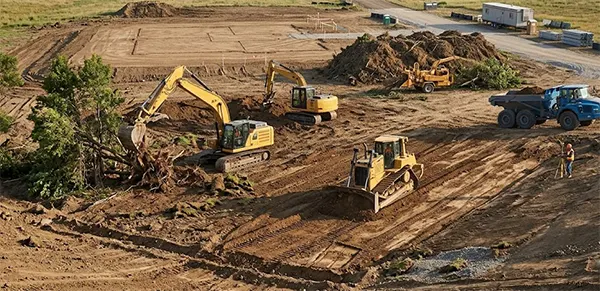
Raw land comes with many hurdles, such as large embedded boulders, uneven terrains, slopes, empty regions underneath, etc. Furthermore, there is also the overgrowth of unwanted vegetation.
So, after making construction plans, clearing and grading assume importance. It is the process where the raw land is manually or with machinery treated to suit the construction ahead better.
5. Infrastructure Installation
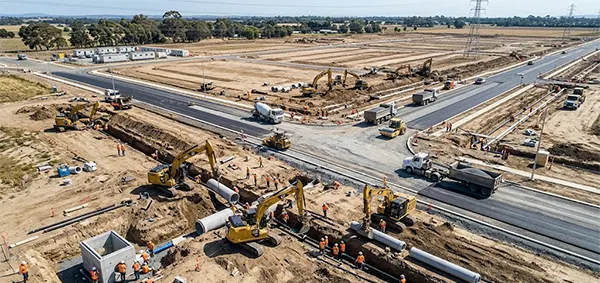
At this stage, all the key features such as water lines, sewer systems, electricity, road access, and internet or telecom lines are installed. Such utilities are inevitable for development during the project and even afterward.
6. Final Plot Preparation
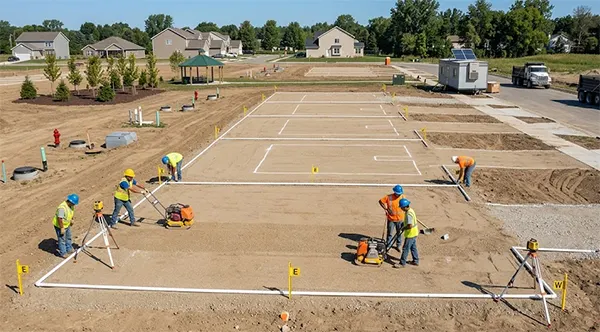
Finally, the raw land becomes fit for building foundations and vertical construction. The project manager checks the quality of the work from time to time. And, it helps ensure the outcomes match the intentions of the original plans.
Also Read: Construction Bidding: Learn Meaning, Stages, Elements, Types, and More!
Land Development Checklist
It mainly includes due diligence related to environmental assessment, legal compliance, proper infrastructural development, functional design & construction, and quality finishing. The commercial land development checklist, issued by NAHB, the National Association of Home Builders, is also very comprehensive.
- Environmental assessment: Make sure the piece of land you obtain is suitable for the project. Your assessment should include all the factors related to soil quality, vegetation, flood zones, and wildlife habitats without fail. Also, don’t forget to factor in natural disturbances such as earthquakes, floods, and wildfires. The project itself must also not pose negative consequences on the surroundings and local people.
- Legal compliance: If you start development without getting approved by government authorities, you might have to face a complete shutdown at any point later. Your project might not be in accordance with the local or national construction laws. There are specific zoning laws, building codes, and environmental regulations to deal with. Thus, don’t forget to ensure all legal compliance first.
- Proper infrastructural development: Pay sufficient attention to the proper set-up of essential utilities, i.e., roads, water & sewage systems, power points, etc. Without due consideration to these, your building activities will halt several times during the build.
- Functional design and construction: Once the infrastructure is in place, it is time to make construction plans and then start building. The project owner must connect with an experienced architect for a functional design. It will provide the best results if your designer is skilled at using advanced CAD software tools. 3D modeling and visualization are a must if you want accuracy. And, during the build, don’t forget to ensure the construction safety checklist as well.
- Quality finishing: Don’t forget to check major finishing essentials once the development is done. Coatings, installations, landscaping, and pavement must all be carried out precisely with care. You can also hire a qualified construction supervisor for that in case you don’t have time as a contractor.
Key Factors that Affect Land Development
The key factors that affect the various land development stages are related to land size and location primarily. Other elements include soil conditions, local regulations, and environmental restrictions. And, a bad transit system is also a thing.
- Land size: The bigger the raw land, the more time, money, skill, and resources it is going to consume for the development.
- Location: A region prone to natural disasters isn’t going to make fine raw land for modernistic civil development.
- Soil condition: Low-quality soil is a big no when it comes to land construction and modernization. For example, the ground that is too porous will give way in case of waterlogging.
- Local regulations: Your project is illegal if it doesn’t comply with the law.
- Environmental restrictions: You cannot develop a piece of land if it comes under no construction zone. Most of the time, authorities are particularly concerned to protect the flora and fauna of the region.
- Access roads: Site inaccessibility due to no proper transit system in place is the biggest cause of delays in the project.
The biggest construction companies in the US always analyze these factors in detail before working on land development projects.
Land Development Cost Factors
The major factors that affect the cost of residential land development or any other form of civil construction are provided below. It includes land clearing, permits, excavation, drainage, utility connections, and labor and machinery.
- Land clearing: A highly uneven, boulder-filled, vegetation-loaded piece of land would always require both clearing machines and laborers more desperately than a plain, already-clear land. It is the biggest factor that escalates the cost.
- Permits: If the site of development is near a protected wildlife area, your permit requirements will increase. That means extra fees for compliance-related hassles.
- Excavation: The presence of the large trees on land requires excavation. That helps ensure no regrowth later, but costs pile up inevitably.
- Drainage: The larger the drainage system required, the higher the project cost will be.
- Utility connections: The size of the project directly impacts the scale of the utility connections, such as water, gas pipelines, etc. The high utility demand means a higher cost of construction.
- Labor and machinery: The more manpower required for construction, the higher the budget it will require.
Sometimes, the land is very uneven and full of boulders and other impurities. Thus, the project manager has to use various types of construction vehicles during site preparation. And that escalates the cost significantly.
Common Challenges in Land Development
During land development stages, a project manager might have to face a variety of challenges. They can be related to
- Zoning laws
- Environmental concerns
- Topography & soil conditions
- Infrastructure & utility availability
- Community & stakeholder engagement
- Budget & cost management
- Project timeline & delays
Some common challenges under these labels are outlined below.
- Zoning laws: Local regulations might limit the building size that considerably alter the intended use of the raw land.
- Environmental concerns: Obtaining permits for environmental law compliance often causes delays. That is particularly applicable if you have happened to develop a piece of land near floodplains, wetlands, endangered species habitats, etc.
- Topography & soil conditions: A lot of rocks, unstable soils, and slopes are the major challenges under this category.
- Infrastructure & utility availability: Not having last-mile connectivity means a significant hike in the logistics costs. It creates another problem of talent unavailability.
- Community & stakeholder engagement: Sometimes, a land development project has to face community anger. That is often true when the development harms the communal interests. For example, cutting a section of forest can spur indigenous people into a massive protest.
- Budget & cost management: Unexpected expenditures from on-site accidents, delays, or new revelations about the land underneath lead to significant cost increases.
- Project timeline & delays: Take examples of supply chain disruptions. When that happens, the entire construction comes to a standstill. The situation even worsens in the case of poor management.
Land Development for Commercial vs Residential Projects
Consider a quick insight into which type of project is more demanding, out of the following two construction types.
| Land Development | ||
| Features | Commercial Projects | Residential Projects |
| Scale | Bigger | Smaller |
| Budget | Higher | Lower |
| Approvals required | More | Less |
| Infrastructure needs | Higher | Lower |
Also Read: General Conditions of Contract: Complete Guide with Meaning, Types & Examples
Conclusion
The land development process is one of the major sources of economic growth for a country. This process is not just long and tedious, but also requires high expertise and dedication. Various types of challenges are inevitable to crop up as discussed above. However, anticipating issues in advance and planning intensively is a panacea for most headaches during the actual development.
FAQs
Q. What is meant by land development?
Q. What are the 7 stages of real estate development?
Ans: The process involves land banking, land packaging, land development, building development, building operation, building renovation, and site redevelopment.
Q. What are the major types of land development?
Ans: Residential, commercial, and industrial construction projects are the three major types of land development.