Ans: The following are the 5 stages of construction.
- Site acquisition
- Envelope construction
- Essential system installation
- Personalized touches
- Finalization

Almost everyone has a dream of owning a perfect house to lead a comfortable life. Thus, if you have finally made up your mind and are ready to get your home constructed, it is the right place to be. Many people don’t know that every type of home-related project doesn’t come under the category of residential construction in the USA, but only the one that fulfills a certain height-related criterion.
There are other key considerations as well before initiating the development of your residence. So, to learn more, read along till the end.
| If we define residential construction according to the United States Department of Labor, it means any development in which the new construction, alteration, or repair of a single-family house or apartment building is involved. Adding to that, the existing or planned build mustn’t exceed the four-floors-in-height criterion. |
Elaborating on this definition of residential construction, three types of projects can fall under the category, namely, new construction, structural changes to the existing construction bathroom remodeling ideas, and repair to the damaged parts of the again existing construction. The only condition is that the property in question mustn’t be more than four floors in height.
Such development projects require tremendous hard work and expertise, thus requiring the involvement of a competent residential contractor.
According to the official statistics, jointly published by the U.S. Census Bureau and the U.S. Department of Housing and Urban Development, more than 1 million residential construction projects are completed each year, which is a huge number!
There are various reasons why constructing residential buildings is a crucial part of modern life. Without it, humankind cannot take advantage of the benefits, such as shelter & safety, quality of life, economic growth, financial investment, and community.
Consider the following elaborations.
Ultimately, the development of housing units leads to a better quality of life and also contributes to economic growth and individual income creation.
There are many professional individuals involved in the process of residential construction, namely owners, architects, engineers, residential contractors, and subcontractors. By their work nature, consider the following explanations. Together, they ensure that the residential construction service runs smoothly from planning and design to execution and final delivery while maintaining quality, safety, and compliance with building standards.
Out of these professionals, general contractors are the ones that owners usually contact to discuss their ideas and give them a concrete shape. Thus, if you have a residential project of any sort in mind, it is very important to get in touch with one of the biggest construction companies so that you get the quality, perfection, and accuracy in your construction.
The definition for residential construction is pretty simple, as it is any structure that is built for accommodation and comfortable living. There are several different types of residential buildings, named such as single-family homes, multi–family homes, townhomes, condominiums, modular homes, and tiny houses. Each of these concepts is elaborated in brief in the table below.
| S.No. | Residential Construction Types | Images | Features | Purpose |
| 1. | Single-Family Home | 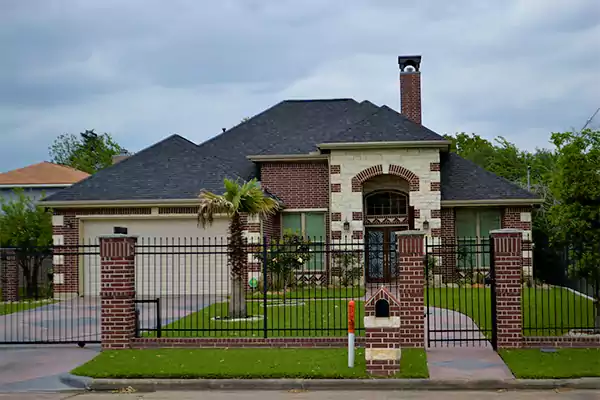 | – Freestanding structure – Designed for one family – Sitting on its own land – No shared walls | – For the use of one family |
| 2. | Multi-Family Home | 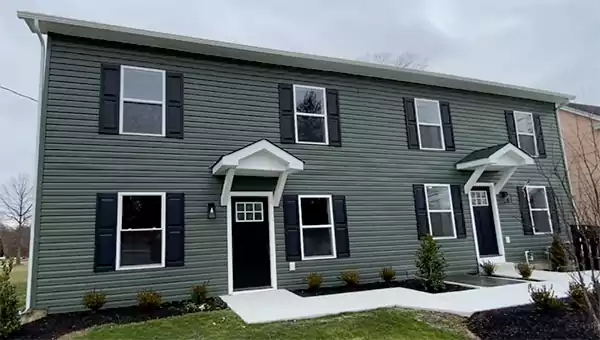 | – Building comprising two or more self-sufficient household (or living) units – All self-contained units under one roof | – For the use of more than one family – Can be built for rental purposes by a project owner |
| 3. | Town Home | 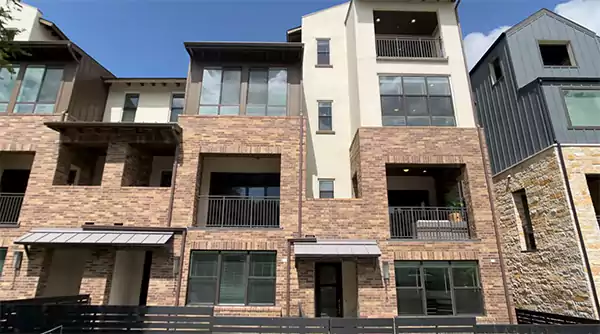 | – Multi-floor self-contained living unit – A line of several such units, attached on either side. – Either-side wall sharing – Featuring a private entrance | – For an individual or a single-family living |
| 4. | Condominium | 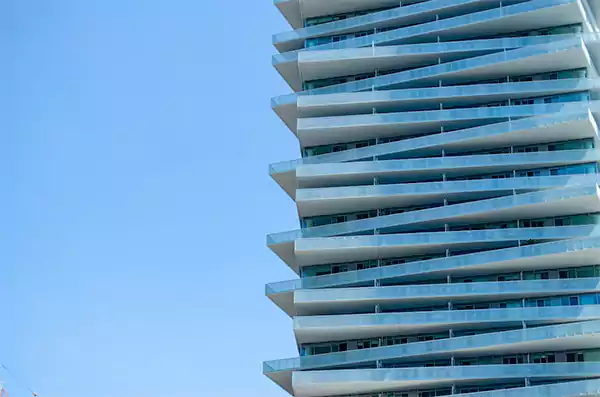 | – A multi-storey building with many individual household units, i.e., condos – Interior owned by the owner – Exterior belonging to everyone (shared spaces) and the Homeowners Association (HOA) | – For the purpose of mass accommodation |
| 5. | Modular Home | 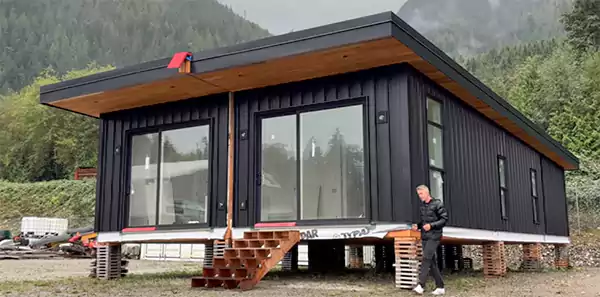 | – Manufactured in a factory in modules or sections – Assembled on-site – Often, small and simple structures | – For offering cost-effective housing solutions |
| 6. | Tiny House | 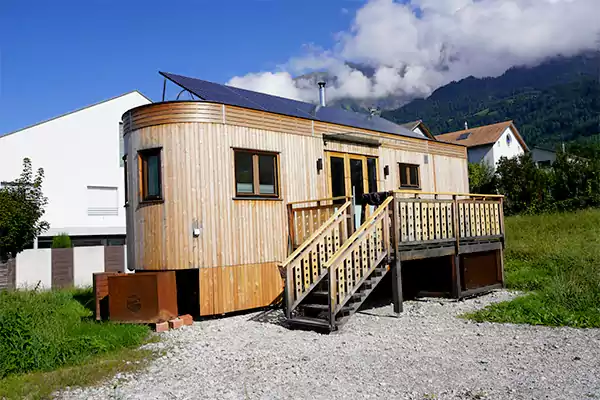 | – A 400-square-foot dwelling – Self-contained residential unit – Higher mobility – Tiny house costs less than large traditional homes | – For minimalistic living – For efficient use |
Many people consider multifamily and multi-story homes the same. However, there is a nuanced hint of difference between these two concepts. If the entire residential construction features more than one individual and complete household unit for big families to live separately but together, it is a multifamily home. Now, a multi-story building cannot always fit this criterion, because a single person can also create a several-floor house for single use.
Furthermore, new owners, not aware of the technical features, also often get confused between a condo and a townhouse. In that case, a deep comparative condo vs townhouse analysis is very crucial.
Ideally, there are 5 major steps that comprise the entire process of residential construction, namely, site acquisition and preparation, building the envelope, installing critical systems, adding design touches (or personalization), and the home stretch.
| Main Steps | Sub-Steps |
| Step 1: Finding, acquiring, and preparing the site | 1.1. Finding an ideal piece of land, either in the cheapest state to buy a house in the USA or the most expensive, posh locality, maintaining the average square footage criterion 1.2. Deciding on the house type you want to build 1.3. Hiring a general contractor 1.4. Getting the required permits from the local government unit or township 1.5. Cleaning and levelling the site for the construction ahead 1.6. Preparing the land for the foundation or basement |
| Step 2: Building the envelope | 2.1. Installing footings 2.2. Pouring the foundation 2.3. Installing drains, sewers, and taps 2.4. Ensuring a quality inspection of the foundation 2.5. Building the frame of the house 2.6. Applying the sheathing to exterior walls 2.7. Installing windows and exterior doors |
| Step 3: Installing critical systems | 3.1. Installing the HVAC system 3.2. Rough plumbing 3.3. Inspection of the newly set-up plumbing through a well-certified inspector 3.4. Installing electrical wires and panels 3.5. Getting an HVAC and electrical inspection done 3.6. Putting the roof on the home 3.7. Installing the insulation 3.8. Hanging the drywall |
| Step 4: Adding design touches | 4.1. Painting the walls 4.2. Installing exterior finishes 4.3. Laying the flooring 4.4. Completing the window sills and trims 4.5. Installing cabinets and vanities 4.6. Setting up light fixtures, outlets, and switches 4.7. Installing kitchen countertops and appliances 4.8. Setting up bathroom fixtures 4.9. Hanging mirrors and completing landscaping or hardscaping outdoors |
| Step 5: The home stretch | 5.1. Final inspection of the home through a verified home inspector 5.2. Self-assessment of the completed residential project. 5.3. Initiating the closing of the project by paying all the dues to the general contractor. |
All these steps highlight the most crucial aspect of residential construction, which is the core. However, at the micro level, sub-steps might differ as per the construction type you need and personal preferences. For example, if you prefer a complex staircase, it will require more expertise, cost, and time than a simple structure.
Furthermore, many people learn how to make stairs and then complete this part of the construction themselves, as a DIY project, which, as a result, eradicates the labor cost completely.
Thus, how the actual process looks for each project owner microscopically is variable in nature.
Many factors influence the overall cost of building a house. In brief, these are location, size and design, material choices (or preferences), expertise, labor, site conditions, economic conditions, permits & regulations, unexpected delays, and home inspection cost.
| Note: There are two types of costs involved in all construction types, potential and actual. Potential costs are calculated through the process of construction estimating and provide the client with a rough approximation as to how much expenditure they should expect. Construction estimating is mainly carried out by general contractors, relying on experiences from past projects and the current state of economic conditions. |
| S.No. | Factors | Explanation |
| 1. | Location | Building a house in a posh area will always cost more than in an economical locality. |
| 2. | Size and Design | The bigger and more complex the build gets, the higher the overall expenditure becomes. |
| 3. | Material Choices | Branded and quality materials offer durability and strength long-term, but come with a high price tag. |
| 4. | Expertise | Many people are involved in converting a project idea into a concrete reality, such as a contractor, subcontractors, field workers, etc. All of them trade their expertise, skills, and experiences for a certain amount of money—the higher the experience or competence, the greater the charges or fees. |
| 5. | Labor | Labor cost differs from one location to another, hugely impacting the overall expenses. |
| 6. | Site Conditions | If the new project is to be built after demolishing the existing one or the site needs a lot of clearing and leveling, such aspects or site conditions also increase the cost further. |
| 7. | Economic Conditions | The inflation, consumer index, interest rates, housing market fluctuations, etc., also impact and fluctuate the residential constructions’ costs. |
| 8. | Permits & Regulations | Legal requirements might not be the same across the USA, due to differences in state-backed real estate legislation. |
| 9. | Unexpected Delays | During the real construction, many types of unexpected events can occur, causing interruptions, cost overruns, and other unwanted consequences. |
| 10. | Home Inspection Cost | Evaluation of sub-aspects like plumbing, electric setups, HVAC systems, etc., and the final build is an essential aspect too, which also influences the money spent on your dream project. |
Many residential construction companies often offer inspection services free of cost as part of the overall project management, and thus, the client doesn’t have to hire anyone, eliminating the evaluation expenses during the home stretch.
Also Read: Builders Risk Insurance: Everything You Must Know About!
Broadly speaking, there are three types of house developments as per the different types of materials used: wood–frame construction, masonry construction, and steel construction. Your residential general contractor will let you learn about these in detail on demand, but for a brief overview, consider the following table.
| Classification of Residential Constructions as per Different Material Types | ||
| S. No. | Types | Explanations |
| 1. | Wood-Frame Construction | – Wood-frame reliance to build the core structure – Most commonly used – Lightweight, cheap, & portable – Ease of assembling – Perfect solution for earthquake-prone locations, to minimize the fatality and physical injury risks |
| 2. | Masonry Construction | – More expensive than wood-frame – Concrete-based construction, i.e., bricks, stones, mortar, etc. – Durable and strong build – Such structures are required for living in harsh weather conditions |
| 3. | Steel Construction | – Most expensive, most durable – Can withstand rain and moisture without corrosion – Fireproof and waterproof – Best for high-humidity regions |
Before hiring residential construction services, make sure that you don’t stumble upon the most common mistakes, such as improper planning, underestimating costs, poor site selection, wrong hiring, use of cheap materials, and rushing the process.
The last point is very crucial. It is important to understand that things take time if you want quality. Thus, not just with budgeting, you also need to be realistic with the time required for the completion of your dream project. So, remember not to rush the residential construction process.
Also Read: Rambler House: Features, Major Structure Styles, & Crucial Considerations!
Never forget the following four essentials or Houseura’s pro tips to build the most functional and comfortable dream residence! The advice usually involves the best expert, clear communication, adequate time, and enough funds.
And, going even further, if you need the one most important piece of advice, it is to ensure the best residential construction services from the most experienced contractors in the field of residential development.
Residential constructions can be completely new, remodeled, or even repair-related projects related to a structure not exceeding the height of four floors, as per the guidelines of the United States Department of Labor. These constructions are often initiated by owners either for the purpose of self-living or renting! The holy grail to ensure quality construction is to get a senior and competent contractor at your service. Leverage their years of experience and expertise to your advantage.
Ans: The following are the 5 stages of construction.
Ans: The cost for a 30×40 house will range from $150,000 to $3,000,000 on average.
Ans: Residential, commercial, industrial, and infrastructural developments are four major types of construction.