Yes, you do. But only on the land component.

Stamp Duty on House and Land Packages: Who Pays and How Much?
“The best investment on Earth is Earth.” –
Louis Glickman (Real Estate Investor and Philanthropist)
Even after decades and millennia, real estate continues to be one of the most sought-after assets to invest in. And who doesn’t dream of owning a beautiful home for themselves, right?
But it’s not as simple as you liking a land/house, negotiating a price with the existing owner, paying that, and getting a home.
We live in a civilized world, and that comes with governments. You can’t trade things without their consent, and you also have to pay a fee for that consent. One of the major official fees while buying a house is the stamp tax.
The homebuyers get confused with many questions regarding this while making the purchase: Who pays stamp duty? Buyer or seller?
In this article, I will tell you everything about stamp duties, when and how much you pay, how you can save on them by going for home and land packages, and what the differences in home-buying costs across Australia are.
Let’s get started.
KEY TAKEAWAYS
- While buying a home, the buyer/purchaser pays the stamp duty at the settlement time.
- Transfer duty is calculated based on the purchase price or market value, whichever is higher.
- If you go for a house-and-land package, you have to pay stamp tax only on the land component.
- You get considerable grants, exemptions, and concessions if you are a first-time home buyer.
Who Pays Stamp Duty When Buying Property?
The buyer (purchaser) is responsible for payment of the transfer duty.
Stamp duties are applicable whenever you buy any property, be it a house, apartment, or land.
Stamp Duty Basics for Home Buyers: When Do They Pay?
The stamp tax is a state government tax payable by home buyers.
This fee is typically due within one month after the issuance of the duties assessment notice or by the time of property settlement.
How is Stamp Duty Calculated?
The transfer duty is calculated upon either the purchase price or the market value, whichever is higher.
It is a progressive tax, so the higher the value of the property, the greater the percentage of duty it attracts.
For easy calculations, you can use the WA stamp duty calculator.
House and Land Packages: The Stamp Duty Advantage Can Save You Thousands
In new home packages, there is a considerable advantage in the stamp tax. The fee is applicable only on the land component, not the entire cost after completion of house construction.
The future construction cost of the proposed house is exempt from transfer duty.
If you are also considering building a new home for yourself, please check out Ross North Homes builders, as they offer the best deals on home and land packages.
What You Need to Know Before Buying
To buy out a house and land package, you have to secure two separate contracts: one each for the land and the building.
House and land packages are a very good option for first-time buyers and people who want a highly customizable home.
Some of the key things include:
- Checking for registered land
- Estimating site works (retaining walls, sand pads)
- Understanding developer covenants
- Hiring a solicitor to review contracts
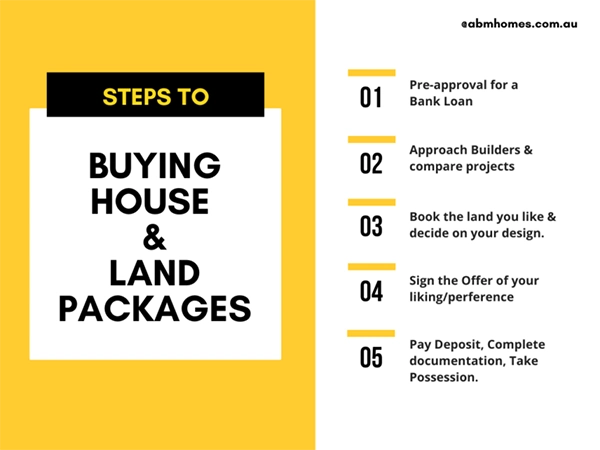
The following infographic summarizes the entire home and land package buying process:
One more thing you should consider doing before the final decision is to get a feel of how your finished house would look after construction/renovation. Check that out through AI-powered remodelling services like hanodecor.
Typical Costs to Budget For
Besides the cost of the new home package, you should also budget for 5–10% in additional costs, like:
- Stamp tax (concessional for first-home buyers)
- Site costs (retaining walls, BAL ratings)
- Fencing
- Landscaping
- Connection fees
- Interim interest/rent during construction
Ignore This, You’ll Pay More
To avoid paying more than you should while buying a home and land package, you must do thorough research beforehand. Also, pay close attention to:
- Contract’s fine print
- Hidden site costs
- Specific inclusions
Ignoring transfer duty payment requirements can also result in penalties, such as a late penalty tax.
State-by-State Differences
Although the core process of buying new home packages is the same across Australia, there are a few state-by-state differences in grants, stamp tax concessions, and average overall costs.
| Grant | Stamp Duty | Costs | |
| New South Wales | $10k for up to $750k cost (FHB) | Waived up to $800k cost; Concessions up to $1M cost | Highest (Median at $1M+) |
| Victoria | $10k for up to $750k cost (FHB) | Waived up to $600k cost; Concessions up to $750k cost | Expensive |
| Queensland | $30k (FHB) | Waived up to $700k cost; Concessions up to $800k cost | Affordable |
| Western Australia | $10k (FHB) | Lower rates for Low-value homes | Low |
First Home Buyer Concessions
In Western Australia, first-time home buyers get $10,000 FHOG (First Home Owner Grant) for properties costing up to $750k.
Additionally, you get stamp duty exemptions/concessions if you go for buying vacant land or new homes. This reduces the upfront cost significantly.
Tips for Calculating Total Costs
Home and land packages are a very popular way to own a home in Western Australia.
It generally costs about $500k+ in capital, Perth.
However, calculating the true total cost is crucial as it is not the package cost every time. Some hidden costs can add thousands to it.
Here are some key tips to estimate the final cost:
- Hidden and Additional Costs: Site work, landscaping, fencing, driveway, fixtures, finishes, BAL requirements, utility connections.
- Understand Two-Part Contracts: About 10% deposit goes to the land developer.
- Legal and Financial Costs: Transfer duty, conveyancing and legal fees, loan lender fees, lender mortgage insurance (if deposit below 20%).
- Safety Buffer: Reserve 10-15% of the purchase cost for unexpected risks.
- Research About Builder: Check the package type; go for a turnkey/fixed-price contract. Also, a reputable builder won’t delay the project, keeping actual costs to the expected ones.
- Long-term Costs: Research council and water rates. Also, budget 1% of property value annually for maintenance.
Conclusion
Your dream of owning a house is now close to fulfillment.
Just remember to pay the stamp duty at the time of settlement. To estimate the stamp tax, just calculate it based on the purchase price or market value, whichever is higher.
If you go for a house and land package, you’d have to secure two contracts: one each for the land and building. However, the benefit of new home packages is that you can save more, as stamp duty applies only to the land component.
It’s even better if you are a first-time home buyer, as you get many grants, exemptions, and concessions.
Cheers to the gorgeous new home!
Do you pay transfer duty on home-and-land packages?
Who pays the stamp tax, buyer or seller?
The buyer pays the stamp tax.
How much is stamp duty on a $1M house?
On a $1M house, you have to pay approximately $42k-43k transfer duty.