Ans: These are used to visualize the final layout of a project in advance so that it can be ensured that the final results are always consistent with what the client or the project owner had in mind at the time of initiating the project.

Floor Plan Symbols in 2026: Meanings, Uses, Pros, Cons & Design Tips
In simple terms, the floor plan symbols are a sign language used by construction professionals to eliminate miscommunication from the project planning process. This language of blueprints helps keep original ideas intact so that they don’t get distorted during the development work.
These symbols are, in particular, most critical for architects, engineers, contractors, and subcontractors. However, the understanding will also benefit project owners or clients equally. It will allow them to effectively communicate their ideas for accurate outcomes. Consider a brief overview of these signs below.
Table of Contents:
- What Are Floor Plan Symbols?
- How Floor Plan Symbols Work
- What are the Common Floor Plan Symbols and Their Meanings?
- Advantages of Using Floor Plan Symbols
- Disadvantages/Challenges of Using Floor Plan Symbols
- What Are the Best Floor Plan Design Tips for Maximum Efficiency?
- Floor Plan Size & Planning Guide
- Floor Plan Symbols vs Basic Drawings
- Conclusion
- FAQs
What Are Floor Plan Symbols?

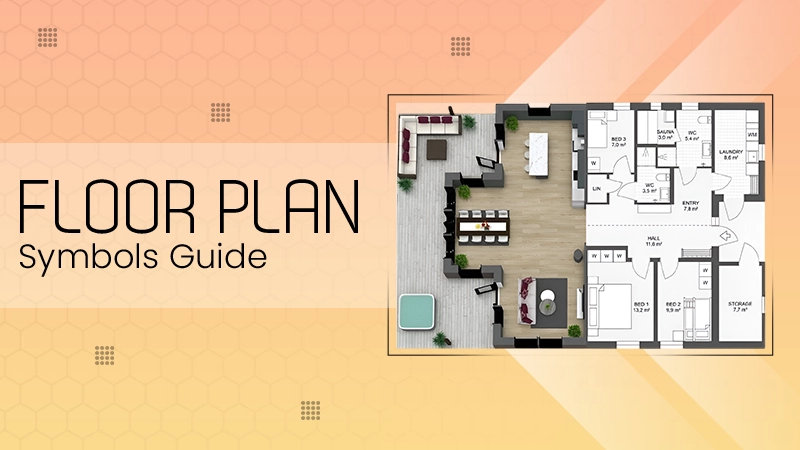
Floor plan symbols are standardized icons, shapes, and lines used in architectural drawings. These symbols represent in 2D, various physical aspects of the floor, such as walls, doors, windows, stairs, plumbing, electrical fixtures, and furniture, in a simple and top-down manner.
Adding further, all these symbols, including architecture abbreviations, create a universal language for all professionals in the construction industry. As a result, it makes communication effective and accurate among stakeholders, such as designers, builders, and clients, regarding a building’s layout efficiently.
| All the floor plan symbols are used in blueprints and architectural drawings, along with a legend, which is like a user manual that helps the concerned professionals understand the meaning of the symbols used in detail. So, there is no scope for misinterpretation or misunderstanding, resulting in inefficiencies. |
Finally, there are two types of floor plans, namely,
- A standard floor plan: Provides an overview with simple shapes for walls, windows, doors, and rooms
- A detailed symbolic floor plan: offering detailed information with the use of specific symbols
If you are planning to have a house constructed, before investing your time in such concepts, first of all, you must learn all the essential steps to building a house. So, you have knowledge of the process in general in advance.
Also Read: 15+ Best Bathroom Remodeling Ideas for 2026 – Transform Your Space with Style
How Floor Plan Symbols Work?

Consider the following floor plan symbols with conventions and learn how they minimally represent compasses, walls, doors, windows, stairs, modern interior décor trends, appliances, HVAC, furniture, plumbing, and electricals.
| S. No. | Floor Plan Symbols | Images | Conventions |
| 1. | Compass |  | A circle with a north arrow |
| 2. | Wall |  | Parallel lines |
| 3. | Doors |  | Simple lines and arcs (typical components of architecture door drawing) |
| 4. | Doorway |  | A break in the straight door line denotes the drawing of a doorway |
| 5. | Window |  | Long rectangular boxes, along with lines showing the direction in which the window will open |
| 6. | Stair |  | A row of rectangles with a directional arrow; such symbols are often discussed while learning how to make stairs in academic settings. |
| 7. | Appliances |  | Minimalistic shapes with abbreviations |
| 8. | HVAC |  | Often represented by the symbols of the exhaust fan, ceiling fan, thermostat, air conditioner, heating elements, etc. For example, AC is a rectangular box with a snowflake design inside |
| 9. | Furniture |  | A combination of squares and rectangles |
| 10. | Plumbing |  | Straight lines with variations for cold and hot water, with abbreviations like T, CSW, HSW, etc. |
| 11. | Electricals, i.e., electrical plan drawing symbols |  | A combination of circles, lines, and arrows |
How floor plan symbols work is very straightforward. These floor plan symbols are just the simplest, reduced forms of real-world features, parts, and objects of a building. All the large-sized objects are proportionally reduced to small, minimalistic drawings, only highlighting the prominent features of the components in question.
| The professional who has to interpret this document uses a special parameter to decode the real-life dimensions of the symbols. This parameter or scale-related information is often provided in the title block. For example, if a door symbol length is 15 mm and the scale is 1:50, then it is required to multiply 15 mm by 50 to get the real-world dimension of the door, which will be 750 mm in this case. |
Additionally, there are many construction types, and thus a professional chooses from various symbols according to the overall requirements of the project at hand, along with the subjective preferences of the clients.
What are the Common Floor Plan Symbols and their Meanings?

The most common floor plan symbols are related to walls, doors, windows, stairs, plumbing fixtures, electrical symbols, furniture & appliances, and compasses. These symbols are used in all types of constructions, from building a tiny project to the most expensive house in America. Consider the meanings of these symbols in the table below.
| S. No. | Meanings (Corresponding Objects of the Symbols) | Images | Common Floor Plan Symbols’ Shapes by Conventions | |
| 1. | Walls |  | Parallel lines | |
| 2. | Doors |  | Simple lines with arcs | |
| 3. | Windows or blueprint window symbols |  | Long rectangular boxes with lines for door opening directions | |
| 4. | Stairs |  | A row of rectangles with a directional arrow | |
| 5. | Toilets |  | An oval and a rectangle | |
| 6. | Sinks |  | An oval inside a rectangle | |
| 7. | Showers |  | Various shapes with lines, rectangles, and squares | |
| 8. | Outlets |  | Circles with lines | |
| 9. | Switches |  | A small circle with lines | |
| 10. | Lights |  | With combinations of circles and crosses | |
| 11. | Bed |  | A rectangle with pillows | |
| 12. | Sofa/Couch |  | A long rectangle modified to suit a particular style | |
| 13. | Table |  | A square or rectangle | |
| 14. | Cabinetor counter |  | Rectangles | |
| 15. | Wardrobe |  | A rectangle with door lines | |
| 16. | Refrigerator |  | A rectangle with an X sometimes | |
| 17. | Dishwasher |  | A rectangle, typically near the sink | |
| 18. | Stove/Range |  | A square or a rectangle | |
| 19. | Washer/Dryer |  | A rectangle | |
| 20. | Water Heater |  | A rectangle or a cylinder | |
| 21. | Compass | | A circle with a northward-pointing arrow | |
These minimalistic drawings are also called the architect floor plan symbols. Additionally, the scale used in these common icons might vary depending on the individual’s professional etiquette. However, in general, two main, widely accepted systems are used, namely
- ¼ inch = 1 foot, which is 1:48, typically for residential constructions, and
- 1:50 or 1:100 ratios for general purposes
Interpreting and using these formulas is straightforward. 1:50 means 1 unit of the measure in the symbol represents 50 units of the same measure for the real-world corresponding object.
Advantages of Using Floor Plan Symbols
There are many advantages of using floor plan symbols. These icons, or simple figures, primarily help with better visualization of space, saving time and preventing mistakes, and improving communication with builders and designers, and are helpful for DIY projects and planning renovations efficiently. Consider the elaborations below.
- Better visualization of space: Such floor-plan-related icons or designs help visualize the outcome of the construction in advance. So, there is less inefficiency and more of what is desired by the client.
- Saves time and prevents mistakes: Construction involves contractors, sub-contractors, architects, engineers, and other workers. Thus, for all of them to be on the same page, a common language is essential. Thus, using the universally accepted symbols for planning saves time and prevents mistakes right from the beginning.
- Improves communication with builders and designers: This is because such commonly accepted shapes facilitate a universal means of communication between the top-level construction professionals.
- Helpful for DIY projects: This system of symbols is also great for people who love to work on DIY projects, as it helps achieve a common understanding among key decision makers.
- Planning renovations efficiently: Such icons are nothing but minimalistic representations of real objects, which help summarize even a complex construction idea into a small 2D piece of paper. This approach streamlines renovation projects just the same as new developments.
Thus, whether you are learning how to build a shed to start a DIY project or reflecting on your grand, traditional house idea, it is compulsory to at least have a basic understanding of these symbols. Such knowledge is even more important for people planning new constructions so they can communicate with the contractor better and also understand the technical design documents created by professionals during the planning phase.
Also Read: Cheapest State to Buy a House in the USA: Find Your Perfect Dream Place & Enjoy Life Forever!
Disadvantages/Challenges of Using Floor Plan Symbols
There are several challenges to using floor plan symbols. For example, these signs can be confusing for beginners initially; misinterpretation can lead to errors; learning curve for complex layouts; and finally, it requires cross-referencing with the legend/abbreviations. For complete contexts, refer to the following points.
- Can be confusing for beginners initially: Not every person planning construction or renovation can easily understand these technical designs. These signs are primarily used by professionals or experts for the efficient discharge of their duties in exchange for fees from the clients. All the biggest construction companies use these visuals to achieve a high-efficiency level in their work. Thus, it might not be everyone’s cup of tea or within their capacity.
- Misinterpretation can lead to errors: Sometimes, a professional mightn’t have the knowledge of all the signs and symbols used in a floor-plan document. Thus, such instances can lead to misinterpretations if support material isn’t provided. Ultimately, the client has to face unavoidable errors.
- Learning curve for complex layouts: Even though a non-technical person/client attempts to learn these minimalistic drawings for the advantages, they cannot learn all the intricacies overnight. It will take time and cost to master the concepts, thus inevitably imposing a steep learning curve.
- Requires cross-referencing with legend/abbreviations: Even most experts, who have worked for years, don’t just open the floor plan drawings and instantly get the message conveyed or intended. Instead, they too have to refer to a special material called a legend that holds specifics and details of abbreviations, if any.
These are just manageable cons associated with the use of technical floor plan symbols. Manageable because professionals, eventually, end up mastering the concepts due to regular practice. For a new learner outside the industry, it can indeed pose a steep learning curve. But that is not an issue if there is enough time and resources available at one’s disposal.
What Are the Best Floor Plan Design Tips for Maximum Efficiency?
A few, but the most crucial design tips regarding using the floor plan icons, are as follows.
- Always check the legend/key.
- Pay attention to scale and orientation.
- Use symbols to plan furniture and traffic flow.
- Consider digital tools for reading or creating plans.
- Proper planning of electrical, plumbing, and HVAC layouts.
Consider the details on each piece of advice below.
- Always check the legend/key: It will help keep misinterpretations and misunderstandings at bay. Without learning about the initial intents of the creator from the legend, engineers can never deliver the desired outcome in the final construction.
- Pay attention to scale and orientation: Even the slightest mistake in the initial calculations can cause massive errors in the final builds because the dimensions of the drawn signs work on a 1:50 ratio in general. It means the real-world corresponding part is the 50 units of the measurement if that part is denoted as 1 unit in the drawing.
- Use symbols to plan furniture and traffic flow: These symbols can be used to denote not only the features of the building, such as doors, walls, windows, etc., but also the furniture items. So, traffic flow can be managed optimally without potential obstructions.
- Consider digital tools for reading or creating plans: In modern times, there is hardly anyone who is not leveraging the power of digital devices and automation to achieve the best work in less time and with fewer resources. You can use tools such as AutoCAD Architecture, SketchUp, RoomSketcher, etc.
- Proper planning of electrical, plumbing, and HVAC layouts: The construction isn’t just all about aesthetics but also about function. Thus, a professional must also create construction documents from the perspective of the proper implementation of all the components of HVAC and other crucial systems. No architecture key plans must skip these aspects.
All of these tips will help you create the most optimal space for living in the end. Only what you have clearly planned will result in the real world without inefficiency. So, whether it is a small unit, a rambler house, or a big bungalow, always plan its layout in advance for clarity and better results. If you hire someone else, then choose the contractor with at least 5 to 6 years of experience in the field, while clearly understanding floor plan symbols.
Floor Plan Size & Planning Guide

| The floor plan symbols are “commonly drawn at a scale of either 1 to 50 or 1 to 100,” according to the learninglab resources made available by RMIT University. That is simple: an object measuring 1 unit in the 2D floor plan is 50 units in the real world. |
For the accurate floor plans, the minimum space representation is crucial. Without it, there will be inconsistency, leading to inefficiencies in the actual parts of the construction. Thus, stick to your scale and always decide on the dimensions that mimic the actual conditions precisely.
Also, always ensure the average bedroom size or other basic limit requirements for the best outcomes. Additionally, before creating a floor plan, there is another consideration that needs the client’s full attention. And that is to decide on the construction type.
There are two categories, based on projects and material quality.
- According to the purpose of use, a project can be residential, commercial, industrial, institutional, mixed-use, or heavy civil.
- However, each of these types can furthermore fall within any of the 5 types of material-based construction types, such as Type I, Type II, Type III, Type IV, and Type V.
Thus, before creating the floor plan, these pre-planning considerations are more important. For a detailed overview, connect with a professional general contractor and get the most precise guidance as per your preferences and project ideas.
Floor Plan Symbols vs Basic Drawings
The following table makes a comparison between floor plan symbols vs. the basic drawings. Key differences covered here are based on objective, accuracy, conventions, readership, and format.
| S. No. | Differences | Symbolic Floor Plan | Simple Sketch |
| 1. | Objective | To provide a detailed floor plan to help engineers build each part of the construction effortlessly | To offer the concept at a glance for quickly exploring and discussing the initial ideas with the client or other stakeholders |
| 2. | Accuracy | Highly detailed, specific in approach | Rough, freehand, not to scale, and general in nature |
| 3. | Conventions | Use of standardized visual language, i.e., universally accepted symbols and abbreviations | Temporary lines, shapes, and abbreviations just for basic understanding |
| 4. | Readership | Intended for professionals in the construction work | Created for the internal design team members or for a quick, general understanding |
| 5. | Format | Part of the large, finalized construction documents | A manually drawn document |
In short, symbolic floor plans are a must in professional and technical settings, whereas rough and general sketches are best for informal settings. The complexity of such designs depends on the complexity of the project itself; for example, a split level house requires more intensive planning work than an open-plan floor architecture.
Conclusion
There are various benefits of floor plan symbols, such as better visualization, time saving, error prevention, and effective communication among key stakeholders. This is helpful even for DIYers and also the best tool for effective renovation planning.
Challenges include the fact that it can be confusing for beginners to learn these signs; without a legend, unknown shapes and abbreviations can be misinterpreted, leading to lasting errors; and a steep learning curve. However, if you have enough time at your disposal, there is nothing to worry about.
FAQs
Q: What are floor plan symbols used for?
Q: Why is it important to understand floor plan symbols?
Ans: It is important because the knowledge of these signs promotes commonality of understanding among the key construction professionals regarding a particular layout.
Q: What are the most common floor plan symbols?
Ans: There are so many shapes that create these symbols with abbreviations. Yet, the basic constituents remain the same, such as circles, lines, rectangles, squares, etc.
Q: How do you read a floor plan correctly?
Ans: A floor plan can be read correctly only with the help of the attached legend that holds the key to interpreting each shape and abbreviation precisely or exactly as intended.
Q: Are there standard symbols for all floor plans?
Ans: Yes, these are the standard minimalistic shapes that are used and accepted worldwide and thus can be used for all floor plans.
Sources:
Cook County Health: Individual Drawings Architectural
Urbanimmersive: Floor Plan Knowledge Base