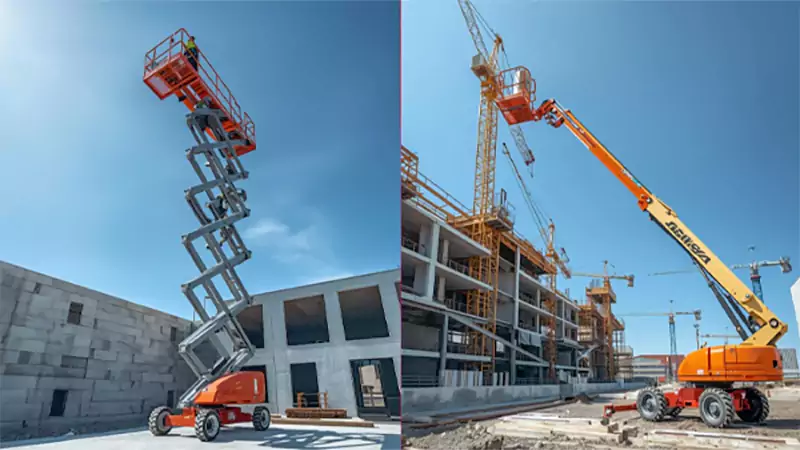
Ans: A boom lift can move the operator vertically as well as horizontally, while a scissor lift only works vertically.

Boom Lift vs. Scissor Lift: Which One Should You Choose for Better Assistance & Higher Productivity?
Whether for simple roof maintenance or a high-rise elevation requirement, aerial work platforms are indispensable. Two major types of such equipment are boom lifts and scissor lifts.
In this article, we will compare boom lift vs scissor lift in detail and help readers understand their relative importance across various construction, maintenance, and industrial projects. By the end of this intensive read, you will easily be able to tell which machine/lift suits the needs of a given project the best.
Table of Contents:
- What is a Boom Lift?
- What is a Scissor Lift?
- Boom Lift vs. Scissor Lift – Key Differences
- Advantages & Disadvantages Associated with Boom Lift and Scissor Lift
- Cost Comparison & Rental Tips for Boom Lift and Scissor Lift
- Safety Guidelines for Aerial Lift Equipment
- Real-World Use Cases for Boom Lift vs. Scissor Lift
- Conclusion
- FAQs
What is a Boom Lift?
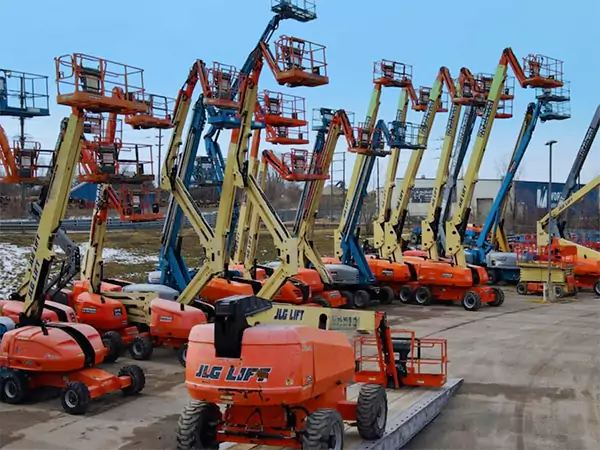
Before we move to the boom lift vs. scissor lift comparison, let’s discuss what a boom lift is and its key function!
A boom lift is one of the essential construction vehicles, equally important in new development as well as renovation/maintenance projects. It is a type of aerial work platform (AWP) or elevated work platform (EWP), which helps workers reach difficult spots vertically with ease.
Besides, the boom lift also helps transport raw materials from the ground level to extreme heights, for example, while building high-rises. And, not just in construction projects, it is also useful in other activities, such as trimming trees, fixing electrical, telecommunication, and lighting problems, etc.
This lift machine features a strong hydraulic and extendable arm that connects with a robust ground base. Consider different types of boom lifts, their specifications, and uses in the table below.
| S. No. | Type of Boom Lift | Working Height | Weight Capacity | Horizontal Outreach | Key Features | Primary Uses |
| 1. | Articulating (knuckle boom) | 30 ft to 150 ft | 227 kg | Moderate | Jointed arm, allowing navigation around the obstacle | Maintenance in tight spots, electrical work, plumbing, & painting |
| 2. | Telescoping boom lift (straight boom) | 40 ft to 185 ft+ | 300 kg+ | High | Single, straight boom for maximum height/distance | High-rise construction, bridge inspection, & steel work |
| 3. | Atrium/Spider (compact crawler) | 30 ft to 100 ft | 450 kg+ | Moderate | Lightweight, tracks, outriggers, fits through doors | Indoor maintenance, delicate floors, & tree trimming |
| 4. | Towable boom lift rental (trailer-mounted) | 30 ft to 55 ft+ | 453 kg | Moderate | Mounted on a trailer, easily towed by trucks | Quick setup, signage install, exterior painting |
All of these figures are approximations, thus subject to variations due to varying model types and future upgrades, if any.
What is a Scissor Lift?
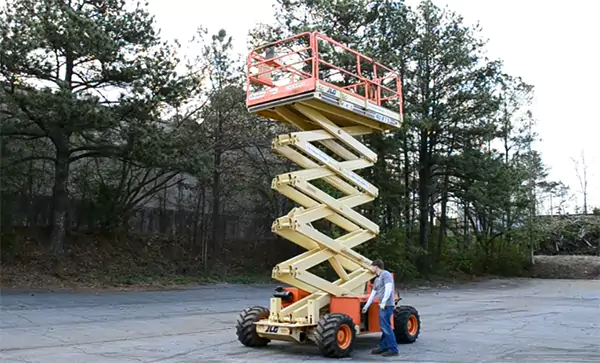
The scissor lift is another type of aerial work platform, specifically designed to lift workers and materials straight up and down without any horizontal outreach capability. This specific AWP, also called MEWP, employs a crisscross, folding metal support mechanism that expands and contracts. Primarily, this equipment is used in construction, maintenance, and warehousing.
Have a look at the following table, summarizing the major types of scissor lifts with specifications and real-world applications.
| S. No. | Type of Scissor Lift | Electric or Diesel | Indoor orOutdoor | Maximum Height | Lifting Capacity | Platform Size | Application |
| 1. | Electric scissor lift | Both | Both | Up to 121 ft | 230kg to 1,000 kg | Starting from 1.6 m x 0.7 m | Construction, warehouse maintenance, electrical installations, & cleaning |
| 2. | Automotive scissor lift | Both | Both | Up to 100 ft | 1 to 10 tons, as per model | Starting from 1.2 m x 2 m | Automotive workshops, multi-level car parking, vehicle display, & construction maintenance |
| 3. | Skyjack scissor lift | Both | Both | Up to 46 ft | 227 kg to 454 kg | Starting from 0.66 m x 1.63 m | Stock checking, warehouse maintenance, HVAC installation, & electrical work |
| 4. | Compact scissor lift | Both | Both | Up to 50 ft | 250 kg to 565 kg | Starting from 0.8 m to 1.2 m | Maintenance, retail, warehousing, construction, & electrical work |
| 5. | Crawler scissor lift | Both | Both | Up to 65 ft | 200 kg to 450 kg | Starting from 1.6 m x 0.7 m | Construction sites, building maintenance, mining, farms, greenhouse work & navigating narrow spaces |
All of these figures are approximations, thus subject to variations due to varying model types and future upgrades, if any.
Boom Lift vs Scissor Lift – Key Differences
The table below brings out the key differences between boom lift vs. scissor lift by analyzing lift direction, reach, platform capacity, indoor or outdoor, ground requirements, and rental costs. However, it only touches up these points from a general perspective, without taking any specific models into consideration.
| S. No. | Difference Area | Boom Lift | Scissor Lift |
| 1. | Lift Direction | Horizontal and vertical | Vertical |
| 2. | Reach | Up to 210 ft | Up to 60 ft |
| 3. | Platform capacity | Up to 1,000 lbs | Up to 1,500 lbs |
| 4. | Indoor or outdoor | Both | Both |
| 5. | Ground requirements | Depends on the model | Depends on the model |
| 6. | Rental costs | Expensive | Affordable |
Elaborations are provided below for further context.
- Lift direction: A boom lift is more capable than a scissor lift, because the former can not only lift the operator upwards but also horizontally. This ensures that the user doesn’t need to reposition the base of the arm to cover any distance on the X-axis. A scissor, on the other hand, can only take the person or material on it upwards, as per the pre-decided position of the base on the ground. Typically, both such lifts are required during construction in all types of houses.
- Reach: The robust and high-capacity model of a boom lift provides the upliftment services up to 210 feet, while it limits itself to 60 feet in the case of a scissor lift.
- Platform capacity: Because there is no horizontal movement in the case of a scissor lift, it can hold more weight than a boom lift. Thus, the former can bear up to 1,500 lbs. However, in projects like the most expensive house in America, both of these lifts are utilized for assistance.
- Indoor or outdoor: Both types of lifts are available in models that are capable of working in indoor as well as outdoor environments.
- Ground requirements: Both types of lifts are available in the market in such models as are capable of working in flat and stable as well as uneven and rugged terrains. So, it just depends on your budget and the nature of the work as to which lift you should opt for.
- Rental costs: Due to its high capacity and versatility, boom lift rental costs are higher than those of the scissor lift.
Note: For large residential construction projects, i.e., high-rises, boom lifts are often required, while house maintenance work, whether indoors or outdoors, can be easily done with the help of scissor lifts.
Advantages & Disadvantages Associated with Boom Lift and Scissor Lift
After our careful analysis of boom lift vs. scissor lift, this section deals with the key pros and cons of each of them. In short, a boom lift is the perfect solution for up and over movements, while the scissor lift is more suitable for indoor environments, as it only moves vertically as per the position of the chassis—the load-bearing structure or base on the ground.
Boom Lift Pros and Cons
| Pros | Cons |
| Superior reach | Limited platform space |
| Up-and-over maneuverability | Higher rental/purchase cost |
| Rough terrain capability |
- Superior Reach: A construction crew often needs to reach a 10th-floor exterior wall for window installation, sometimes even under excavated ground. In that case, only a boom lift can provide support with its capacity to reach up to 200 feet.
- Up-and-Over Maneuverability: A worker can easily bend in multiple places around the desired spots with the help of an articulating boom. It is not just a vertical lift but also involves bending in several horizontal directions.
- Rough Terrain Capability: Most diesel-powered boom lifts have 4WD, oscillating axles, and heavy-duty tires, which makes them perfect for unpaved, uneven, or muddy construction sites.
- Limited Platform Space: Boom lifts often feature small baskets that only hold enough space for 1 to 2 workers. That also implies that heavy materials cannot be lifted using this machinery.
- Higher Rental/Purchase Cost: A boom lift is more expensive to get on rent than a scissor lift.
Scissor Lift Pros and Cons
| Pros | Cons |
| High load capacity | Limited motion |
| Large workspace | Flat & stable ground requirement |
| Stability | |
| Cheaper |
- High Load Capacity: In the scissor lift, the user can carry more weight than in the boom lift basket. The major reason behind this is its restricted mobility. The scissor lift can only move in the vertical direction.
- Large Workspace: There is more space on the platform for workers than in the case of a boom lift. More than 2 people can simultaneously be on the platform and work in collaboration without any trouble.
- Stability: Due to its restricted or limited vertical lift, a crisscross lifting mechanism provides better stability and weight-bearing strength.
- Cheaper: This equipment is cheaper to acquire on rent than the boom lift, and the reason is its simple build.
- Limited Motion: The biggest flaw associated with this lifting machine is its low capacity, compared to the boom lift. First, it only moves in the upward direction. Second, it is also limited to a medium height, approximately reaching up to 120 ft maximum.
- Flat & Stable Ground Requirement: Majorly, these types of lift equipment work best on even and flat ground surfaces, like residential or industrial buildings’ interior flat floors or paved paths on the outside.
Cost Comparison & Rental Tips for Boom Lift and Scissor Lift
The average cost comparison & rental tips between boom lift vs. scissor lift are provided below. Generally, a scissor lift is less expensive to rent than a boom lift. Refer to the average rental price table below for elaboration. The same sentence is also true for the purchase price.
Average Rental Price
| Lift Type | Daily Rate | Weekly Rate | Monthly Rate |
| Electric scissor lift | $100–$300 | $350–$600 | $800–$1,500 |
| Rough terrain scissor lift | $400–$500 | $900–$1,200 | $1,500–$2,500 |
| Boom lift rental (small/medium) | $250–$600 | $650–$1,200 | $1,400–$2,500 |
| Boom lift (large/diesel) | $600–$1,000+ | $1,500–$3,000+ | $3,000–$4,700+ |
Purchase Price Range
| New boom lift cost | $25,000–$300,000+ |
| Used boom lift cost | $18,500–$210,000+ |
| New scissor lift cost | $12,000–$125,000 |
| Used scissor lift cost | $5,000–$30,000+ |
Tips for Choosing the Right Lift Between These Two
The following points will help you decide on the right piece of lift machinery if you are still confused about which one to choose.
| Feature / Situation | Scissor Lift | Boom Lift |
| Project Height | Best for projects under 50 feet | Ideal for projects over 50 feet |
| Budget | Suitable for a tight budget | Better if you have a flexible budget |
| Movement Type | Moves straight up vertically | Can reach up and over obstacles |
| Work Environment | Electric scissor lifts are great for indoor or flat surfaces | Suitable for outdoor jobs and uneven terrain |
| Terrain Capability | Rough-terrain scissor lifts can handle moderate uneven ground | 4-wheel-drive boom lifts work well on rough outdoor terrain |
Also Read: Construction Estimating in 2025: Get 100% Accuracy with Tried and Tested Methods!
Safety Guidelines for Aerial Lift Equipment
Now, we have come to the safety part of operating boom lift vs. scissor lift. Consider the following points with respect to the OSHA/ANSI regulations, PPE requirements, when not to use each lift, and training tips for operators.
- OSHA/ANSI regulations
- Boom lifts: Regulated under OSHA 29 CFR 1926.453 (aerial lifts) and ANSI A92.2 standards. These are considered vehicles with articulated or extensible arms.
- Scissor lifts: Regulated under OSHA 29 CFR 1929.451 (Scaffolds) and 1926.452(w) (Mobile Scaffolds). OSHA does not classify scissor lifts as aerial lifts, but rather as mobile scaffolding.
- PPE requirements
- Boom lifts: A full-body harness and lanyard are mandatory. The lanyard must be attached to an approved anchorage point within the basket, never to an adjacent structure or pole.
- Scissor lifts: A harness is not strictly required by OSHA if the guardrails are adequate, i.e., top rail, mid-rail, and toe-board.
- When not to use each lift
- Boom lifts: Don’t use them in confined/indoors spaces and unstable ground.
- Scissor lifts: Don’t use them in rough/unlevel terrain, over obstacles, and in high winds.
- Training tips for operators
- Hands-on training: Operators must receive expert education from well-certified trainers on how to use the lift equipment.
- Hazard recognition: The training sessions must also include potential hazard identification skills. So, likely damage can be averted in advance.
- Re-training: Training an operator again is important in case of long absence from work, machine upgrade, or incorrect use.
- Site inspection: Operators must always perform thorough checks before operating the lift. Such an inspection includes checking brakes, controls, and tire conditions.
Real-World Use Cases for Boom Lift vs. Scissor Lift
Consider the following table and quickly decide which lift equipment will serve your needs better.
| Need | Best Lift Type | Key Feature |
| Straight Up | Scissor lift | High capacity/stable platform |
| Up & Over | Articulating boom lift | “Knuckle” joints |
| Up & Out (Far) | Telescopic boom lift | Long reach |
| Rough Terrain Outdoors | 4WD/RT boom lift | Heavy-duty tires |
| Tight Indoor | Electric scissor lift | Zero emissions/silent |
Also Read: Discover 240+ Construction Company Names to Stand Out In the Market
Conclusion
So, the key takeaway after a thorough comparison analysis of boom lift vs. scissor lift is as follows. Always choose the boom lift for outdoor, extreme height projects such as a 10th-floor building or similar developmental constructions. And, if you just need to get uplifted for small projects or activities, such as fixing lighting, storing things in higher shelves in warehousing, or roof maintenance of a single-story house, a scissor lift is the best pick.
FAQs
Q: What is the main difference between a boom lift and a scissor lift?
Q: Can you move a boom lift while elevated?
Ans: Yes.
Q: Are scissor lifts safe outdoors?
Ans: Yes, they are safe on flat and even surfaces.
Q: Do you need certification to operate either lift?
Ans: Yes, you need to be well-trained and certified to operate a lift, whether a boom lift or a scissor lift.
Q: Which lift is more cost-effective for indoor projects?
Ans: A scissor lift is more cost-effective and better suited for indoor projects.