What is a Submittal in Construction? Learn How Submittals Work and Why You Need to Focus on Them
Those who aren’t familiar with the construction world should know about Submittals. In construction, submittals are a form of document containing samples sent for review by the contractor to the design team or the general contractor during the pre-construction phase.
Submittals are an important part of the general construction process and are required in all types of projects. In this guide, we have provided a basic overview of what is a construction submittals is and its importance. Read to know what you should know about submittals and learn how they work.
What is a Submittal?
Submittals are written documents containing samples, designs, and other kinds of information related to construction work. These documents are needed in the pre-construction phase to demonstrate proposed plans to members of the team so everyone is on the same page.
A submittal can be a design, written document, list of resources, application, or anything that serves to ensure compliance with the project requirements and special needs.
These are essential for the completion of the project and are used for quality control and to ensure that all requirements are met. There are different types of submittals and all are required to complete a project. If you want to become a successful contractor, you should understand all types of submittals and their use.
Types of Submittals
These are the multiple types of submittals that you should know about:
Design Drawings: Design drawings show a visual representation of the project. It is used to show what the project is supposed to look like and give an idea about what the workers are supposed to do, aligning with evolving home design trends and contemporary styling choices. It states the designer’s vision to all the parties involved so they can follow without ease.
Product Data: Product data provides detailed information about the resources and products required for the completion of the project. This is used to ensure that the construction team knows what material they need during the construction and can successfully complete the project.
Samples: Samples in construction refer to the physical samples of the materials required in the project. These samples are sent with the purpose of quality control to other members of the team. Once the quality of materials is confirmed, the construction team can proceed with the process and start working on it.
Reports: Reports in the form of contractors’ compliance with the project are also needed to complete the project. Reports are usually documents demonstrating that the contractor intends to complete the project in full. Reports such as these are needed in large projects. It also showcases how the contractor is planning to complete the project.
Mock-Ups: Similar to samples, mock-ups show the physical samples of a specific part of the project, like ceilings, walls, plumbing, etc, to show how the final project will appear. Mock-ups are needed to solve difficult parts of the construction process.
Submittals are vital for the completion of the project, and it is important that they are provided in the right way so the project can be successfully completed. The next section discusses the importance of submittals in construction.
How the Submittal Process Works?
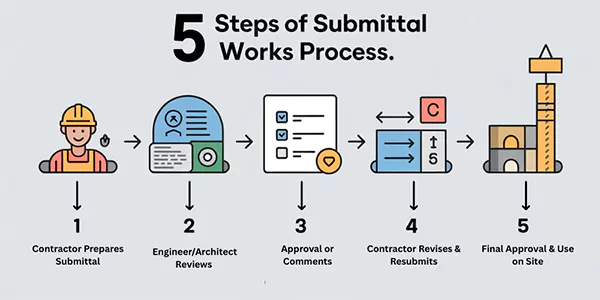
The submittal process is like a quality checkpoint system in construction.
It ensures that whatever goes on site is correct, safe, and approved by the design team.
Here is a well-explained, practical breakdown of how it works:
Step 1: Contractor Prepares the Submittal
This is the starting point.
The contractor collects all necessary information such as shop drawings, product catalogues, technical data sheets, and material samples.
They also check project specifications to ensure that the material or equipment selected matches the required standard.
Basically, the contractor ensures:
- The product is correct
- The documentation is complete
- Everything follows the design requirements
Only after checking internally, the contractor forward it for review.
Step 2: Engineer / Architect Reviews the Submittals
Once submitted, the design team (architects, engineers, consultants) carefully examines the details.
Their job is to verify:
- Does the product match the project design?
- Is the quality as per contract specifications?
- Does it meet safety standards and IS codes?
- Will it fit properly with other components of the building?
If there is any mismatch in size, material, colour, or technical parameters, the reviewer notes it immediately.
This review is important because wrong materials can cause safety issues, rework, and project delays.
Step 3: Reviewer Issues Approval or Comments
After evaluation, the design team responds with one of the following:
- Approved: Everything is correct, can be used on the project
- Approved with Comments : Small corrections needed, but the item can be used after fixing
- Rejected / Revise and Resubmit : Major issues found; contractor must revise
This communication ensures that both the contractor and designer stay aligned on project requirements.
Step 4: Contractor Revises and Resubmits (If Required)
If the reviewer sends comments or rejects the submittal, the contractor must revise it.
This may include:
- Updating drawings
- Selecting a new product
- Correcting technical data
- Fixing dimensions or quality details
After making corrections, the contractor sends the updated version again for final approval.
This stage prevents costly mistakes during installation.
Step 5: Final Approval & Use on Site
Once the submittal receives final approval, the contractor can:
- Order the material
- Begin fabrication
- Start installation on the site
This ensures the work executed at the site follows the approved design.
Final approval means no confusion, no mismatch, and no risk.
Importance of Submittals in Construction
Submittals are crucial for the completion of the construction project. Showing all the important parts needed to complete a project, submittals ensure that everything that is needed is secured for the construction.
Here are some reasons why submittals are important:
Ensures Compliance: Submittal ensures that all materials have been acquired for the project and that the construction team is ready to comply with the process.
Quality Control for Materials: Sending out materials for reviewing ensures all materials are of the right quality and can be used for the construction. It reduced the risk of error later on and also helps tackle internal corruption.
Ensures Proper Communication Between Workers: With submittals in place, each section of the construction team stays connected with each other to make sure all plans are set in place for the completion of the project. Establishing communication allows the project to proceed way more smoothly.
Cost Control: Submittals help to confirm the cost of the materials involved and significantly reduce the total cost by reducing extra costs. By figuring out the construction budget, contractors can better plan their budget.
Avoid Mistakes and Rework: The main purpose behind submittals is to prevent mistakes that would have happened during the construction. By mapping out every bit of detail and designing the project, submittal helps in avoiding mistakes and rework.
Establishes Proper Management: Submittals help establish proper management for the whole project and ensure proper order for each part of the construction. Submittal also helps in tracking material quantity/quality, and make sure that everything is done accordingly.
Submittals work as the backbone of the construction process and are the only reason why projects go so well. Without submittal in construction, each project would be riddled with errors, take way more time to complete, and cost even more.
What is a Revision in Construction Submittals?
Revisions in submittal refer to changes or updates made to a submittal after it has been sent to the architect. Revisions occur when submittals fail to meet the requirements of the project in general construction.
Revisions are a normal part of construction projects and are often seen as feedback rather than errors. These revisions further help in improving the submittals in construction and ensure that projects are completed in an even better way than before.
Depending on the state of the submittal, revisions can be short or be a complete overhaul of the proposal. Revisions help in making sure that submittal is in high quality and does the job it is intended to do.
Revisions are just as important to submittals as submittals are to the project. These help fill the gap left by submittals and make even more upgrades to the project.
Common Mistakes in the Process of Submittals.
Even though submittals are simple documents, small mistakes inside them can create big problems on-site delays, rework, cost overruns, and confusion among teams.
Here are the most common mistakes explained in detail:
1. Late Submission
This is one of the biggest issues in real construction projects.
When contractors submit submittals late:
- Material procurement gets delayed
- Fabrication work cannot start
- Site activities get stuck
- The entire project timeline gets disturbed
Submittals should always be submitted as per the schedule, otherwise even a small approval delay can push the project behind by weeks.
2. Incorrect Product Data
Sometimes contractors attach the wrong catalogue, wrong product model, or incomplete technical details.
This leads to:
- Confusion for the design team
- Immediate rejection
- Time wastage in resubmission
- Delays in ordering materials
Incorrect data also creates a risk that the wrong product might get ordered, which results in costly rework.
3. Missing Specifications
Every submittal must match the project specifications mentioned in the contract document.
Many times, contractors forget to highlight or attach:
- Required IS codes
- Technical parameters
- Material grade
- Performance details
When specifications are missing, the reviewer cannot check the accuracy properly, leading to resubmission.
This makes the review process slow and complicated.
4. Material Mismatch
This happens when the submitted sample or product does not match what was asked in the specifications or drawings.
Examples:
- Wrong tile shade
- Different thickness of glass
- Incorrect type of electrical fitting
- Different brand than approved
Material mismatch leads to:
- Conflicts on site
- Client dissatisfaction
- Replacement and reordering
- Extra cost and delay
This mistake can be avoided simply by checking the specs before preparing the submittal.
5. Not Submitting Revised Versions
After receiving comments from engineers or architects, the contractor must update and resubmit the corrected version.
However, many times:
- Comments are ignored
- Old versions are resubmitted
- Revisions are not properly highlighted
This results in repeated rejections, which wastes time and creates frustration in the review process. Submitting clear, updated, and properly revised documents keeps the project moving smoothly, especially when dealing with submittals in construction.
Submittal Logs & Tracking System Explained
Managing submittals is not just about sending documents for approval, it’s also about tracking their movement, keeping proof of communication, and ensuring nothing gets delayed.
For this purpose, construction teams use something called a Submittal Log.
What Is a Submittal Log?
A submittal log is a structured record or master list that captures every submittal created for a project.
It acts like a centralized tracking system that shows:
- What materials/products have been submitted
- When they were submitted
- Who approved or reviewed them
- What comments were given
- Whether they are approved, pending, or rejected
- When resubmission is needed
- Expected dates for final approval
In simple words, the submittal log is the project’s “tracking dashboard” for all material approvals.
It keeps everyone, contractor, engineers, architects, and client on the same page.
Why is a Submittal Log Important?
A submittal log helps the project team by:
- Avoiding missed deadlines
- Preventing material delays
- Ensuring no submittal is forgotten
- Maintaining transparency
- Tracking review timelines
- Improving coordination between teams
Without a log, submittals can easily get lost in emails, leading to confusion and project delays.
How Submittals Are Tracked on Construction Projects?
Submittal tracking can be done using both simple and advanced tools.
The method depends on the project size.
1. Spreadsheets (Small or Medium Projects)
Many contractors maintain logs in Excel or Google Sheets.
The log usually includes columns like:
- Submittal number
- Title / description
- Submitted date
- Review status (Pending / Approved / Rejected)
- Reviewer name
- Comment details
- Resubmission date
- Final approval date
This method is simple, cost-free, and easy to update.
2. Construction Management Software (Medium to Large Projects)
Bigger projects prefer digital tools because they reduce errors and provide automation.
Popular tools include:
- Procore
- Autodesk Construction Cloud
- Buildertrend
- Primavera Contract Management
- Bluebeam
These tools automatically:
- Send reminders
- Track deadlines
- Highlight overdue submittals
- Maintain revision history
- Create reports for meetings
This makes project management faster, accurate, and more organised.
How Submittals and RFIs Work Together in Construction?
RFI (Request for Information) is a separate document used to ask for clarification when any design detail is unclear especially when preparing accurate submittals in construction.
However, RFIs and Submittals are closely connected:
How They Are Related:
- When the contractor finds unclear or missing information in the drawings, they raise an RFI.
- The designer replies with clarifications, updated details, or corrected drawings.
- These clarifications then guide the contractor in preparing accurate submittals.
Sometimes, an RFI answer changes the product selection, material specification, or dimension, which directly affects the submittal.
Example:
If the drawing shows a door but doesn’t mention the fire rating, the contractor submits an RFI.
Once the engineer confirms “2-hour fire-rated door required,” the contractor prepares the correct submittal accordingly.
So RFIs and Submittals work hand-in-hand to ensure accuracy and avoid mistakes in construction.
Why Tracking Matters?
A well-maintained submittal log ensures that:
- Every material gets reviewed on time
- There is no confusion about approval status
- Site activities do not stop
- The project runs smoothly without delay
In short, tracking submittals properly is the backbone of efficient project management.
Final Thoughts
Whether it is shop drawings, product data, material costs, or samples, all have their own way of preparing the team for the construction process and verifying each important detail.
Understanding submittals in construction is not just about sending documents and designs to show what to create, it is about preparing the team for the work ahead, ensure all materials are of the highest quality, keep the budget in check, reduce risks and ensuring that each important aspect of the process is perfectly aligned with the project’s vision.
If you are new to the world of construction, you should get to know about submittal and learn how it is processed. In this guide, we have attempted to give you a crash course on submittals and explain how they are processed. Next, you should keep learning about different aspects of submittals and see how to handle them.