Ans: Yes, it is a universal requirement for utmost safety and proper ventilation.

Commercial HVAC in Fort Worth & Key Considerations Before You Plan Its Installation!
HVAC is short for heating, ventilation, and air conditioning systems that are used in a building for balanced air flow, the right temperature, and minimum suffocation. This component is even more necessary in commercial structures because they house a large number of people at once, i.e, like malls, shopping centers, etc.
Careful planning of commercial HVAC in Fort Worth is very important, given its intense, humid subtropical climate conditions. The heat in summers can easily reach up to 90°–100°F+, with equally intense cold days in Winters. This gives rise to the need for controlling the temperature within the building for high productivity.
Table of Contents:
- What is Commercial HVAC?
- Why Does Quality Commercial HVAC Matter in Construction?
- What are the Types of Commercial HVAC in Fort Worth?
- What is the Commercial HVAC Installation Process in Construction?
- What are Fort Worth Building Codes & HVAC Regulations?
- What are the Factors Affecting Commercial HVAC Costs in Fort Worth?
- What are the Essentials of Commercial HVAC Installation in Fort Worth?
- What is the Key Difference Between HVAC Installation in New Construction vs Renovation?
- What are the Common Mistakes to Avoid in Commercial HVAC Projects?
- What are the Common Signs that You Need Commercial HVAC Repair Services?
- What are the Planned Service Agreements (PSAs) Related to Commercial HVAC in Fort Worth?
- How do Construction Companies Handle Commercial HVAC?
- Why Should One Choose a Professional Commercial HVAC Contractor in Fort Worth?
- What is the Right Way to Choose a Commercial HVAC Contractor in Fort Worth?
- What are the Industries that Rely on Commercial HVAC Systems?
- Conclusion
- FAQs
What is Commercial HVAC?
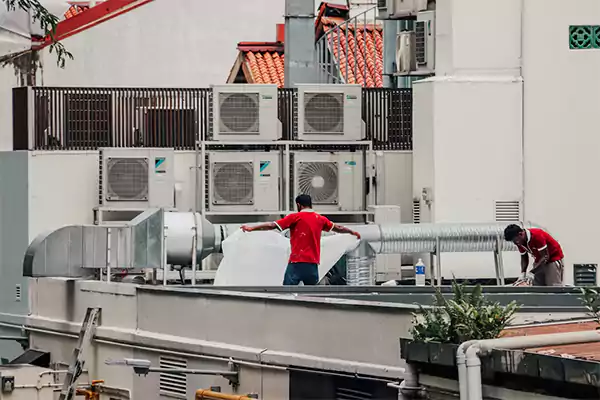
Before elaborating on commercial HVAC in Fort Worth later in the article, let’s first understand what a commercial HVAC is.
- HVAC stands for the heating, ventilation, and air conditioning systems in modern buildings. The sole purpose of these systems or units is to maintain the temperature, humidity, and air quality at optimal levels.
- Primarily, HVACs are of two types, namely, residential and commercial, being an integral part of all construction types in modern times.
- While the former is used in homes, the latter is for commercial HVAC in Fort Worth, commercial structures such as offices, retail spaces, warehouses, hospitals, schools, etc.
- Hence, all the systems concerning the right maintenance of heating, ventilation, and air conditioning in commercial buildings are, in short, called commercial HVAC.
The key differences between residential and commercial HVAC are provided in the table below.
| Feature | Residential HVAC | Commercial HVAC |
| Size/Capacity | Smaller (1.5 – 5 tons) | Large (2 – 30+ tons) |
| Placement | Backyard, side of house, closet | Roof (Rooftop Units – RTU) |
| System Type | Packaged or split system (simple) | Modular, complex (chillers, boilers) |
| Maintenance | 1-2 times/year (basic) | Monthly/quarterly (intensive) |
| Ductwork | Small and simple | Large and complex |
| Complexity | Lower | High |
| Lifespan | 15-20 years | Generally shorter (due to 24/7) |
| Controls | Basic thermostat | Complex building automation systems |
Also Read: 10 Biggest Construction Companies in the US to Know Before Hiring a Contractor!
Why Does Quality Commercial HVAC Matter in Construction?
The major reasons why quality commercial HVAC matters in construction are as provided below, namely, comfort, indoor air quality, energy efficiency, operational costs, compliance with building codes, and long-term building performance.
- Comfort: For maintaining a comfortable environment within the building for employees and customers.
- Indoor air quality: For keeping the air quality at the right temperature and optimal humidity, along with filtering pollutants out of it.
- Energy efficiency: For less energy consumption and lasting, favorable atmospheric conditions inside the building, high-performance, quality HVAC units are a must.
- Operational costs: Efficient and well-maintained systems automatically lead to low fixed expenses in the long run.
- Compliance with building codes: Commercial HVAC in Fort Worth or any other place is crucial for adhering to mandatory laws, e.g., ASHRAE, which are strictly concerned with the proper maintenance of safety, ventilation, and air quality within commercial buildings.
- Long-term building performance: Highly standard HVAC units last long and thus boost the sustainability of the overall construction.
What are the Types of Commercial HVAC in Fort Worth?
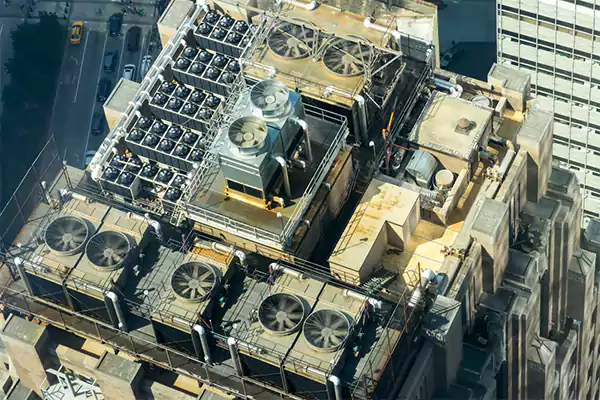
The five major types of commercial HVAC systems used in Fort Worth are packaged HVAC units, split HVAC systems, VRF (Variable Refrigerant Flow) systems, chillers and boilers, and rooftop units (RTUs). All of these only suit commercial needs well, not those of various types of houses.
| S. No. | Types | Details |
| 1. | Packaged HVAC Units | Ideal for retail, restaurants, and single-story buildings due to housing all major components in one cabinet |
| 2. | Split HVAC Systems | Systems connecting an outdoor condenser to an indoor air handler; thus, being the smartest choice in smaller commercial offices or restaurants |
| 3. | VRF (Variable Refrigerant Flow) Systems | Advanced, energy-efficient systems allowing for precise temperature control in multiple zones with commercial HVAC in Fort Worth, all at the same time |
| 4. | Chillers & Boilers | Best suited for large, complex, and high-rise buildings, typically using water-cooled processes for large-scale climate control |
| 5. | Rooftop Units (RTUs) | All-in-one systems combining heating, cooling, and ventilation, saving space on the ground |
What is the Commercial HVAC Installation Process in Construction?
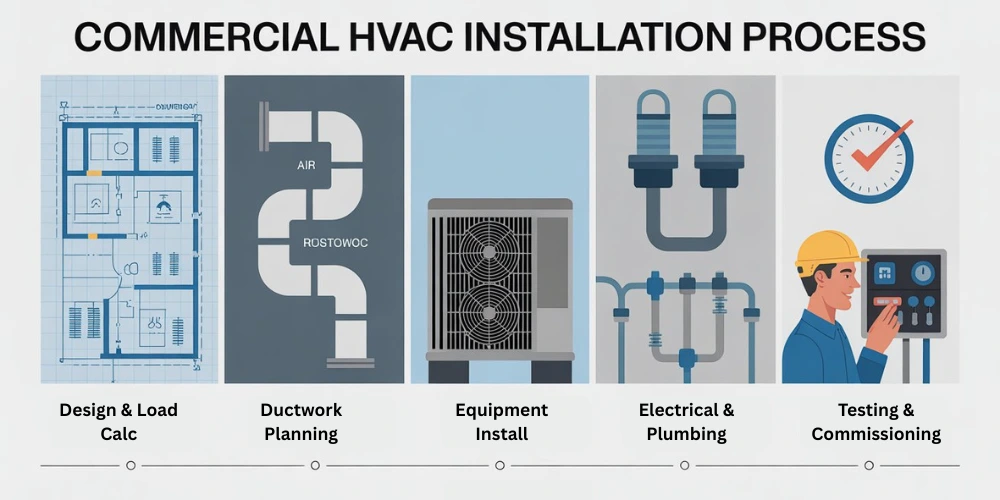
Various stages in the installation of the commercial HVAC in Fort Worth are as follows:
- HVAC design & load calculation
- Ductwork planning
- Equipment installation
- Electrical & plumbing coordination
- Testing, balancing & commissioning
Consider the key highlights below.
- HVAC design & load calculation: Engineers start by analyzing the building plans, occupancy, and heat loads to determine the required capacity. The standard used in the context is 1,200 BTU per occupant.
- Ductwork planning: A detailed layout is designed for proper air distribution, ensuring a high level of efficiency.
- Equipment installation: At this stage, the required rooftop units (RTUs), chillers, or air handlers are secured onto strong and capable structures for optimal performance.
- Electrical & plumbing coordination: HVAC units cannot exist in isolation. They also have to be duly connected with the building’s electrical and plumbing systems when handling commercial HVAC in Fort Worth, for power, condensate drains, refrigerant piping, etc.
- Testing, balancing & commissioning: The final step involves checking that every part of the HVAC system is working as intended without any unexpected obstructions.
What are Fort Worth Building Codes & HVAC Regulations?
The building codes and HVAC regulations in the context of professional commercial HVAC in Fort Worth are briefly outlined below under local building permits, energy efficiency, HVAC regulations, ASHRAE standards, and fire safety.
- Local building permits: 2023 National Electrical Code, 2018 International Swimming Pool and Spa Code, and 2021 International Existing Building Code are some specific codes in this regard used and imposed by the city.
- Energy efficiency: Fort Worth utilizes the 2015 International Energy Conservation Code (IECC) for energy efficiency compliance.
- HVAC regulations: The installations must comply with the 2021 International Mechanical Code (IMC), which governs ventilation and heating/cooling equipment.
- ASHRAE standards: Ventilation-related compliance under IMC section 403 requires that the occupied spaces be ventilated by natural or mechanical means for commercial HVAC in Fort Worth. Furthermore, ASHRAE Standard 62.1 is in place to ensure an acceptable level of indoor air quality in commercial buildings. Finally, ASHRAE Standard 34-2019 deals with refrigerant safety classifications.
- Fire safety: The 2021 International Fire Code (IFC), along with other structural integrity and safety measures, is primarily used for protection against uncontrollable fire emergencies.
Note: If you are new to commercial construction and related concepts, make sure you learn about key concepts in advance thoroughly for better bargaining with the service providers. For example, before signing any contract, read about major terms in detail, such as what Under Contract means in real estate, what the major loopholes are that are easily skippable that can be twisted for undue advantage later, etc.
What are the Factors Affecting Commercial HVAC Costs in Fort Worth?
Building size & capacity, system type, energy efficiency, and new construction vs. renovation are the major factors affecting the cost of commercial HVAC in Fort Worth.
- Building size and capacity: Large, complex, and high-capacity-requiring commercial structures often demand more resources for the HVAC setup than simpler and smaller buildings.
- System type: The equipment quality and capabilities also affect the cost. For example, rooftop units typically range from $5,000 to $30,000+, whereas complex chiller systems reach up to over $100,000 in cost.
- Energy efficiency: The higher the energy efficiency ratings (SEER2, EER2, IEER, etc.) get, the higher the upfront purchasing prices become for commercial HVAC in Fort Worth. However, a high rating provides long-term benefits in terms of reduced operational costs.
- New construction vs. renovation (retrofit): Retrofits are often more expensive due to requiring old equipment, the modification of the existing ductwork, and the fact that the work is carried out during the operational business hours, which leads to loss of revenue.
What are the Essentials of Commercial HVAC Installation in Fort Worth?
The installation of commercial HVAC in Fort Worth is a highly demanded service. Key aspects or considerations with respect to this process, such as HVAC planning during the construction phase, load calculations & ductwork design, compliance with Texas building codes, and new construction vs retrofit installations, are briefly outlined below.
- HVAC planning during the construction phase: The ductwork, electrical, and structural support all must be ensured in place for HVAC units in advance, before interior finishes. Otherwise, it would lead to inconsistencies between the required structural conditions for the ideal setup and the actual architecture.
- Load calculations & ductwork design: The required tonnage has to be calculated with precision for utmost efficiency and long-term sustainability, especially when planning commercial HVAC in Fort Worth. This unit typically lies between 200 and 600 square feet per ton. The design of the ductwork mainly depends on this critical calculation.
- Compliance with Texas building codes: The installation work must adhere to the local Fort Worth codes and Texas energy standards. Also, permits from the Texas Department of Licensing and Regulation (TDLR) are to be duly obtained before the start of the work.
- New construction vs retrofit installations: The nature of the project also affects the conditions of the HVAC installation work. For example, new construction often takes fewer resources than the retrofit services, as the latter requires dealing with an already existing system, which could be outdated and complicated, and even needs to be understood deeply first before modifications.
What is the Key Difference Between HVAC Installation in New Construction vs Renovation?
Various distinctions between the new construction and renovation related to the setup of the commercial HVAC in Fort Worth are highlighted in the table below. The key aspects on which the comparison is made are system design, infrastructure, efficiency & code, initial cost, installation time, performance, and maintenance.
| Features | New Construction HVAC | Renovation (Retrofit) HVAC |
| System Design | Designed from scratch | Working on an existing and outdated layout |
| Infrastructure | Full freedom in routing ductwork, placing units, and installing zones | Limited by existing walls, joints, and other installed units |
| Efficiency & Code | Highly compliant with all the applicable laws in effect | Might not be in compliance with the modern legal standards |
| Initial Cost | Higher upfront | Lower due to being built in the past |
| Installation Time | Predictable, as planned, and integrated during the actual construction | Unpredictable, due to the unfamiliar networks of the HVAC units and hidden weak points |
| Performance | More streamlined than the previous generations | Limited by the technology available in the past |
| Maintenance | Lower due to durable structures | Higher due to the lack of and non-availability of the version-compatible parts |
Also Read: How Much Does a Home Inspection Cost? Know All The Factors Behind It
What are the Common Mistakes to Avoid in Commercial HVAC Projects?
The major common problems related to the installation of the commercial HVAC in Fort Worth are undersized or oversized systems, poor duct design, ignoring future expansion, and skipping energy efficiency planning.
- Undersized or oversized systems: This problem arises when the engineer or service provider doesn’t calculate the load carefully, leading to the selection and installation of either a lower- or higher-capacity HVAC system.
- Poor duct design: Excessive bends, long runs, or improper sizing are some of the symptoms of improper duct-related work during HVAC installation. Furthermore, sealing joints and insulating ducts improperly contributes to significant energy loss and other complications.
- Ignoring future expansion: Not considering any future modifications while creating the initial components of the complete design might cause problems later during commercial HVAC in Fort Worth projects. Thus, HVAC planning must be future-friendly with ease of accessibility and change implementation.
- Skipping energy efficiency planning: Without strictly adhering to the standards of energy efficiency or paying attention to zoning capabilities, the operational costs become higher, even with the lower performance.
What are the Common Signs that You Need Commercial HVAC Repair Services?
Weak airflow, uneven temperatures, high energy bills, strange noises or odors, and system leaks are the most common signs indicating that you need repair services for commercial HVAC in Fort Worth or anywhere in the world.
- Weak airflow: Clogged air filters, failing blower motors, or obstructions in the ductwork often cause such conditions.
- Uneven temperatures: That is an indication of the imbalance in ductwork, poor insulation, or an improperly sized system.
- High energy bills: This can be caused by a plethora of things underneath, such as an oversized system, component breakdown within the installed structure, dirty coils, etc.
- Strange noises or odors: Banging, grinding, or squealing noises often indicate loose parts or internal failure. Always watch out for musty or burning smells in the system.
- System leaks: Such issues often result from blocked drain lines or damaged refrigerant coils.
What are the Planned Service Agreements (PSAs) Related to Commercial HVAC in Fort Worth?
A PSA, or planned maintenance agreement, is a contract between a business and an HVAC service provider for routine inspections, maintenance, and, often, emergency repairs. To be specific or more precise, these agreements ensure that the equipment, such as furnaces and AC units, is professionally maintained from time to time.
Key benefits of PSAs are as follows:
- Prevention of failures and extension of the lifespan
- Improved efficiency
- High safety and compliance
- Reduced costs
- Budgeting
- Priority service in case of emergency
Such contracts or agreements are ideal for offices, retail, hospitals, and warehouses.
How Do Construction Companies Handle Commercial HVAC?
The construction companies handle commercial HVAC in Fort Worth and other industrial locations in a sequenced and predefined manner. The various critical aspects of the process are as defined below:
- Design & engineering: It involves developing detailed layouts, sizing equipment (chillers, boilers, and AHUs), and determining air distribution routes based on the building’s heat loads.
- Coordination & installation: Next, there comes the task of accurately placing HVAC ducts, pipes, and units before the installation, which is often done when handling commercial HVAC in Fort Worth with the help of BIM (or Building Information Modeling). In this process, potential spatial clashes are identified and sorted out well in advance.
- Compliance & efficiency: Ensuring that the systems meet energy standards, safety regulations, and local codes is also a critical part of the handling.
- Testing & commissioning: Lastly, the installed units of the HVAC are checked for proper functioning. Additionally, fixes are made if issues are detected.
Why Should One Choose a Professional Commercial HVAC Contractor in Fort Worth?
Choosing a professional commercial HVAC in Fort Worth results in benefits such as local climate expertise, code compliance, long-term maintenance planning, and warranty & service benefits.
- Local climate expertise: Hiring only the Fort Worth/Dallas Area-based professional contractors is a must, as it allows for leveraging their deep insights and experience in working with the local climate conditions.
- Code compliance: Locals who have worked in the industry for an extended period of time often exhibit a deep understanding of the applicable laws and their mandates.
- Long-term maintenance planning: Dedicated local commercial HVAC contractors often incorporate preventative maintenance techniques into their practice, leading to more desired results in terms of reduced energy consumption, low frequency of emergency breakdowns, and an increase in the system’s lifespan for commercial HVAC in Fort Worth.
- Warranty & service benefits: The project owner will be well informed about all the manufacturer’s warranties and other benefits for maximum advantage. Additionally, due to proximity, services become highly accessible and fast.
What is the Right Way to Choose a Commercial HVAC Contractor in Fort Worth?
Consider the following practical advice to find and decide on the right contractor for the installation of the commercial HVAC in Fort Worth.
- Licensing & certifications
- Verify a valid Texas HVAC license
- Look for EPA 608 certification and NATE certification
- Check the authority of the dealer in the market online
- Experience with commercial projects
- Request a portfolio of past projects
- Choose experience over affordability
- Ask for references from everyone in your known circle
- Knowledge of local codes
- Ensure that they have complete knowledge of the local laws
- Must handle all the permit-related legal requirements from the govt. authorities
- Maintenance & emergency support availability
- Check for 24/7 support
- Ensure the service includes preventative maintenance
- Request service level agreements (SLAs)
Also Read: Choice Home Warranty Prices in 2026: Plans, Costs & Is It Worth It?
What are the Industries That Rely on Commercial HVAC Systems?
The major industries that heavily rely on commercial HVAC systems are as follows, specifically:
- Office buildings
- Retail and shopping centers
- Healthcare units
- Industrial & manufacturing facilities
- Warehouses
- Data centers & IT
- Educational institutions
- Restaurants & hospitality, etc.
Conclusion
HVAC systems are the most important part of modern construction. Without it, proper air, temperature, and humidity conditions cannot be maintained within a commercial building, where a lot of people are present at a time, as evident in trade centres, shopping malls, retail shops, etc.
So, to make an enclosed structure habitable and less suffocating, HVAC units are needed. If you are planning to invest in commercial HVAC in Fort Worth, connect with Houseura for insightful guidance.
FAQs
Q: Is commercial HVAC required for all commercial buildings?
Q: How long does commercial HVAC installation take?
Ans: On average, it typically takes from two to four weeks, even though a simple project can also be completed in a few days.
Q: What HVAC system is best for large buildings?
Ans: VRF/VRV systems, chiller systems, rooftop units (RTUs), etc., are the major options to name a few.
Q: Does commercial HVAC require permits in Fort Worth?
Ans: Yes, commercial HVAC requires permits in Fort Worth.
Related Posts