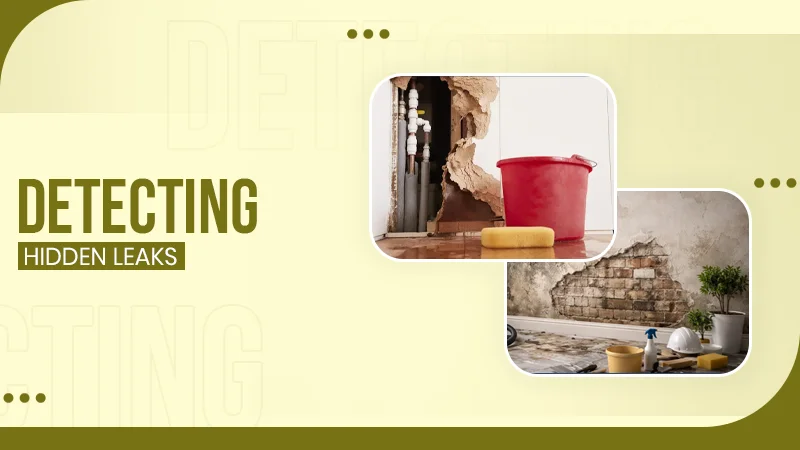
You can detect water leakage behind the wall by checking for faded paint, bubbling paint, musty odor, moisture, etc.

How to Spot Water Damage Behind Drywall Before It Reaches the Subfloor
The hidden leakage wall does its work in silence, and you will be unaware for months or years. It will not give you any hint to get to any about the hidden water leakage. It is necessary to detect the leakage on time that will save water as well as damage. However, you can find it through various methods such as noticing your walls, musty smell, moisture, or checking the water bills, which will not even take any skill.
If you’re facing the same problem, this article provides you with the solution that will detect the hidden water leakage.
Table of Contents:
- Why Leaks Behind Drywall Stay Hidden So Long
- Stains, Bubbling Paint, and Discoloration
- The Musty Smell That Arrives Before the Stain
- Soft Spots, Nail Pops, and Warped Trim
- Checking the Subfloor Before the Damage Spreads
- Moisture Meters and Thermal Imaging
- Water Bills and Meter Readings as Early Evidence
- FAQs
Why Leaks Behind Drywall Stay Hidden So Long
Drywall absorbs moisture quietly, and a supply line dripping a few drops an hour soaks the paper covering sheet, the physical barriers, and the bottom plate well before the moisture and bubbles appear on the painted side. Gravity pulls that water down inside the hollow space, where it collects at the base of the wall and absorbs outward into the subfloor. By the time a stain shows at eye level, the base plate and the subfloor have often been wet for weeks. Passing time makes it worse, as the older metal and plastic lines rust from the inside out, and mineral-heavy water thins pipe walls through constant increase. Once the source is traced to a failing line, the sensible next step is to work with a company that offers pipe repair services in Palm Harbor, FL, including burst pipe repairs, trenchless pipe lining that avoids tearing up the area, and full water line replacement. Pirates Plumbing is one such provider, offering 24/7 emergency response and same-day appointments when a leak is actively running. Acting at this stage is what keeps a repair confined to the pipe instead of the pipe, the wall, and the floor beneath it.
Stains, Bubbling Paint, and Discoloration
The earliest surface clue is rarely a dark brown ring, but it is usually a faint yellow or tan shadow that looks like dirt until you compare it against clean drywall a few feet away. Paints will start reacting unevenly before it stains; such as, flat finishes develop a dull patch, satin finishes lose their shine, wallpaper appears separated, etc. On textured walls, the texture starts to soften and loses its texture because the joint blend underneath has remoistened. If any of these changes appear in a spot with no logical explanation, such as no sunlight, no traffic, and no furniture rubbing, then you need to check the area, whether it has a hidden leakage or not.
The Musty Smell That Arrives Before the Stain
After a few weeks, you will notice a smell from the particular place. Wet recycled material and damp paper backing produce a musty, earthy odor that collects at floor level and increases in closed rooms. It is strongest early in the morning before doors open and air circulates. Walk the boundary of a room slowly with your nose near the baseboard, and note where the odor has a strong smell. Closets built against bathroom or kitchen walls are the usual main focus area, because they stay shut and trap the air. A stubborn musty smell with no visible source almost always means the leakage of water somewhere you cannot see.
Soft Spots, Nail Pops, and Warped Trim
Drywall loses rigidity when it stays wet. Press your palm flat against a suspicious area and compare the texture to another dry section of the same wall. Soaking board gives slightly, feels spongy, or stretches under stable pressure. Hardware tools tell the same story from the outside, including screws and nails back out as the board swells and shrinks, leaving small circular bumps or cracked paint dots in vertical lines along the studs. Baseboards begin to cup away from the wall, filler lines split, and door casings swell enough to catch against the frame. These are mechanical symptoms, which means they show up whether there are laekge or not.
Checking the Subfloor Before the Damage Spreads
Water that reaches the bottom plate moves next into the floor. Flooring boards begin to lift at the seams closest to the wall. Tile cement darkens in a line parallel to the baseboard, and individual tiles develop a hollow sound when tapped. Hardwood cups, with board edges rising higher than their centers. Carpet along the tack strip feels cooler and heavier than carpet two feet away. Where there is access from below; a crawl space, a utility area, an unfinished section, look directly at the underside of the subfloor for dark staining, white mineral deposits, or rusted fastener heads. Damage at this depth changes the scope of the job considerably, which is why the earlier signs matter so much.
Moisture Meters and Thermal Imaging
Guesswork is unnecessary once you suspect a specific wall. An inexpensive pinless moisture meter reads through paint and gives a relative percentage in seconds. Take readings in a grid across the suspect area and a matching grid on a wall you know is dry, then compare. Anything substantially above the dry baseline confirms moisture inside the cavity. Thermal cameras, including the clip-on models that pair with a phone, show wet areas as cool patches because evaporation pulls heat out of the surface. Neither tool identifies the source, but both narrow the search to a defined area so a plumber can open the smallest possible section of wall rather than probing blindly.
Water Bills and Meter Readings as Early Evidence
Numbers often catch a hidden leak before any physical sign does. Compare your current bill against the same month in previous years rather than against last month, since seasonal use varies. An unexplained climb of even a few hundred gallons points to water escaping somewhere. Confirm it at the meter, shut off every fixture and appliance in the house, note the reading, wait two hours without using water, and read it again. Movement means a leak somewhere in the system. That simple test takes almost no effort and frequently identifies a problem months before the first stain reaches the surface of a wall.
FAQs
How to detect water leakage behind the wall?
How long can a water leak area be hidden?
It can take a few days, months, or even years.
Which chemical is used to stop water leakage?
Polymerised Silicone Vinyl (PSV), Premix, Polyurethane Membrane, and PVC Waterproofing Membrane are some chemicals that can prevent water leakage, and these are used according to the requirements.