Not necessarily. While they’re designed for scale, many mid-sized companies are adopting them as they grow and need better visibility.

6 Ways Enterprise Security Systems Improve Office Building Safety
Most office buildings look secure. Cameras at the entrance, a guard at the desk, keycards for employees. On paper, it checks out.
But when something actually goes wrong, these systems often don’t deliver.
Workplace risks are rising. The US Department of Labor stated that nearly 2 million workers in the U.S. report workplace violence each year, and many of these incidents happen in places that already have “basic” security.
The real problem isn’t missing tools. It’s disconnected systems that react too late.
That’s where corporate security architecture changes the game. They don’t just monitor. They connect, analyze, and respond in real time. They’re making modern office buildings safer in practical, measurable ways.
In this article, I’ll explain how enterprise security systems improve office safety with AI monitoring, access control, and real-time alerts. The following sections collectively present a practical, data-backed guide for modern workplaces.
KEY TAKEAWAYS
- Security systems are shifting from reactive to proactive as AI is helping detect issues faster.
- Access control prevents incidents while centralized platforms reduce confusion during emergencies.
- Fewer false alarms mean better focus and faster action, while faster investigations save time and improve decision-making.
1. They Spot Problems Before People Do
Most traditional security setups rely on humans watching screens. And that’s where things break down.
There’s a well-known study in the security industry showing that operators monitoring multiple video feeds can miss up to 90–95% of important events. Not because they’re careless, but because it’s just too much information.
Enterprise systems change that dynamic.
Instead of waiting for someone to notice something unusual, AI constantly scans video feeds in the background. It can flag things like:
- Someone lingering near a restricted area
- A door being forced open
- Movement at odd hours
And the key difference is timing. These alerts happen instantly.
That small time advantage matters more than people think. Even shaving off a minute in response time can prevent a situation from escalating.
2. Access Control Becomes More Than Just a Keycard
A keycard isn’t security. It’s just a starting point.
In many offices, cards get shared, doors are held open, and temporary access lingers longer than it should. That’s how gaps appear.
Industry data suggests that over a third of workplace security incidents involve unauthorized access, often from someone who wasn’t supposed to be there in the first place.
Modern enterprise systems tighten this up without making things complicated.
Instead of just unlocking doors, access control becomes more dynamic:
- Permissions can be tied to roles, schedules, or locations
- Access can be revoked instantly if needed
- Temporary credentials can expire automatically
It also helps with visibility. You don’t just know that a door was opened. You know who accessed it, when, and whether it was expected.
That level of control makes a big difference, especially in larger office environments.
3. Everything Finally Lives in One Place
Security tools often grow in silos. Cameras in one system. Access control in another. Alerts scattered across emails or apps.
When something goes wrong, people end up jumping between systems trying to piece together what happened.
That delay is the real problem.
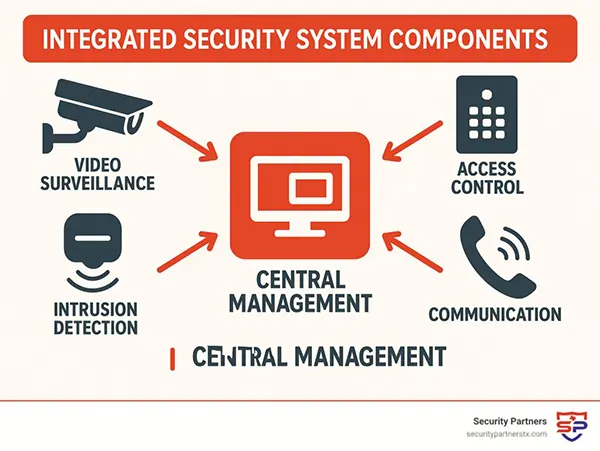
Enterprise security systems solve this by bringing everything into a single view.
A good example of this approach can be seen in platforms like Coram’s enterprise security system. Instead of treating video, access control, and alerts as separate layers, it connects them into one cloud-based dashboard. This means when a door event happens, it can be instantly paired with video footage and real-time alerts, giving security teams immediate context.
Another important detail is that it works with existing IP cameras. That’s a big deal for companies that already have infrastructure in place and don’t want to start from scratch.
The result is simple: less switching between tools and more clarity during incidents.
The following infographic illustrates the integratedness of corporate security architecture:
4. False Alarms Drop Significantly
If every alert feels urgent, eventually none of them are.
Older systems generate a huge number of false alarms. Shadows, lighting changes, minor movements. All triggering unnecessary alerts.
In some cases, up to 80–90% of alarms in commercial buildings are false, which leads to alert fatigue. And once people start ignoring alerts, the system loses its value.
AI-based systems handle this differently.
They’re trained to distinguish between:
- People and objects
- Normal activity and suspicious behavior
- Routine movement and unusual patterns
That means fewer unnecessary alerts and more focus on what actually matters.
Over time, this doesn’t just reduce noise. It builds trust in the system. When an alert comes in, teams are far more likely to take it seriously.
5. Investigations Don’t Take Hours Anymore
After an incident, time matters just as much as accuracy.
Traditional systems make it hard to find what you need. Hours of footage, manual scrubbing, and guesswork.
Enterprise systems simplify this.
Instead of manually searching, you can:
- Filter by time and location
- Look up specific events (like a forced door or denied access)
- Jump directly to relevant footage
In some cases, what used to take hours can be done in minutes.
That speed matters not just for internal teams, but also for compliance, reporting, and even legal situations where accurate timelines are critical.
6. Emergency Response Becomes More Coordinated
Most offices don’t lack response plans. They lack coordination.
In a typical scenario, one person calls security, another checks cameras, and someone else contacts emergency services. Everything happens, but not together.
Enterprise systems improve this by connecting everything in real time.
For example:
- Alerts can trigger instantly when something unusual happens
- Security teams can view live footage immediately
- Access points can be controlled if needed
According to FEMA, organizations with integrated emergency systems can improve response efficiency by up to 40%. That’s not a small improvement. It can directly affect outcomes in critical situations.
It also gives employees a sense of confidence. Knowing that systems are in place and that responses are coordinated makes a workplace feel safer.
Conclusion
Office security is no longer about having more tools. It’s about making them work as one.
The old model of cameras and access cards working in isolation just doesn’t hold up anymore. Risks are more complex, and expectations around safety are higher.
Enterprise security systems don’t just add more technology. They connect what already exists and make it more useful.
And in most cases, that’s the real difference. Not more tools, but better visibility, faster decisions, and fewer blind spots.
FAQs
Is corporate security architecture only for large companies?
Do these systems replace security staff?
No. They support teams by reducing manual work and helping them focus on real issues.
Can they work with existing cameras?
Yes, many platforms are designed to integrate with current IP camera setups.
Is AI surveillance safe from a privacy perspective?
Most systems focus on behavior and events, not personal identity, and must comply with privacy regulations.
Do they really reduce incidents?
Yes. Studies show that better monitoring and faster response can significantly reduce security-related events.
Related Posts